


Filed under: 10 Questions for Strategists, blast from the past, Experience, Get Friendly, Great Stuff, passion
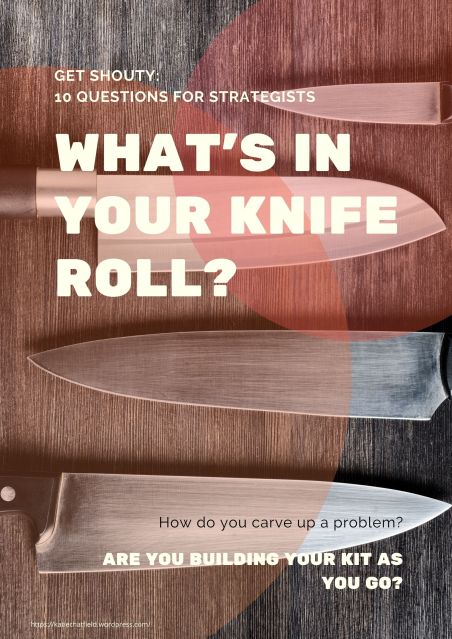
2 of 10 QUESTIONS FOR STRATEGISTS
One of the key things you learn as you practice strategy is to size up the problem you’re addressing.
As you tackle business problems and marketing challenges and service design opportunities and consulting projects you start to understand the unique components that you need to address to get it done.
You start to build frameworks to organise the chaos. Matrices so that you can map out a messaging house. You build process to describe the journey you’ll take clients on. You work out what sells and how clients buy.
You craft your process into a practice. You make charts. Lots of charts that you can remix and reuse and refresh.
They say the only difference between a junior and a senior strategist is the amount of charts they have access to…
(Vegetarian warning….)
All tenure gives you is the experience to know what kind of beast you’re dealing with…and what you need to carve it up.
Charts are knives- they should cut through, they should help you break things down, and carve out the cuts in the carcass.
The more knives you have, the more tasks you can get done quickly.
You wouldn’t use the same knife to chop an onion that you would to fillet a fish.
So your charts need to be fit for purpose, many and various.
And above all- sharp.

Some of the things I love, love, love about what I get to do for a day job are the opportunities to examine workplace cultures and develop ways to influence them to exhibit resilient positive outcomes.
It’s not a simple process, it’s not even complicated. It’s complex and sometimes chaotic. Mostly though where I start is Disorder.
I recently got asked by my friend Matt Granfield to comment on what he put forward as an hypocritical action from a holding company about the contradictory behavior and promises of two of their brands, and did I see anything wrong with that.
I thought it was an interesting notion that we might hold advertising to greater standards of morals and ethics than we hold ourselves. I thought that it might be valid to ask if that was right.
In I tweet therefore I am, Peggy Orenstein shares her experiences:
Each Twitter…
View original post 437 more words

