


Was reading William Gibson Talks Zero History, Paranoia and the Awesome Power of Twitter over at Wired and loved this…
Gibson: Well, I discovered Twitter while I was writing the novel, and I immediately saw its odd potential for being a tiny, private darknet that no one else can access. I’m always interested in the spooky repurposing of everyday things. After a few days on Twitter, what was most evident to me is that, if you set it up right, it’s probably the most powerful novelty aggregator that has ever existed. Magazines have always been novelty aggregators, and people who work for them find and assemble new and interesting stuff, and people like me buy them. Or used to buy them, when magazines were the most efficient way to find novel things.
But now with Twitter, after following people who have proven themselves to be extremely adroit and active novelty aggregators, I get more random novelty every day that I can actually use. A lot of it just slides by, but a lot of it is stuff that I used to have to go through considerable trouble to find. And a lot of it is so beyond the stuff I used to be able to find, which is good.
Jonah Lehrer reports why thinking too much causes us to focus on variables that don’t matter:
When it comes to judging jam [the focus of the studies], we are all natural experts. We can automatically pick out the products that provide us with the most pleasure.
When researchers added extra analysis to the study, asking participants to explain the why of their jam preference and justify their decisions, the “extra analysis seriously warped their jam judgment:”
“[T]hinking too much” about strawberry jam causes us to focus on all sorts of variables that don’t actually matter. Instead of just listening to our instinctive preferences, we start searching for reasons to prefer one jam over another.
And it’s not just jam:The new science of morality
[The researchers] have since demonstrated that the same effect can interfere with our choice of posters, jelly beans, cars, IKEA couches and apartments. We assume that more rational analysis leads to better choices but, in many instances, that assumption is exactly backwards.
The larger moral:
[O]ur metaphors for reasoning are all wrong. We like to believe that the gift of human reason lets us think like scientists, so that our conscious thoughts lead us closer to the truth. But here’s the paradox: all that reasoning and confabulation can often lead us astray, so that we end up knowing less about what jams/cars/jelly beans we actually prefer. So here’s my new metaphor for human reason: our rational faculty isn’t a scientist — it’s a talk radio host.
As Howard Moskowitz, expert researcher on Prego spaghetti sauce and other foodstuffs once declared, “The mind knows not what the tongue wants.”
I’m liking the space in between novelty aggregator and “extra analysis seriously warped their jam judgment”. We don’t know why we like what we do, or even what we’ll like but tasty new stuff is what we’re after….
Filed under: Digital Strategy
Love the Soap guys:
After the success of the 6 Principles of Digital Creative and our 2010 Predictions for Digital we now bring you 10 Facebook Myths Busted.
Paul? Julian? Heather? Jye? anything to add?
Mel Exon shared this fab presentation over at BBH LAbs
“… my presentation focused primarily on what brands and their agencies are learning about integration, interaction and new partnerships in the hypersocial environment we find ourselves in. I also attempted to explain why brands may be reticent about taking a step further into building deep, immersive, narrative worlds. Along the way, telling the story of a (failed) BBH Labs joint venture and what we took from it… and finally, ending with a proposal.
That proposal was simply this: that producers should look beyond viewing brands as “promoters” (cf the current raft of Toy Story 3 and The A-Team tie-ups) and consider them as partners instead. Develop stories together that add value to the overarching narrative (think Jeep for Lost Experience) AND stay open-minded to the idea of engaging audiences through collective creativity.
Love the thinking here:
- Thinking about it, the one thing I feel like we’re tasked with daily is to ‘change behaviour’. To get people to ‘do something that they’re currently not doing’.
- Organisations spend a lot of energy trying to get people to spend their energy differently.
- Let’s look at consumer energy first
- Is it worth it? Is what they’re getting out of it worth the effort needed to participate?
- That’s what it all comes down to… Reward vs effort what are we giving what do they have them? To do to get it?
- Every day, billions of people do things whether you ask them to or not
- How do you take advantage of the waves of human energy already out there
- Eco-systems re-channeling existing energy
- “When millions of people are tapping away at computers every day: filling in forms, clicking links, forwarding emails, there is energy and effort that can easily be re-used if we’re smart about it.”
- Why fight against the current?
- You shouldn’t have to… Persuade people to do things they don’t want to do waste energy when you can borrow it invest in something temporary, when you can build things that run themselves
- Disrupt. Persuade. Help
- It’s getting easier… To help people do the things they already love to help people see the relevance and value of new ideas to match products and experiences to the people that want them
I’m thinking about agency agility and crack content creation teams that have a newsroom editorial structure and publishing discipline.
This work by Chet– it’s a couple of years old, but its’ still pretty clever clogs.
I can’t help but think that all those notions of finding the story, getting the angle, getting it out the door in a day in a way that’s going to build an audience and get people watching as it all unfolds is an intriguing model to bring to our agency skill set.
When you combine the ultra topical with easily findable you might be onto a good thing.
I’m liking the question ‘what’s newsworthy?‘ as a thought starter. It’s more than ‘what will generate Word of Mouth?’ ’cause it takes me to places where I think about: what can we report on? what will get us coverage? what’s the photo op? what wires will pick it up?
More later..
Filed under: Digital Strategy
The baker’s dozen of posts that you all really liked in the last year:
- Social media measurement notes
- Where did the future go?
- everyday acts of innovation
- curating resonant agents
- The future belongs to the few of us still willing to get our hands dirty
- more = betterer
- Tell me and I’ll forget; show me and I may remember; involve me and I’ll understand.
- How frickin’ awesome are cardboard boxes…
- Plan, Flow and Discover
- foundations of taxonomy
- how do you describe what you do?
- people and stories
- user pays
My favourite, one of the most important things I’ve ever done and one of the hardest things I’ve ever had to share:
And so what’s the outtake from this year? This blogging thing, this tweeting thing – it’s not about technology.
If you’re not using it to fundamentally try to understand all that what being human is like you’re missing the point.
You can make the invisible visible.
You can preserve and protect the fragile and ephemeral from disappearing.
You can inspire people to do things.
You can create places where people can listen and share; laugh, collaborate and hope; and support and grieve.
My lessons in this fourth year of Get Shouty have been about the real costs of committing to real communities.
And the real value of participating in them.
Thanks everyone.
So many thinkering Sydney events this week. It’s always great to get away from behind your desk and fill up the inspiration tanks a little.
While I usually broadcast my experiences of these things while I’m out and about, I’m starting to become very much aligned with Tim Burrows thinking outlined in Why I’m over live blogging (and I’m not sure about live tweeting either) as I believe it reduces your ability to absorb what’s actually going on in the room, or as Tim puts it:
Often, the temptation to be first, or even instantaneous, is at the expense of proper thought…often, I don’t think the process does anyone much justice.
I attended some Adtech keynotes and Breakfast sessions as well as a new event put on by the APG this week. My focus was not only to get information and inspiration, I was trying to see the value of ‘being in the room’. Seeing people do their stuff and chatting in between sessions is a great way to get a sense check of the barometer of the industry and the strength of your personal network.
With so much digital content and opinion being generated swirling around the live moment and the speaker I think that, if you can’t be present yourself, you need to have a rock in the audience. Someone you know, someone you trust, someone who can make you think and put their own ego aside to contextualize what’s going on.
So I’ll let some of my rocks, people who I really respect and admire, to give their opinion and outtakes:
From Ad:tech- which focuses on all aspects of digital marketing and advertising
Mark Pollard’s experience
- Social media campaign vs commitment: short-term or long-term? Ad:tech Sydney
- Reputation management in the digital space: challenges and opportunities – Ad:tech Sydney
- What does ‘return’ mean in today’s digital landscape? Ad:tech Sydney
- How and why CEOs are driving digital media in their businesses – Ad:tech Sydney
- Going beta: What ‘being brave’ can do for your advertising message and medium – Ad:tech Sydney
- Channel Planning: How to weave advertising messages through different platforms – Ad:tech Sydney
- How relevant is the concept of a ‘big idea’ in today’s interactive landscape? Ad:tech Sydney
From the Battle of the Big Thinking- put together by the Australian Planning Group, fifteen people speak for fifteen minutes each in five topics. You can see the whole list here.
- Tim Burrow’s outline of the first section: Big Business Ideas Battle of Big Thinking part 1: Creating unique brands; Changing the world; Perth vs Sydney
- Tim Noonan’s presentation Voices, Relationships, Trust and Time Travel – Notes and Resources
- Richard Sauerman (who won the match) has a YouTube channel where you can see a number of his presentations
Filed under: Digital Strategy
| Michael Jackson 10.3 million fans |
Barack Obama 6.9 million supporters |
Vin Diesel 6.6 million fans |
VIPS | Ashton Kutcher 3.9 million followers |
Ellen DeGeneres 3.6 million followers |
Britney Spears 3.6 million followers |
| Face•book n. 1: A service that “gives people the power to share and make the world more open and connected.” — Facebook 2: A “cyberland of rampant narcissism and wasted time.” — Andy Ostroy, The Huffington Post |
Twit•ter n. 1: “A real-time short-messaging service that works over multiple networks and devices.” — Twitter 2: “A playground for imbeciles, skeevy marketers, D-list celebrity half-wits, and pathetic attention seekers.” — Daniel Lyons, Newsweek |
|||||
| 300 million users. Valuation: $10 billion. “Cash-flow positive,” in 2009. | STATUS | 20 million users. Valuation: $1 billion. “We spend more money than we make.” | ||||
| Share information with a closed group of friends. | WHAT USERS DO | Broadcast information to the world. | ||||
| Landing page, fan page, custom tabs for support, shopping, and feedback. | TOOLS FOR BRANDS | Live search, direct replies to people tweeting about the brand. | ||||
| Users surf the Best Buy inventory on the store’s fan page, then click “Get Advice” to solicit feedback from all of their friends, via a news-feed post, about the products they’re considering. | DOING IT RIGHT | Gabika99 @Starbucks Is there going to be a mobile app for those of us out here that avoid buying iPhones and iPods? Starbucks @Gabika99 Yes, we’re working on mobile apps on other platforms as well. |
||||
| Procter & Gamble’s Pringles has nearly 3 million fans but hasn’t used any special tools or tabs — and hasn’t posted since July. | MISSING OUT | Dell has more than 30 accounts (@DellOutlet, @StudioDell, @TeamDell, etc.), dividing followers and clogging feeds. | ||||
| Burger King’s Whopper Sacrifice app, which had users unfriend 10 people for a free Whopper, set the blogosphere ablaze. Before the app was disabled, more than 230,000 users were sacrificed. | BUILDING BUZZ | For 10 days, Web-site builder Moonfruit offered users who mentioned its name the opportunity to win a MacBook Pro. Its brand was Twitter’s top trending topic for days, beating the Iran election. | ||||
| Hasbro forced the hugely popular Scrabble knockoff app off Facebook and sued its creators. Thousands of users joined protest groups, such as Save Scrabulous and #$@(*& off, hasbro. | BIG-NAME BLUNDER | When Fox aired episodes of Fringe and Glee with a live Twitter-feed overlay, viewers tuned out and bloggers called it “annoying” and “intrusive.” The experiment was discontinued. | ||||
Loving the binary definitions…..
Chart from Fast Company
For crazy amounts of case studies- be sure to explore Peter Kim’s lists, with 500 examples in each Master List 1, Master List 2 and Master List 3.

Dr. Lene Nielsen outlines her approach to developing personas:
Having worked with personas before the method ever came to be known as personas there are, from my research and practical experience, three important areas that have to be considered: the data material, engagement in the personas descriptions, and buy-in from the organization which is part of the development process whether it is redesign or a development from scratch. This is the rationale behind my development of 10 steps to personas, an attempt to cover the entire process from initial data gathering to ongoing development.
You can have a look at the entire article here, and see a larger version of her chart here.
Thank to Ian Lyons for the find.
A freak stranglet from the Large Hadron Collider is interfering with many potentials incuding my ability to get my thoughts down in post form. Time is not my friend right now. Perhaps the future is merely being kind.
There are heaps of speaker notes in the presentation- loads of chewy thinking:
Our relationships to each other, the cities and places we inhabit and navigate have been transformed in the last few years by the technology, products and services that we have designed — but what about that last one of the three — time?
“People, places, time. The triumvirate of factors at play in mobile, social, locative services might be familiar at the surface level to designers and developers.
Using examples from the development of Dopplr.com and other services — alongside historical and science-fictional perspectives — Matt Jones explores what we might call neochronometry and illustrates some directions we could take as interaction designers to treat time as a material.”

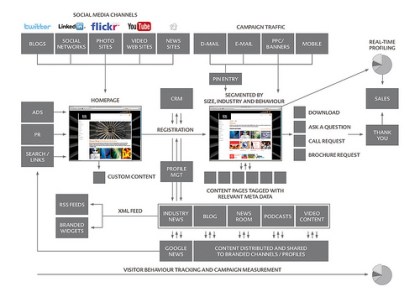
Jeff Bullas summarizes a couple of reports about what top brands are doing in Social Media.
His 4 Key Observations
- As the number of channels increase, overall engagement increases at a faster rate. Brands that were in seven or more channels engaged deeply across all channels where they were present, as compared to brands that were present in fewer channels. There is an exponential growth in the depth of engagement as the brand extends itself into more and more channels.
- Engagement differs by industry. Not only are some industries on average present in more channels, they also engage with them more deeply. For example, media and technology companies tend to be in more channels and engage deeply within them than,…. apparel, consumer products, food & beverage, and financial brands which is to be expected given that companies in these industries are just beginning to experiment with social media.
- Financial performance correlates with engagement. Back to the million-dollar question: Why do social media? Because it pays off. While no one yet has the data to determine direct cause and effect, what is found is a financial correlation between those who are deeply engaged and those who outperform their peers
- It Provides ” Multiple Communication Touch Points” More touch points can present a ripple effect, inducing viral marketing, boosting brand recognition and driving sales volume. Simply it means that different people prefer different types of communication, so the more types of communication, you as a company are enaging in, the more chance you have of creating a broader and deeper reach in the market place.
15 Best Practices of Social Media Implemented by the Top 100 Brands
- Deputize people throughout the organization.
- Understand how each channel provides a different dimension of engagement
- Centralize coordination
- Find champions who can explain and mitigate risk.
- Be in it for the long haul
- Pick channels carefully.
- Spread engagement to employees beyond the social media team.
- Open the platform to anyone and everyone.Encourage employees to tap into social media to get work done
- Engage in new channels where people already are
- Support engagement as an extension of the company culture.Be conversational from the start.
- Be conversational from the start.
- Make social media part of the job, just like email
- Modularize and synchronize content across channels
- To scale engagement, make social media part of everyone’s job.
- Emphasize quality, not just quantity.
Filed under: Digital Strategy
The Rodney District contains a highway that leads north of Auckland, New Zealand’s largest city. It’s one of the most dangerous roads in New Zealand and has a rising death toll due specifically to speeders. The message: Slow down.
The agency (Saatchi and Saatchi NZ):
We wanted to prove how violent the force in a crash was, so we had an engineer calculate what a head on collision would be equal to in grenades. At 125 kph it is equal to 10 grenades exploding. To demonstrate this we blew up a car, collected the debris, reconstructed it with 1000’s of pieces of string and invited people to see it. Visitors included the Deputy Mayor, head of police, TV3 news (one of New Zealand’s main news station) and, but most importantly, a surprising number of 18-25 year old males.
Filed under: Digital Strategy
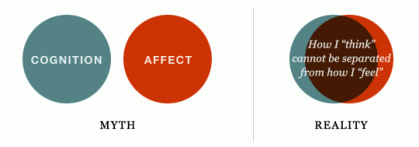
In Defense of Eye Candy by Stephen P. Anderson looks at trends in neuroscience pointing out that how we “think” cannot be separated from how we “feel,” and applies that to web design.
Love these quotes :
“…emotion is not a luxury: it is an expression of basic mechanisms of life regulation developed in evolution, and is indispensable for survival. It plays a critical role in virtually all aspects of learning, reasoning, and creativity. Somewhat surprisingly, it may play a role in the construction of consciousness.”—António Damásio, Emotion and Feelings: A Neurobiological Perspective
In the early 1900s, “form follows function” became the mantra of modern architecture. Frank Lloyd Wright changed this phrase to “form and function should be one, joined in a spiritual union,” using nature as the best example of this integration.
The more we learn about people, and how our brains process information, the more we learn the truth of that phrase: form and function aren’t separate items. If we believe that style somehow exists independantly of functionality, that we can treat aesthetics and function as two separate pieces, then we ignore the evidence that beauty is much more than decoration.
Filed under: Digital Strategy
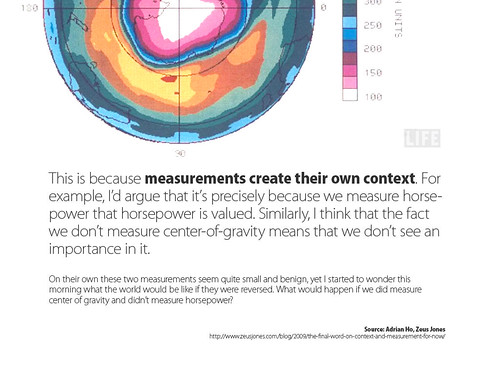
measurmentscreatetheirowncontext, originally uploaded by everythingnewisdangerous.
Filed under: Digital Strategy
As promised here are the notes I was referring to on the Ad:tech panel. All the research and loads of the thinking were done by the lovely and talented Rachael Maughan at the white agency.
Here’s measurementcamp‘s list of free tools:
- Addictomatic A cool search engine that aggregates rss feeds into a nice visual dashboard
- Blogpulse Blog search engine with conversation tracker tool
- Boardreader Search forums and message boards
- Boardtracker Forum search engine offering instant alerts
- Buzzmonitor Embeddable widget showing recent instances of your search term
- Compete.com Comparable site metrics for any website
- Del.ici.ous Social bookmarking engine. Search by tags and subscribe to feed results
- Facebook lexicon Searches facebook walls for words and phrases
- Google alerts Email updates of key search terms
- Google insights Compare search volume over time
- Google trends Compare search term trends
- Howsociable Gives a social media score for your brand, with email updates of your score.
- Ice rocket Blog search engine with results rss feed
- Newsflashr News search engine, presenting results in nice dashboard
- Sphere Related content widget
- Summize Search for keywords in ‘tweets’.
- Technorati Blog and social media search engine
- Twing Discussion board and forum search engine
- Twingly Spam free blog search engine
- Twitturly Track what urls people are talking about on twitter
- Xinu Shows how well your site is performing across different metrics. Also gives a site diagnosis.
- Quarkbase Fricking cool mashup tool
- Twitter Grader Enter your twitter username to get your grade and ranking
- Twist Graph Keyword trends in Twitter. Very cool.
- yExplore Not strictly social media, but easy access to see inbound links to a page.
- Trendpedia Excellent blog search engine that graphs results over time.
- Website Grader Not completely sure how accurate, but cool tool anyway!
- Yahoo Pipes Err, yeah, can’t believe I missed this off in the first place.
- Socialmention Real time UGC search engine, with social rank
- Bit.ly and Cli.gs – analytics for your tiny urls.

