


Filed under: Digital Strategy

Yesterday I was in Melbourne, a city I just love, part of a team presenting to a group of really smart marketers. I showed a collection, not of case studies per se, but of thought starters on how to create digital connections between brands and their consumers.
The philosophy can be described by my digital planning diagram, but is best summed up by the following:
- Insights (Research)- you must have them about what your brand truth is and about your audience.
- Bravery (Design)- it’s easy to have a ‘look, don’t touch’ philosophy for your communication, but the rewards of conversation and the merits of authenticity reap long term results
- Smarts (Evaluation)- have an understanding of what you want to get out of your online efforts. Reach? Sales push to a specific channel? A consumer panel for insights? Map and measure your goals.
It brought home to me how powerful storytelling is in generating understanding and inspiration. It was a joy to see what these guys created at the end of the day in their team workshops.
Of course there was a call for hard numbers, particularly around how much do you need/ can you get away with shifting online to get results. We had a scenario on hand that highlighted:
- if you took 5% away from the ATL TVC media budget
- what would you need to spend online to make it up?
We were able to evidence:
- that we could gain almost 3 times the exact target audience we needed to reach to make up the budget shift
- with less than half the budget
- delivering 4 times the time with brand
- and articulate the product benefit in a way the would also increase packaging recognition in channel.
- Hurray!
Some more studies on the effectiveness of moving budget to online:
- IAB Cross Media studies on Colgate, and Kleenex (thanks Sean!)
- some hot presentations from the Adelaide Now “introduction to online advertising seminar”
- and a great little story on the effectiveness and emotional pull of blogs in Australia
Thanks guys- I hope to see you all again soon.
Filed under: Digital Strategy
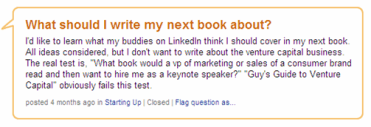
Here I was thinking that I was being a little naff in asking questions, lots of questions.
In my trawl for FMCG/CPG case studies I came across a cool bit on the Linked in site that I hadn’t found before-LinkedIn Answers.
There’s heaps of good stuff:
- What have been the most successful programs for advertising successfully online?
- What are your favorite big brand blog case studies?
- What is the best way to measure marketing ROI?
And this: Guy Kawasaki askes a simple question: What should I write my next book about?
Finding all this it made me feel alot better- and not because I have more to draw on but because it really brought home to me that it doesn’t matter who you are, asking questions and listening to all the answers makes you a better marketer.
And if no one wants to share? Then give, give, give!
Filed under: Digital Strategy

iMedia report that Consumer packaged goods (CPG) marketing online ad spending will rise to $470 million in 2006, up from $390 million predicted in 2005, according to a report from eMarketer.
So it must be working…that wool is coming off from marketer’s eyes…
As ever, we need stories that bring this to life- not only to tell our clients, but to remind ourselves that a measure of success is also a campaign’s ability to be remembered, be re-told.
Marketers in Australia need these tales of online success- we’re in a bit of a drought right now.
I’m trying to get a collection together of CPG (or FMCG) case studies as a resource for online effectiveness- please contribute!
This is traditional:
CPG brands succeed because they differentiate in the consumer’s mind—driving sales is not enough to guarantee long-term success. For Kraft it was important to measure the branding impact of online advertising, as well as the immediate sales lift. The study shows that online advertising produced these measurable results:
-
- Online advertising increased Jell-O offline sales: +7.5 percent increase.
- Key branding metrics lift: +7 increase in purchase intent (top 2 box score).
- Both sales and branding improve when online is increased considerably above current levels.
I kinda like this Ninja-style one:
This is the seriously edited version of an amazing Aussie style online campaign, not for FMCG- but an $70,000 return in eight weeks with an active community sounds like a great idea:
Background: We ran out of cash to hand feed our sheep and ran out of grass.
So, faced with sending the entire flock of 2600 to slaughter and lose 7 years of breeding for superfine wool (which no bastard wanted to pay for anyway), we went public and appealed to people to adopt our sheep for $35 a head, the amount required to feed them for 100 days (the planning horizon during a drought).
Action: Bodgied up a blogsite with PayPal to take donations.
Got the Press involved: I sent press releases to 2 Sydney dailies – SMH & Tele – and waited. Two days, 3, 4, and a call from Tele asking for pix. Sent what we had. No, need a sad pic of farmer and wife. We took one, hard not to laugh. Kabloom! 5000 hits on blogspot
Got advocates:Louisa and Daniel, no training, giving interviews on air to listeners all over the eastern states. Orders pouring in. 10000 hits by start of week 2. Recruit local business centre for help. Disaster. Customer complaints. Recruit sister-in-law. Great
What’s that rumbling? The rising drone of the online conversations about us. StatCounter lets me see where hits coming from. Follow hits backwards to source to find links. Turns out people are posting stories and links on their personal blogsites, discussion groups arguing about the rights and wrongs of farming in Australia, quilters and knitters and spinners and crafty ladies telling each other they adopted, highschool girls (lonelygirl15) adopting a lamb for company in their adolescent cocoons.
Results: Our target $87000. Total Week 8: $70000. (We had spent $60,000 up to when the appeal started.)
Customer is always right. No, not “customer” in our case. New friends? No. We are now family. This farm is their farm. These sheep are their sheep.
Promotional Budget: Media $0. Website: $0. PR: $0. Reason for Outcome: 1. Novelty.
Next steps: Expand the relationship. Expand the family.
What’s your favourite?
Filed under: Digital Strategy
Fionn from DGM gave a comprehensive and totally accessible presentation at the Bootcamp last week on SEM.
Who knew that effectiveness modelling could be funny?
The term that resonated with me was : Return On Ego.
The context here was making sure that you compartmentalize business decisions in the online space between those that are founded on KPI’s and those that make the Brand team feel good.
I love the concept of being able to analyse the sexy but a bit vapid vs the perhaps a little dull but efficient.
Hot!
Update: Had to share this quote from Philippe over on Sean’s Craphammer site
About ego, always remember the wise words of Baba Ram Dass (a friend of Timothy Leary): “The Ego is an exquisite instrument. Enjoy it, use it–just don’t get lost in it.”
Filed under: Digital Strategy


![mum, thank you for everything you've done for me. you mean the world to me =] i love you.](http://www.thankyouproject.com.au/nsw/photos/thumbnail/13665)


These images are from the Thank You Project, which is truely lovely in it’s sentiment and almost equally as awful in it’s visual and experience design.
This online exhibition collects and displays thousands of thankyou notes and images. You can browse the gallery (this is cool! check out the Mum messages, or the great teacher messages, or just thanks to the universe messages) or create a thankyou for someone you know.
Like this:


Filed under: Digital Strategy
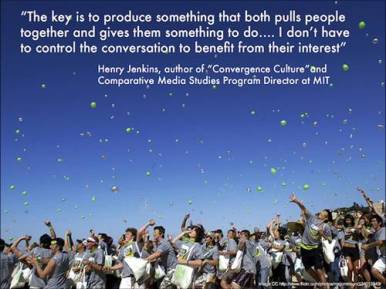
I’m presenting at the interactive boot camp over the next couple of weeks, the first one on Wednesday, and have been tasked with giving a bit of a 101: “How to plan great interactive media campaigns”.
My process is this, used to create ‘digital connections’ between consumers and brands:
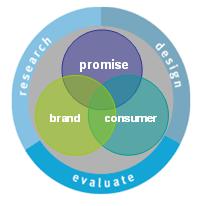
It’s a continuation of my thoughts on Loveocracy and another post and some bouncing back and forward with Sean and Gavin.
The centre of the diagram is brought to life with this kind of voice over:
“digital connections opportunities present themselves when we look for an overlap between the Brand Position and Consumer Interests, what Position unites the two and what Promise can be tactically expressed? Aiming to be inside this area makes great sense. It’s the point at which all the vectors unite”
I surround this with robust research (insights), consumer experience design (context) and evaluation modelling (building actionable intelligence) processes.
I’d love to hear your thoughts and get your examples on great interactive media planning.
After I’ve finished the bootcamp I’ll compile it all together and post the presentation for all to share.

Can you make a difference with out coins?
Ripple is a new project that has found a cunning way of edirecting internet advertising profits to charity.
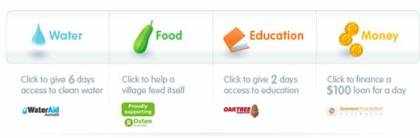
These clever kids – Melbourne’s Robin Hoods of IT if you will – also have a search bar on Ripple (with down loadable toolbar) which is powered by Google.
This directs revenue to the website for every search run. Click a little here, a little there, run all your searches from it, and all the while you’re donating money to charity. The price of benevolence has never been so low.
Filed under: Digital Strategy
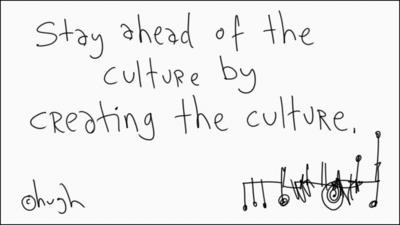
David Armano’s latest post Blogs Are Free Samples of Your Brand has an interesting, call to action: Stop calling yourself a blogger.
“Blogging is a commodity. Anyone can do it. We are human beings with passions and interests that come out in our blogs—not the other way around. Stop calling yourself a blogger. You are a… (designer, businessperson, marketer, artist, baker, mother, grandfather, etc). Calling ourselves bloggers takes away from what makes us unique.”
An article in the New York Times, Sex, Drugs and Updating Your Blog puts forward that the term might be Artist 2.0:
“It’s possible to see these online trends as Darwinian pressures that will inevitably produce a new breed — call it an Artist 2.0 — and mark the end of the artist as a sensitive, bohemian soul who shuns the spotlight… being a musician is rather like being a business manager, memoirist and group therapist rolled into one, with a politician’s thick hide to boot. ”
Joseph Jaffe has a posted a video from his Australian visit, Content + Context, which brings to life Adam Curry’s claim that in 5 years time 50% of all content will be consumer generated.
That’s quite a trend. With over 75 million blogs there are a lot of people who are doing it, a lot of people expressing themselves. Not all of it will be good, sure. But is it vital to define people who create content? Are they artists? Are they bloggers or vloggers or podfathers? Do you define the nature of expression ,or the nature of the person, by the materials used? Just because people had access to pencils, it didn’t make everyone a writer.
Isn’t it more important for people to define themselves? Isn’t this Creation Age all about self definition and self expression?
I believe that the hand of an artisan is shaped by their tools. Sergovia’s hands were undoubtedly those of a classical guitarist, I have a film producer friend that could organise a colony on Mars in two weeks and I can spot a network engineer at ten paces.
I am blogger.
Fundamentally, the resistance I have in turning away from allegiance to the medium is the notion that building something, expressing something (for someone else) is somehow more valid than creating it (for yourself).
I’d have to disagree.
With great respect David: blogging is unique. It’s solitude and time to think in very good company. It provides structure and discipline to create and it provides feedback and authority to just born thought.
Oh, and loads of stuff to Get Shouty about too….
Filed under: Digital Strategy
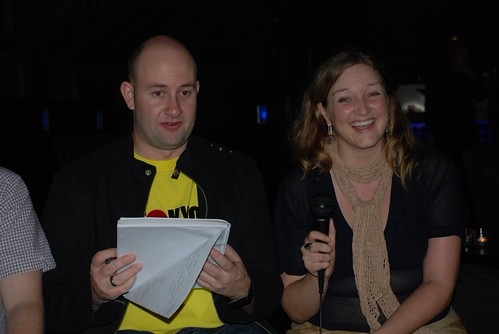
Hanging out at the Water Bar, originally uploaded by josephjaffe.
I believe I was talking about brand minxy-ness here.
The guy to my right has obviously never heard anything like it.
Filed under: Digital Strategy
e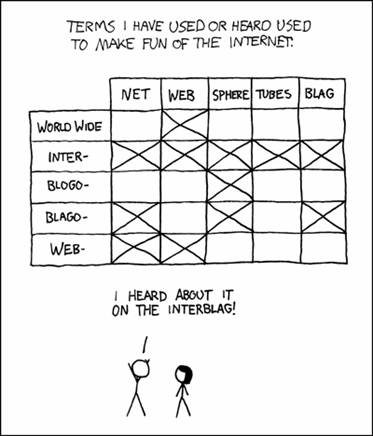
Joseph Jaffe was in town this week. He dropped his balls (you had to be there), fought some dinosaurs (hooray!) and held court in his self depreciating chap-tastic fashion. Interested and interesting wins in my book, and he has had double servings of both for breakfast.
It was quite an experience to watch him skillfully acknowledging the old school resists to his message, while still challenging the assumptions and prompting innovation testing.
It seems that marketers do want to do something different and join the conversation. Unsurprisingly they don’t want to spend their budgets on projects that might not get results.
What they want to do most is create the old sales spike. Not a long term brand building proposition sure, but when the average tenure of a CMO is 23.2 months there doesn’t seem to be much incentive to create long term value.
Evaluation modelling is really the key here- which combination of the digital channels, or as Jaffe would say, which of the 93 crayons can you use to create the best picture for your brand?
I’m a maths fiend. I love how you can make numbers dance and tell a story and there’s a creativity to crafting a series of premises that a financially driven board can follow. I’m looking forward to new metrics on a brand by brand basis beyond TARPS and CPM.
The only figure worth a damn is TWB (time with brand). You win if people choose to hang out with you and you loose if they ignore you. Thanks for the juice Mr Jaffe!
Thanks XKCD for the pic.
Thanks also to Paul for last name vigilance.
On Fridays time moves differently. It’s very easy, in a Douglas Adams fashion, to get lost:
I hope I find the weekend soon!
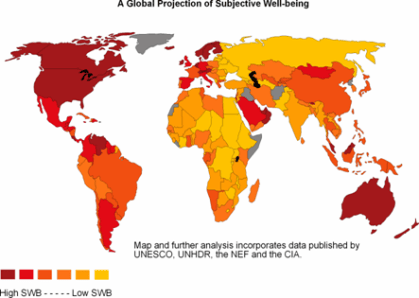
This map found here.
“Happiness is inward, and not outward; and so, it does not depend on what we have, but on what we are.” So intoned American man of letters Henry Van Dyke. A noble vision of a less materialistic world, some might say — but is it something that can be quantified? The International Development Research Centre have some insight into how the people in the rugged and remote Asian country of Bhutan are busy trying to “operationalize” a notion of true happiness that sounds a lot like Van Dyke’s dream.
In modern times, human prosperity and wellbeing have been measured by blunt economic standards, such as Gross Domestic Product (GDP), that are essentially gauges of economic activity. More often than not, however, these indicators fail to take account of whether that activity is good or bad. Perversely, a rise in crime rates may come across as an economic benefit because it stimulates economic activity: more crime leads to the building of more prisons, the hiring of more police, and so on. By the same dispassionate logic, natural disasters could also be seen as contributing to the economy, for example if they created a repair and reconstruction boom. It all depends on what you choose to count.
The alternative approach draws upon a broader set of social, environmental, and health indicators aimed at more accurately representing the real condition of society.
Measuring wellbeing
In Bhutan, this comprehensive indicator is charmingly known as Gross National Happiness (GNH).
The east Himalayan Buddhist monarchy of approximately 800,000 people, sandwiched between the world’s two most populous countries, has recently ended its long self-imposed isolation. Only in the late 1990s did it admit television and the Internet; now Bhutan is considering applying to join the World Trade Organization (WTO).
One of the world’s least-developed countries, Bhutan is worried about what globalization may bring, and it is determined to protect its unique culture. The country wants to safeguard its social values by entrenching them in terms that the wider world may understand and respect, that is to say, in quantifiable measures. By developing measures of progress that account properly for the country’s social, cultural, and environmental assets as well as its economic development, the country is following through on the 1972 declaration made by His Majesty King Jigme Singye Wangchuck: “Gross National Happiness is more important than Gross National Product.”
Much closer (for me) to home is a street campaign that I saw when I was last in Melbourne. I was reminded of it today through a post Australians taking it upon themselves to create a vibrant community on Mack-tastic’s The Viral Garden.
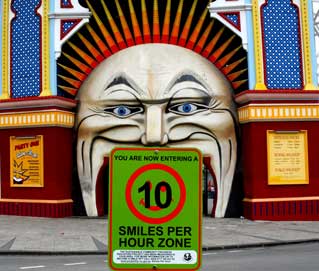
This local government has started a series of Sustainable Community Progress Indicators (SCPI) which compares and prompts the sight of smiles across the city.
I believe that this is an expression of an initiative of VicHealth. Suggestions to “smile at the person next to you” at bus stops, “walk instead” in car parks and “catch up with friends” are among 50 messages that will be shared with the population.
The health promotion organisation will also stencil streets in the cities of Darebin, Melbourne and Bayside in a bid to encourage people to get active and socialise as part of every day life.
Mr Moodie said depression would be the second largest disease by 2020, and one in five children in Australia was now overweight.
“Here’s a fresh approach that will help combat these disturbing figures by encouraging physical activity and connecting with others,” he said.
The gym and playing team sports were not for everyone, but exercise and social interaction could be as simple as walking to the bus stop, he said.
I do love the idea of happiness and friendly interaction being a measure of success and sustainability for a community, a country and (Mack prompted this)-a brand.
Filed under: Digital Strategy
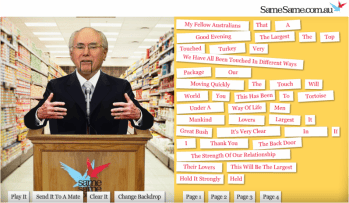
This fun and ultra topical viral piece in beta testing from the terribly clever Thought By Them guys gave me some food for thought on my recent widget crusade.
I wanted to blog about it, add my own fuel to the fire and introduce it to people whose email address I don’t know…I wanted something to embed, something to share, to create a signpost so that others could discover it too.
This experience reminded me of a post I saw over at Greg Verdino‘s blog about an interview he had with Adweek about widgets on MySpace:
For advertisers, widgets hold the hope of cracking the social media code, giving consumers the ability to spread a brand’s message. This viral component is sorely lacking in standard ad placements on social sites. “Widgetization [is] about getting the consumer to take the brand with them,” he said. “It’s ultimately the key to success in community-based social media implementations.
I’m loving the notion that “time with brand” is not about demanding that people come and spend time on a brand’s website. Widgets allow brands to join in conversations where their consumers spend their time, and are a great starting point for consumer centric digital design. They can help answer some the most compelling questions brands need to ask and answer in creating digital brand expressions:
- Does this digital expression further the undersanding and the relationship between the brand and the consumer?
- Does it start a conversation?
Any ways….see what it’s like for the Australian Prime Minister to say something that you might want to hear (for a change) over at SameSame.
Filed under: Digital Strategy
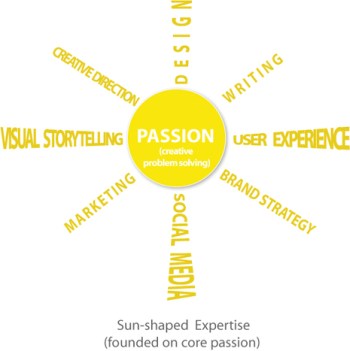
David Armano, thought starter extraordinaire, has continued his series on the mindset and team structures required to create truly fabulous brand experiences. This diagram comes from T-Shaped + Sun-Shaped People.
I love it, and not because I think it describes a great structure (which it does)- but because I think it describes the kind of feeling you get when you’re lucky enough to be able to contribute and participate in a great creative team.
The idea of creative people being brought together by passion and shining their light on brands is a really compelling one. Sunlight can make a thousand flowers bloom in a brand’s garden.
What’s really interesting to me is how passion is shaped in the burning heart of the creative sun. The core of this passion must be empathy with consumers and insight into their needs- that’s where truly creative problem solving can spring.
Filed under: Digital Strategy

A cheat sheet for my workshop attendees today.
Audio 2.0
Lastfm* – Profile your taste, share, personalize your radio. http://www.last.fm/
Pandora* – Personalized radio. http://pandora.com/
Blog 2.0
Cocomment – Track back your commentosphere. http://www.cocomment.com/
Feedblitz – Notification2email. http://www.feedblitz.com/
Blogger.com, WordPress.com
Bookmarking 2.0
Delicious* – Social bookmarking. http://del.icio.us/
Digg* – Social bookmarking. http://www.digg.com
Chat 2.0
www.twitter.com
Communication 2.0
Skype – Call, conference, messenger, file sharing. http://www.skype.com/
Community 2.0
Facebook – Student communities. http://www.facebook.com/
Frappr – Put your group on the map, share photos. http://www.frappr.com/
Friendster – Connect with friends. http://www.friendster.com/
Email 2.0
Yousendit – Email large files. http://www.yousendit.com/
Images 2.0
Flickr – Upload & share photos. http://www.flickr.com/
Photobucket – Upload, publish & share photos. http://www.photobucket.com/
Knowledge 2.0
Squidoo – Share knowledge. http://www.squidoo.com/
RSS 2.0
Feedburner – Manage your rss & podcast feeds. http://www.feedburner.com/
Tagging 2.0
Tagcloud – Folksonomied, personalized tag clouds. http://www.tagcloud.com/
Zoomclouds – Make & publish tag clouds. http://www.zoomclouds.com/
Video 2.0
Youtube* – Upload & share video. http://www.youtube.com/
Vsocial – Upload, rank & share video. http://www.vsocial.com/
Extensive list of web 2.0 sites here.
Filed under: Digital Strategy
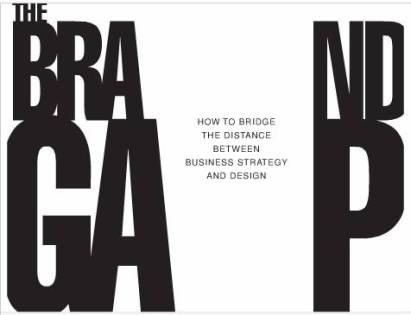
Annoyingly good.
How to bridge the distance between business strategy and design .

Widgets are great. A well designed widget is a class act of cleverness.
You’ll have to follow this link to see the beauty of this one though.
Have A Slogan promise to deliver a wee app that has terrible things matched with popular commercial slogans:
Retardation:
Keep that schoolgirl complexion.Paris Hilton:
That was easy.Child Abuse:
It takes a tough man to make a tender chicken.
WordPress, however isn’t as happy with this as me… but do check it out.
Found on the fab BannerBlog.

Never backwards in coming forwards, I’ve put my hand up to be a part of a project set up by the ever fabulous Gavin Heaton and Drew McLellan .
I’ll let Drew outline it:
Gavin & I concocted the idea for an e-book about this new era of communications we’ve all entered together. But not just any book. It has to be a quick book. Exciting. Sharp. Inclusive. It had to be a book about community and conversation that came from that community and spoke the same vernacular. The title — The Conversation Age.
And that is why we are talking to you. Our idea:
- 100 authors. We’re a few but need more.
- The overriding topic is “The Conversation Age” — where you take it is up to you.
- The items are short – one 8.5″ x 11″ page — it can be words, diagrams, photos (again up to you) If it is words – about 400, give or take a couple.
- We write it quickly and get it out there. We publish electronically.
- We make it available online for a small fee and we donate 100% of the proceeds to Variety the Children’s Charity — which serves children across the entire globe.
Here are the contributors to date:
Please do come and join in the conversation!
Filed under: Digital Strategy
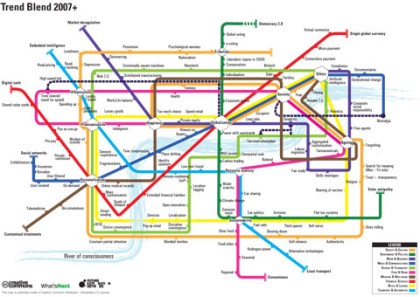
Nowandnext.com and Future Exploration Network have collaborated in producing a map of major trends for 2007 and beyond, across ten segments: society & culture, government & politics, work & business, media & communications, science & technology, food & drink, medicine & well-being, financial services, retail & leisure, and transport & automotive.
It’s lovely work.
Go here to download a full sized PDF from Ross Dawwson’s blog, Trends In The Living Networks.
Thanks to Lyndelle for the great find!
Filed under: Digital Strategy
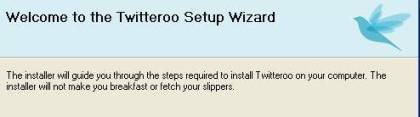
Twitter is real loud and demanding. It’s a bit like a hangover on a sunny day- you just want to grab some shades and head for cover.

Twitteroo allows you to draw the blinds a little, even if it won’t make you breakfast or get your slippers.
Not too sold on the whole thing just yet- but joining in on the conversation is the way to tell.

