


Filed under: Experience
I’m a huge believer that people can process information more quickly and more deeply when it is presented as a visual narrative. 80% of the brain is dedicated to visual processing….
One of the best examples of this is Gapminder -a data visualization tool used to highlight statistics about our world to promote the UN Millenium Development goals.
Contextualizing abstract data in this manner allows for an increased understanding of the World, possibly leading to insights and more informed decisions.
If you can get people to play with the information and see the impact, you can unlock even greater understanding:
Designers Jochen Winker and Stefan Kuzaj work with the visualization of data, and have been developing innovative models for absorbing complex information. Their latest work (you can see above) features methods for making information interactive, requiring users to engage with devices in order to fully unlock the value of the information at hand.
Some great examples:
- If there’s anything good that has come out of the financial crisis it’s the slew of high-quality graphics to help us understand what’s going on. Some visualizations attempt to explain it all while others focus on affected business. Others concentrate on how we have been affected. Some show those who are responsible. After you examine these 27 visualizations and infographics, no doubt you’ll have a pretty good idea about what’s going on.
- GOOD recently asked its readers to create an infographic that shows both the devastation of the recent Haiti earthquake along with aid efforts thus far
- the entire collection of GOOD’s infographics can be found here
- 7 Visualization Groups On Flickr
- Infographics & Data Visualisation (slideshare presentation)
- Jeffrey Veen – Designing our way through data
- We hear all about a rich web of data, but what can we learn from these trends to actually apply to our designs?
Love it live
- Experiential – from Live to LOUD
- Social media is having an explosive effect on experiential campaigns, creating the potential to multiply thousands of brand interactions into millions.
- Japanese landscape design studio EARTHSCAPE, have created a giant travelling human-shaped herb garden. Called Medical Herbman Café Project (MHCP), the garden arrives in shipping containers which convert into a shop and cafe at each location. Proceeds from the shop and cafe are used to build playgrounds in developing countries.
- For Sony Ericsson’s Hopper Invasion campaign a grid of inflatable ‘hoppers’ were constructed that were each connected to air pump devices. Fans of the event were encouraged to use the hashtag #prompt while tweeting what creative things they would like to do if they had hundreds of hoppers; these tweets triggered the inflation of the hopper grid, resulting in a real-space visualization of online activity associated with the event.
The business of show business
- Julia’s Bicycle :an online tool to measure a venue or event’s greenhouse gas emissions
- Check out the reviews of some European expos: PLASA for lighting & visuals, audio and motion control; ABBT for theatre tech; ProLight+ Sound
- The staging at the Brit Awards was mind blowing.
- See the versatility of the staging: Dizzee Rascal & Florence + The Machine and Jay Z & Alicia Keys
- Have a read of the how the 2009 Awards were put together
- See the versatility of the staging: Dizzee Rascal & Florence + The Machine and Jay Z & Alicia Keys
Innovation
- Sportpong is an interactive physical computer game where the field is projected on the ground and two (or more players) compete in teams. With a ‘paddle’ you hit the ball and try to strike a goal or defend your goal.
- Elie Zananiri’s Big Screams project featured an interactive screen displaying cartoon-like characters, each generated by, and linked to participants, who called into a specific number through their mobile. Each character battled the other participants in a game won by whoever screamed the loudest into their phone, the resulting audio pushing other characters off the screen.
- It may become possible to transform a variety of surfaces into a touch sensitive screen. Displax has created an incredibly thin, interactive film that can be applied onto surfaces both curved and flat.
- faderTouch 3.0, is a portable rear projection touchscreen interface. The display can be viewed from front and rear. Audio visual instruments are programmed in Processing triggering sounds in Ableton Live via MIDI.
- Augmented reality (AR)
- A short film about the social and architectural consequences of new media and augmented reality.
- A t-shirt houses an AR game of Paper, Scissors, Stone.
- 35 great examples of where Augmented Reality and their applications to the commercial and art world.
Show Business
· Check out the reviews of some European expos: PLASA for lighting & visuals, audio and motion control; ABBT for theatre tech; ProLight+ Sound
· The staging at the Brit Awards was mind blowing.
o See the versatility of the staging: Dizzee Rascal & Florence + The Machine and Jay Z & Alicia Keys
§ Have a read of the how the 2009 Awards were put together
· Julia’s Bicycle :an online tool to measure a venue or event’s greenhouse gas emissions
· Love the rambunctious jazz cabaret, twisted circus and burlesque performers that create the mayhem at Redbennies in South Yarra
Innovation
· Sportpong is an interactive physical computer game where the field is projected on the ground and two (or more players) compete in teams. With a ‘paddle’ you hit the ball and try to strike a goal or defend your goal.
· Elie Zananiri’s Big Screams project featured an interactive screen displaying cartoon-like characters, each generated by, and linked to participants, who called into a specific number through their mobile. Each character battled the other participants in a game won by whoever screamed the loudest into their phone, the resulting audio pushing other characters off the screen.
· It may become possible to transform a variety of surfaces into a touch sensitive screen. Displax has created an incredibly thin, interactive film that can be applied onto surfaces both curved and flat.
· faderTouch 3.0, is a portable rear projection touchscreen interface. The display can be viewed from front and rear. Audio visual instruments are programmed in Processing triggering sounds in Ableton Live via MIDI.
· Augmented reality (AR)
o A short film about the social and architectural consequences of new media and augmented reality.
o A t-shirt houses an AR game of Paper, Scissors, Stone.
o 35 great examples of where Augmented Reality and their applications to the commercial and art world.
Filed under: Experience

Social Media
- Facebook Groups Vs Pages: The Definitive Guide
- Over the past couple years the Facebook Pages and Groups products have moved closer together, forcing marketers to ask themselves: which one should they use? A be useful to highlight the core differences between Facebook Pages and Facebook Groups. If you had any lingering questions, this guide should completely clear things up for you
Online Measurement
- YouTube – Measuring Social Media
- Just the 1st three minutes of this one
- A presentation on the tools of social media monitoring
- A word to the wise- monitoring leads to measurement in social media
- You need to design what you’ll monitor when you design your experience in social media
- This means things like hash tags and naming protocols
- … cues that you can point your monitoring tools to find and report on
- This means things like hash tags and naming protocols
- The Missing Google Analytics Manual |
- There’s a whole bunch of ‘how-to’s’ and ‘what-does-it-means’ here
- And for the really keen
- The Science of Social Media Marketing by Dan Zarella– a fairly analytical approach to socila media and makes sense of something that is often hyped. 55 minutes
Case Studies
- A new take on viral video from Addidas
- Genius 101 website architecture and the outlines of the roles responsible for each section internetonlinewebsite.com/
- Google Wave in Action: Real-World Use Case Studies – Google Wave – Lifehacker
Creative and Strategic thought starters
- idea = p(k+i) where p is the person, k is knowledge, and i refers to new information. “The ability to combine knowledge and information in a new way is important. Just because you have knowledge and information does not mean you are a creative person. But it is also impossible to be a creative person without knowledge and information.” More here: http://knowledge.smu.edu.sg/article.cfm?articleid=1267
- The Future of Planning
- Where will planning go next? Will different agency planners — creative, media, digital, strategy — form a collaboration of like minds, or will planning reside at the client? An Admap roundtable of six planning sages recently gathered to debate their future
The New Economics of Business (Or, the Case For Going Great-to-Good)
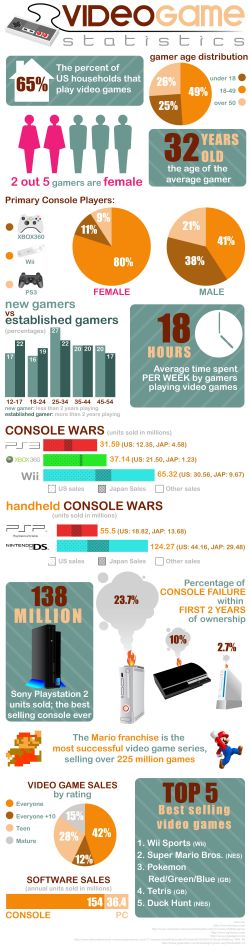
Got to love visualisation.
Also check out the video game time line here.
You can search the timeline by person, technology, business, console, accessory, game or cultural.
The timeline starts at Charles Babbage in 1792 with some key turning points games development, like the establishment of Milton Bradley in the 1860’s and the launch of Nintendo in 1889.
1947 is believed to be the first year when a game was designed for playing on a Cathode Ray Tube (CRT). This very simple game was designed by Thomas T. Goldsmith Jr. and Estle Ray Mann. A patent application was filed on January 25th, 1947 and U.S. Patent #2 455 992 issued on Dec 14th, 1948.
Spacewar! is one of the earliest known digital computer games. Steve “Slug” Russell, Martin “Shag” Graetz and Wayne Witaenem of the fictitious “Hingham Institute” conceived of the game in 1961. It took approximately 200 hours of work to create the initial version.
Anyways- there’s loads of history geekiness – and some really useful launch dates and synopsis of most of the major games up to 2010.
Filed under: Experience
Innovation is undoubtedly the ‘secret sauce’ of business success. The good news is, the ability to innovate is a learnable skill — at least according to three researchers from INSEAD, Brigham Young and Harvard in their new study conducted over a six-year period.
‘Our research showed that at most companies, top executives do not feel personally responsible for coming up with strategic innovations,’ said Hal Gregersen of INSEAD. ‘True innovators rely on their courage to innovate and a willingness to take risks.’
Most innovative leaders possess five key “discovery skills” that distinguish them from their less creative colleagues:
- Associating – The ability to successfully connect seemingly unrelated questions, problems, or ideas from different fields, is central to the innovator’s DNA. The world’s most innovative companies prosper by capitalising on the divergent associations of their founders, executives, and employees.
- Questioning – Innovators constantly ask honest questions that challenge common wisdom or ‘question the unquestionable.’ While most managers focus on how to make existing processes – the status quo – work better, innovative entrepreneurs are more likely to challenge assumptions.
- Observing – Discovery-driven executives produce uncommon business ideas by scrutinizing common phenomena, especially the behaviour of potential customers.
- Experimenting – Using the world as their laboratory, innovative entrepreneurs actively try out new ideas by creating prototypes and launching pilots. Most engage in some form of active experimentation, whether it is intellectual exploitation, physical tinkering, or engagement in new surroundings.
- Networking – Innovative entrepreneurs devote time and energy to finding and testing ideas through a network of diverse individuals in order to develop radically different perspectives. Unlike most executives who network to access resources, innovators go out of their way to meet people with different kinds of ideas and perspectives to extend their own knowledge domains.
The five skills, Gregersen says, are ‘a habit, a practice, a way of life’ for innovators.
Although Gregersen and his co-authors use the DNA metaphor, innovative entrepreneurs are actually made or developed, rather than born. “We each have unique, fixed physical DNA,” says Gregersen, “but in terms of creativity, we each have a unique set of learnable skills that we rely on in order to get to the ideas that will give us some insight.” Research involving identical twins suggests that only about 20-25 per cent of our creativity ability is geneticically driven. “This means the other 75-80 per cent comes from the world we live in,”
Quotes and data compiled from here, here and here. The study appears in the December 2009 issue of Harvard Business Review and can be accessed online at http://www.hbr.org.
Filed under: Experience

New York photographer Spencer Tunick is looking for thousands of Australians to disrobe in the name of art on the steps of the Sydney Opera House.
The photographer, who has produced almost 100 installations around the world, wants to create an installation involving nude volunteers on the steps of the Sydney Opera House on Monday, March 1.
Tunick is hoping at least 2,000 people will get involved in the photograph to be called The Base.
“In a way, I’m making a base for the structure, a base for the architecture – and by combining straight and gay and lesbian people I’m weaving the different sexes and society together to form this wonderful fabric that holds up this gorgeous building,” he said.
Stolen from TIGS tumblr
I just fell in love with this video…and then I dug a little further.
It’s a call to action to apply for the Rethink Scholarship here :
The Communication and Ideation Design (CID) program is a modern educational approach to the Graphic Design, Art Direction, Advertising and creative industries. It provides a design education where each class builds upon the previous one to expand the creative process. Particular attention focusses on ideation, which is the process of initiating, developing, and refining ideas. Ideation is an integral part of the design process.
Classes are structured around a wider approach for today’s modern designer. The curriculum incorporates communication for design and human interaction, with regards to digital (web pages) and physical realms (graphic and information design print, publication, wayfinding, exhibition and experiential design).
Noice. Wayfinding. Someone’s thinking about the future of our industry then….
I’m a bit fond of the entry mechanism:
We’ll be judging the winner based on one thing: a sketchbook.
Remember not to worry about filling out the whole book, because a few brilliant ideas are always better than a huge pile of mediocre work.
Your job is to put your most interesting ideas into that sketchbook to demonstrate what you can do. Your book should also tell us something about who you are.
Love this insight on how they’ll pick the winner:
Plain and simple, we want a book that amazes us. Here’s a few criteria we’ll be judging the books on:
– Clarity. Both in your idea(s) and your execution.
– Relevance. Keep in mind the program you’re applying to.
– How fresh the thinking is.
– Quality not quantity. Don’t show us every idea you’ve ever had please.
– The craft and execution of your work.
Can’t help but think that’s how work ‘wins’ in my world too.
Check out the site: http://www.rethinkscholarship.com. The video showcase of last year’s entries are worth a look.
Filed under: Experience

I have a half a library of notebooks that have acted as drawing boards and kept me company all throughout this year.
My favourite is the one I use on Fridays.
Fridays for me are for compassion and conversation- being there, in the moment, for both. I’ve been fortunate in this downturn to have the opportunity of a four day week, and all the sums seem to have turned out in my favour. That extra day to play and give back….
Here are some snippets of the conversation notes:
- (note): expectations are premeditated resentments (SHARE!!!)
- (note): what effects/ impacts handwriting on a day-to-day basis?
- (note): eating wild boar prosciutto with an ex vegan chef talking fish and chipocrates
- haiku and origami
- (List): Something fun, funny, relevant, timely. Entertain and Inform. Stuff that matters. Generosity, giving, sharing, real experiences, genuine interactions. Belive in something. Progress+ Passion+Playfulness
- (coffee morning list): Cognitive Edge/ Dave Snowden, Top 50 Arts videos on YouTube , Rolling Stone interview between William Burroughs and David Bowie, Laurie Lock Lee, Nancy White, Johnnie Moore, Dave Pollard
There’s a lot of organic flow chart diagrams unpopulated with text- empty buckets quickly drawn that I must have been using to explain a concept to someone. They all look completely mad though now.
The compassion scribbles are different. They’re witness to time spent in wards and waiting rooms:
- (List): scrabble, a bag of furry ears, 2 word dictionary, Julia + Julia
They’re longer, they’re less visual and more first person. The time between breaths. Pen and paper can bind, can help close open wounds. Reading these notes reminds me how fresh those scars are. Luckily I’m a big believer in scars. They are a map of how you came to be and a measure of who you are.
Filed under: Experience
BBH London has posted a series of “audio walks” on the Johnnie Walker Web site, in which folks like Richard Branson, Ranulph Fiennes and, yes, John Hegarty are heard ruminating about life and work while walking around places that mean something profound to them, personally or professionally.
In the clip, BBH founder Hegarty strolls through Carnaby Street and Soho in London, recapping his career. He covers lots of ground—why he was petulant and angry as a young creative, his advertising philosophy now, the interplay between inspiration and fear, what he learned about business from playing tennis,
Filed under: Experience
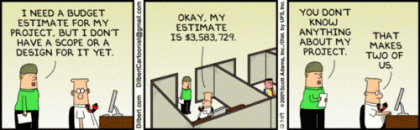
I’m sure that everyone is under the ‘oh… can you get back to me before Christmas’ pump right now.
While it’s awesome for revenue that people are realising the ‘if you don’t use it you lose it’ nature of most marketing budgets it is astounding to me that rigour and strategy can tend to go out the window.
Like trying to find a present at the last-minute, trying to come up with innovation and excitement for a blue sky briefing in 24-48 hours (even for a six or seven-figure budget) is kinda hard. Bowerbird ways and kaizen ‘how can we do this better next time’ practices can help build a cache of ideas and tactics that can pay real dividends on their investment.
I’m more than happy to spend other people’s money. I’m really glad to have thinking already charted up and mostly costed that as ‘value ads’ that never got the time of day…which only need the current context so that they can now contribute to the bigger picture
Don’t be afraid of the zeros at the end of your estimates. Big thinking doesn’t cost you more and sometimes there is a big present under the tree waiting to be unwrapped.
Filed under: Experience
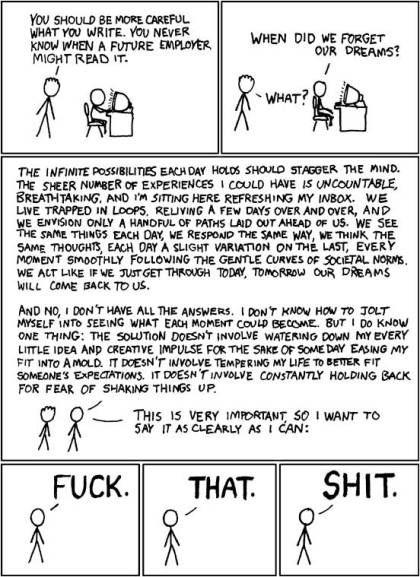
Maybe the greatest art director ever was Helmut Krone. At the end of his life, someone asked him why advertising had become so predictable.
“We were anti-establishment. But nowadays the kids want to be part of the establishment.”
It reminded me of a Picasso quote:
“When the avante garde becomes the establishment, you’re in trouble.”
And the wrong kind of trouble. The dull, boring kind.
Now there’s more reason and more opportunity than ever to create controversy, and free advertising.
Isn’t that what creative people enjoy?
“It’s more fun to be a Pirate than to join the Navy.”
Filed under: Experience
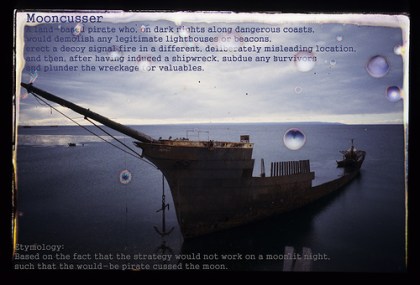
I’m a bit of a bricoleur – I love collecting random facts and lists and etmymologies and anything that will add colour and movement to the improvisational nature of most of my expressions whether it be my paid work or cooking or scaring people at dinner parties…well anything really.
@charlesfrith: New etymology last night. Conspire = breath together; con spire. Sweet eh?
You can’t make good decisions unless you have great choices, and I’m a big fan of stocking up on those. Adding articles into Delicious is a great example that kind of bowerbird behaviour, and this combined with feeding my favourites on Flickr, my Google reader starred items and other caches of bits and pieces that have caught my eye helps me create collages pretty quickly.
It means that you need to have the discipline to contribute to your stock pile every day- but when fast strategy is required it really does become a pirate’s treasure just waiting for you to dig up. Tag ho!

Dr. Lene Nielsen outlines her approach to developing personas:
Having worked with personas before the method ever came to be known as personas there are, from my research and practical experience, three important areas that have to be considered: the data material, engagement in the personas descriptions, and buy-in from the organization which is part of the development process whether it is redesign or a development from scratch. This is the rationale behind my development of 10 steps to personas, an attempt to cover the entire process from initial data gathering to ongoing development.
You can have a look at the entire article here, and see a larger version of her chart here.
Thank to Ian Lyons for the find.
In the West Wing episode “Constituency of One” the VP says to Will:
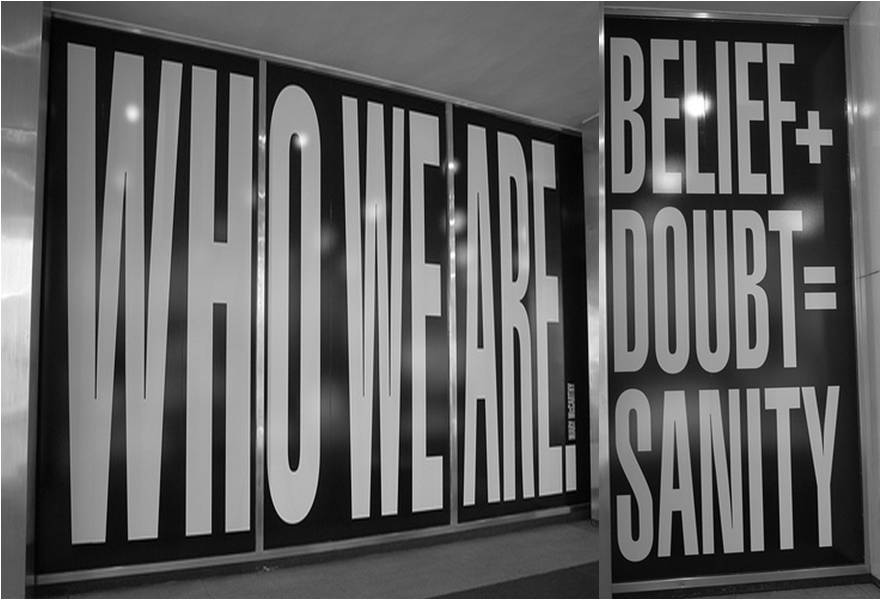
“I admire speech writers. They have to have the tendency to doubt and the capacity to believe in equal measure….”
and I can’t help but think that these are one of the base pairs in the DNA strands of planners.
I often have people ask if I need to 100% believe in the product I’m working on- or if cynicism feeds good work.
Yes and no.
You need to doubt that the problem put in front of you is the one that need solving, you need to doubt that you have enough insight into a group of people of which you are not part and whose behaviour and reactions you’ll need to understand. You need to doubt the ‘known knowns’.
You also need to believe- that what you’re doing can help keep businesses sustainable, can create great culture and good working environments inside of organizations and that the siren call of the manifestations of our entrepreneurial spirits will write the kind of future we’ll want our kids to live in. You need to believe in answers.
As for the balance between the two? All things in moderation- including moderation. Passion will out. Know what feeds yours.

Productive stupidity means being ignorant by choice. Focusing on important questions puts us in the awkward position of being ignorant.
One of the beautiful things about science is that it allows us to bumble along, getting it wrong time after time, and feel perfectly fine as long as we learn something each time. No doubt, this can be difficult for students who are accustomed to getting the answers right. No doubt, reasonable levels of confidence and emotional resilience help, but I think scientific education might do more to ease what is a very big transition: from learning what other people once discovered to making your own discoveries.
The more comfortable we become with being stupid, the deeper we will wade into the unknown and the more likely we are to make big discoveries.
I can see a lot of the thinking that might well have been inspired by the presentation given by Matt Jones at Design by Fire 2009 called “we have all the time in the world” – but Bud has taken this seed, personalized it, brought it to life within the context of message creation and the potential of the ideas of how we experience ‘time’ to help craft more effective opportunities for calls to action.
Seriously- lovely work.
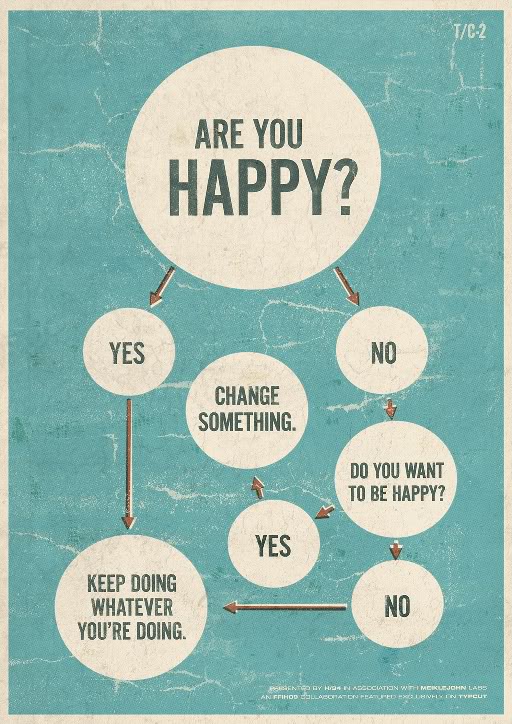
A freak stranglet from the Large Hadron Collider is interfering with many potentials incuding my ability to get my thoughts down in post form. Time is not my friend right now. Perhaps the future is merely being kind.
There are heaps of speaker notes in the presentation- loads of chewy thinking:
Our relationships to each other, the cities and places we inhabit and navigate have been transformed in the last few years by the technology, products and services that we have designed — but what about that last one of the three — time?
“People, places, time. The triumvirate of factors at play in mobile, social, locative services might be familiar at the surface level to designers and developers.
Using examples from the development of Dopplr.com and other services — alongside historical and science-fictional perspectives — Matt Jones explores what we might call neochronometry and illustrates some directions we could take as interaction designers to treat time as a material.”
Filed under: Experience
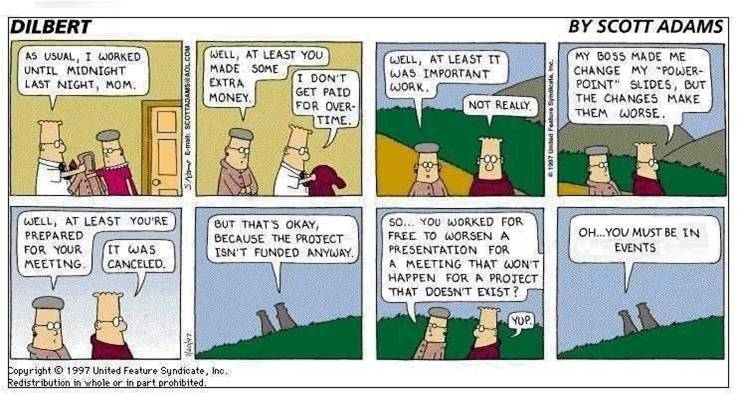
still the same when it’s called experiential…

