Filed under: Great Stuff

The nominations for post of the month
Time As Context… from Charlie Gower
The Price of Pomposity… from Euan Semple
Nixon And Complexity… from Charles Frith
Purefold’s Family Tree… from Leland Maschmeyer
How Small Change Became Big Money… from James Cherkoff
Creative Paralysis… from Dave Trott
Making Money From Social 1 & 2 … from Neil Perkin
What Does It Take To Get Some Service Round Here… from David Cushman
Filed under: Great Stuff

You’ll need to click through to see it’s awesomeness.
As the comments say:
WIN click WIN click WIN WIN click WIN click WIN WIN click WIN click WIN WIN click WIN click WIN WIN click WIN click WIN WIN click WIN click WIN WIN click WIN click WIN WIN click WIN click WIN WIN click WIN click WIN WIN click WIN click WIN WIN click WIN click WIN WIN click WIN click WIN WIN click WIN click WIN

Looking forward to dipping into “the Social Brain‘: a project that looks at research pitched at the three levels of brain, individual behaviour and social organisation. It aims to integrate this research into a credible and useful model of decision-making, in light of the breakdown of the rational-choice model employed in recent years. The idea is to give an account that does full justice to all the different ways we are human.
Tomorrow’s Investor: Where is your money being invested?
Arts and Ecology: Gustav Metzger: artists“taking moral standpoints”
Design and Society: Calling spiritually prosperous and self-knowing designers everywhere!
Thanks for the tip off Mark.

Sputnik Observatory is a New York not-for-profit educational organization dedicated to the study of contemporary culture. They fulfill this mission by documenting, archiving, and disseminating ideas that are shaping modern thought by interviewing leading thinkers in the arts, sciences and technology from around the world.
Their philosophy
- ideas are not selfish.
- ideas are not viruses.
- ideas survive because they fit in with the rest of life
The site contains jaw dropping videos of the most amazing thinkers, or ‘extraordinary minds shaping modern thought’ like the transcript below from Wade Davis who is the National Geographic Society’s Explorer-in-Residence,and honorary member of the hundred-year old Explorers Club. He’s an ethnographer, writer, photographer and filmmaker, observing worldwide indigenous cultures and the traditional uses and beliefs associated with psychoactive plants, celebrated in his best-selling book “The Serpent and the Rainbow” about the zombies of Haiti.
In the Amazon, I’ve been with hunters who could smell animal urine at forty paces and tell you what species left it behind. You look at the Polynesian seafarers who could, just by reading the ocean like a series of rivers which is how they saw the currents, by looking at the rhythm of the waves, they could sense the presence of a distant atoll far beyond the horizon. You talk about how, even the taxonomy of the Amazonian shaman, when they begin to characterize and systematize creation, particularly with some of their sacred plants. For example, one of the most important Amazonian plants is something called Ayahuasca, which is a Liana and, to the botanical eye, there’s one main species that’s used. But that species is actually, by at least one tribe that I know, the Sienna Sequoia(?), they recognize 17 different types of it. Now, to our scientific taxonomic eye, they’re all referable based on morphological traits to the same species. Indistinguishable. They consistently distinguish them and from great distances in the forest. And you ask them what is the foundation of their taxonomy? And they’ll say to you, “Well, you take each one on the night of the full moon and it sings to you in a different key.” Well, obviously, that’s not an idea that is going to get you through Harvard with a PhD, but it’s a hell of a lot more interesting than counting stamens. But, more importantly, you start thinking of what does that intuition really says to you? How do they find these plants in the forest, for example? And they say to you, “Well, the plants talk to us.” And we, of course, with our Descartian rational mind say, “Well, that’s nonsense.” And it’s only nonsense because it doesn’t fit into our paradigm. But when you begin to consider the possibility that different societies belief systems can make almost for different individuals, but also make for different levels of perception.
Filed under: Experience
My lovely friend Luc asked me for a definition of a creative strategist….and I had this in the cupboard.
The embed from Slideshare doesn’t seem to be working properly you can find it here:
What’s This Creative Strategy Thing All About?
from Wired: Director Guillermo del Toro on the Future of Film
del Toro: In the next 10 years, we’re going to see all the forms of entertainment—film, television, video, games, and print—melding into a single-platform “story engine.” The Model T of this new platform is the PS3. The moment you connect creative output with a public story engine, a narrative can continue over a period of months or years. It’s going to rewrite the rules of fiction.
Wired: It sounds like you’re talking about an entirely new form of storytelling.
del Toro: Think about the way oral tradition became written word—how what we know about Achilles was written many, many years after it made its way around the world with different names and different types of heroes. That can happen when you allow content to keep propagating itself through different kinds of platforms and engines—when you permit it to be retold with a promiscuous form of mythology. You see it when people create their own avatars in games and transfigure their game worlds.
Wired: So how will the public story engine tell those same 10 stories differently?
del Toro: We are used to thinking of stories in a linear way—act one, act two, act three. We’re still on the Aristotelian model. What the digital approach allows you to do is take a tangential and nonlinear model and use it to expand the world. For example: If you’re following Leo Bloom from Ulysses on a certain day and he crosses a street, you can abandon him and follow someone else.
Wired: But these nonlinear, hybrid storytelling forms involve gaming tech, which could trap them in a geek ghetto. What’s going to bring down that wall?
del Toro: Go back a couple of decades to the birth of the graphic novel—I think we can pinpoint the big bang to Will Eisner‘s A Contract With God. Today, we have very worthy people doing literary comics. I think the same thing will happen on the Internet-gaming side. In the next 10 years, there will be an earthshaking Citizen Kane of games.
Rosebuuuuuuuuuuuuuuuuuuuuuuuuuuuuuud!
I love radio. I love the immediacy and the deadline and the wonderful opportunity of telling a story with the human voice. I had my own show for four years and know exactly what track you need to play to make a cup of tea and make a pit stop. But Ira Glass of “This American Life”, can tell you a lot more than I can on how you can know that you are on your way to developing the building blocks of a great story.
To paraphrase:
You start out doing something (like writing, or making films, or painting)
Because you love the form and because you have great taste
And then you start out doing it for your self- and because you have great taste you know that what you’re doing is not good
It’s kinda crappy
It falls shortA lot of people never get past that stage- they quit
Everyone goes through this stage – its totally normal
Sometimes it takes years to get past itThere’s only one way out of it
The most important thing that you can do -is a lot of work
Put yourself on a deadline
Get someone to expect it, to make you create that output
Don’t miss out on his excellent delivery, wonderful self analysis and the end of his story…it’s part of a series.
Filed under: Great Stuff
This educational video helps you understand the mind of a marketer, and what shapes our decision making, workplace behavior and marketing mix.
Can you become a marketer, or are they born? Find the answer you’ve long sought.
Comments on this video youtube:
Thanks. The proven centricity of this situational indicator message allows me to be aware of the performance dashboard metrics to drive my strategy to a larger footprint of the core competency awareness for the client’s customers – in a voracious manner.
Something akin to cultivating ubiquitous methodologies with relation to extending interactive portals – so to speak, scaling killer convergence while proactively seizing viral markets and, with all things being equal, generating revolutionary mindshare. Five out of five!
Filed under: Experience
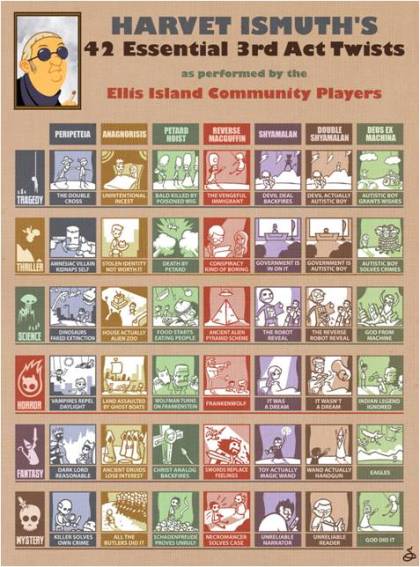
Gotta love ’em, those third act twists. They seem to happen all the time in ad land and they’re all the colours of the rainbow: just part of the job, ma’am.
Sometimes I feel that working in fast turnaround high pressure creative communications is a little like being on the stage, tap dancing on ball bearings. The trick is to make it seem effortless, hold your form while keeping a great smile on your face and giving everything you’ve got to keep your grace.
Never, never let a client see you running. One of mine used to say:
When you come home and your house is on fire, the last person you want to see bolting is the fireman.
Good advice. Perception is everything. Turning in circles is probably best avoided too. Especially if someone can see you. Try to keep that stuff on the inside.
There’s no way to theoretically teach someone how to manage the twists. It comes from experience in the trenches- war stories and battle scars are not only great anecdotes and funny after the fact- they are the only medals a professional soldier needs to mark their measure.seriously
When you can play all the roles and have grease paint and a grin and calmness in the face of a fire storm you’ll not only survive the third act, you’ll turn the play from a tragedy into a comedy. And earn yourself some pretty good drinking stories too.
Filed under: Get Friendly

Filed under: Great Stuff

20 of 100 | RECEIPT, 1992: I’m not telling the actual story behind this one… but I kept this receipt from a coffee shop in Kentucky to remind myself to not be an idiot. Doesn’t always work
This is one of the exhibits in Bill Keaggy’s collection of personal archeology projects, this one called 100 pieces of paper and the stories behind them.
Most of his work focuses on the ephemera of others
I’m a collector. But I don’t like to collect rare or expensive items. I like common stuff. It’s all about seeing the beauty in small things forgotten — about getting a glimpse of some tiny, everyday moment that lives on. With these photos, it’s the simple fact that someone was here before you were, and they had something to say. For one reason or another it got said in spray paint, or scratched or scrawled into something. Then it got left behind.
His photograph collections include sad chairs; unspectacular doors of St Louis; random graf public displays of affection :
It’s not so much vandalism as thinking out loud. Well, in many cases it is vandalism. We see these public displays of affection every day. “I love Sue.” “Amber loves Sean.” “Led Zeppelin rules.” We see them so often that they’re easy to ignore.
But the great thing is that when you do notice them, they can set you to thinking. When I see them, I think that if someone’s going to say something for all the world to see, it’s great that they chose to say “I love you”.
I particularly like his haiku generator to describe what’s for dinner, it’s well worth a play.
Filed under: Digital Strategy
The Rodney District contains a highway that leads north of Auckland, New Zealand’s largest city. It’s one of the most dangerous roads in New Zealand and has a rising death toll due specifically to speeders. The message: Slow down.
The agency (Saatchi and Saatchi NZ):
We wanted to prove how violent the force in a crash was, so we had an engineer calculate what a head on collision would be equal to in grenades. At 125 kph it is equal to 10 grenades exploding. To demonstrate this we blew up a car, collected the debris, reconstructed it with 1000’s of pieces of string and invited people to see it. Visitors included the Deputy Mayor, head of police, TV3 news (one of New Zealand’s main news station) and, but most importantly, a surprising number of 18-25 year old males.
Filed under: Get Activist
At the 2009 PSFK Conference NYC, Graham Hill, founder of Treehugger shared a selection of his favorite environmentally positive, high-impact products, services, and people. Hyper Pecha Kucha style, with 60 powerful ideas helping to make the world a better place.
I’m chewing on this short film was directed by Azazel Jacobs at Taxi for MOMA’s Multimedia channel and by a post over at Eyecube called Public Relations: Not just Trust & Measurement, but Art as well
The film shows that art might not be immediately accessable, that you might need a guide, but once you’ve been shown the path your world view might change. Forever.
Rick Liebling‘s piece expands on this beautifully:
It would be fair to define..(our goals)… as building an emotional connection between consumers and a brand. Certainly not the only definition, maybe not even the most accurate, but not off base either.
Art, in all its forms and by the broadest of definitions, stirs the passions and elicits emotions like nothing else – with the possible exception of love, and that’s the subject of much of the best art.
Consumers don’t want a itemized list of hyperbole and industry jargon, they want a story that captures their imagination.
What was the most memorable image of 2008? It was a piece of art
:

Filed under: Great Stuff
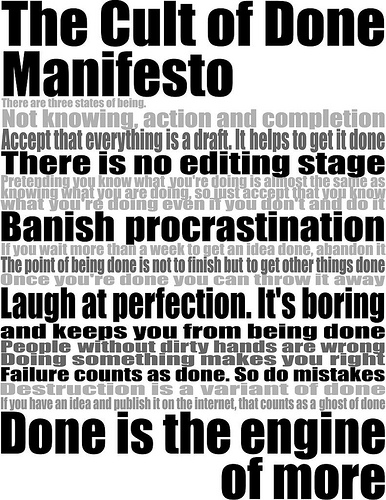
- There are three states of being. Not knowing, action and completion.
- Accept that everything is a draft. It helps to get it done.
- There is no editing stage.
- Pretending you know what you’re doing is almost the same as knowing what you are doing, so just accept that you know what you’re doing even if you don’t and do it.
- Banish procrastination. If you wait more than a week to get an idea done, abandon it.
- The point of being done is not to finish but to get other things done.
- Once you’re done you can throw it away.
- Laugh at perfection. It’s boring and keeps you from being done.
- People without dirty hands are wrong. Doing something makes you right.
- Failure counts as done. So do mistakes.
- Destruction is a variant of done.
- If you have an idea and publish it on the internet, that counts as a ghost of done.
- Done is the engine of more.
Bre Pettis in collaboration with Kio Stark written in 20 minutes because they only had 20 minutes to get it done.