



According to Chinese folklore, when a child is born they are connected by an invisible red thread (or string of fate) to all who will care about them. As the child grows, the thread becomes shorter, drawing them ever closer to people who will impact their destiny.
I’m loving this term and how it can relate to consumer centric design and service oriented architecture- that you can design systems which, as you move through them, will allow the objects that will help you evolve, be drawn to you.
Some of my recent pulled strings:
- a wonderful piece on the power of Information Architecture: The full realisation of the power of the information when you add an access layer to data.
- Jay Smooth’s ill Doctrine smart styling rap hip-hop video blog http://www.illdoctrine.com/ Is he talking about politics, rap or the nature of masculinity? Or all three?
- Gartner predicts that by 2010, social-banking platforms will have captured 10 per cent of the available worldwide market for retail lending and financial planning.
- Astound your friends and amaze your colleagues with Canuckflack’s cheat sheet post “I Am A Capable Strategist and Thoughtful Person”
- one of the best recent articles on designing brand utility Fun Way to Lose Weight: Turn Dieting Into an RPG which also has a link to Jane Mcgonigal’s opening address at SXSW.
- the growing ‘ambient awareness’, smashing the Dunbar number and the rapid growth of weak ties in the NYTimes article “I’m so totally, digitally into you: Brave New World of Digital Intimacy” by CLIVE THOMPSON – and get into the readers comments
Filed under: Digital Strategy
Filed under: Great Stuff

09/09/2008, originally uploaded by katie_chatfield.
You gotta wear 3d shades.
And travel by bmx.
In the office
Filed under: Zeitgeist

For all the God-like powers that video games have bestowed upon us — from slaying armies to pretending to be rock stars — it wasn’t until now that players could actually build life. Spore, designed by Will Wright of Sim City fame, is based on evolution: you start with microbes and customize on up. Seth Schiesel declares it “probably the coolest, most interesting toy I have ever experienced.” Go create your universe.
“Playing God, The Home Game,” by Seth Schiesel
“Gaming Evolves,” by Carl Zimmer
Contageous special report on gaming
Filed under: Get Friendly

- gusto: vigorous and enthusiastic enjoyment
- spicy or savory condiment
- enjoy: derive or receive pleasure from; get enjoyment from; take pleasure in; “She relished her fame and basked in her glory”
- the taste experience when a savoury condiment is taken into the mouth
- (and who knew?) Relish is the king of the troll kingdom and the father of Burly, Blabberwort, and Bluebell. He temporarily joins forces with the queen, but later abandons her plans for conquest when he decides to take the 4th Kingdom for himself. telan.pl/en/wiki/The_10th_Kingdom.html
What’s yours?
Filed under: Digital Strategy
Q: Everyone seems to be wired into the blogosphere as a way of exchanging ideas, opinions and industry gossip. As a senior exec at an advertising agency with virtually no blogging experience, either as a reader or author, am I missing out? Is “amateur media” the way of the future?
A: I’m not convinced that advertising and marketing blogs could be called ‘amateur media’. After all there’s quite a difference between the opinion of a professional practitioner and that of a professional observer.
I’ve been blogging for a couple of years now and have found the practise to be invaluable; not only to my professional development, but as an introduction to a global community of people and to places that has made my personal life richer too. My online adventures, into campaigns, applications and technology, have been more than met with real world opportunities that have taken me to New York, Barcelona and Marrakesh and have helped create local experiences like Interesting South.
So what are you missing out on? What’s the ROI?
As with anything that’s going on in social media, it’s all about the Risk of Ignoring:
- As a reader of blogs: Can you afford not to be informed about the latest thinking in your discipline? Can you afford not to learn from some of the brightest minds and most passionate advocates in the industry?
- And as a writer: Can you afford not to keep a notebook of your online reading? Can you afford not to contextualise and have an opinion on what’s going on in advertising?
- And ultimately, as an ad-exec: Can you afford not to have experiences that would help you understand people’s behaviour in the social media space?
Filed under: Great Stuff
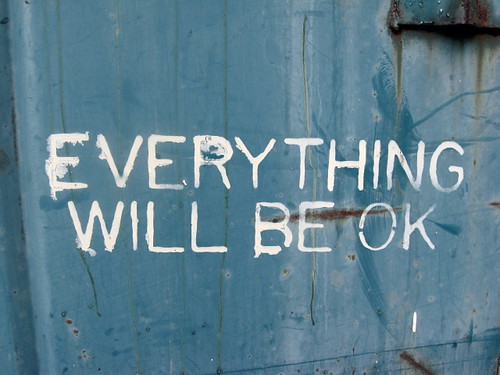
Here it is. Awesome.
Heroism is an ideal as old as humanity. Who will be the heroes of the 21st Century? What is heroism in the digital age? These are a few of the questions that a new group of researchers are seeking to understand.
Everyday Heroism is designed to bring together the general public and scholars interested in this topic to explore what heroism is, who performs heroic acts, and why.

 Heroism Survey
Asks people to help better understand what heroism is.
The survey takes about 15 minutes to complete.
If you are interested in participating, please click here.
Resources:
The Banality of Heroism” Zeno Franco & Dr. Philip Zimbardo (2007). Greater Good Magazine. (2MB pdf).
The Lucifer Effect: Understanding How Good People Turn Evil. Dr. Zimbardo’s new book and website by the same title.
For Goodness’ Sake. Essay for O Magazine, Dr. Zimbardo, April 2007. (.doc)
“Is Lei Feng (雷锋) Still a Modern Hero?: A Consideration of Heroic Action in the Context of Culture” Paper. Franco, Z.E., Pamlin, D., Langdon, M., Blau, K. & Zimbardo, P. For the 4th International Conference on Humanistic and Transpersonal Psychology and Psychotherapy, Guangzhou, China
Filed under: Great Stuff
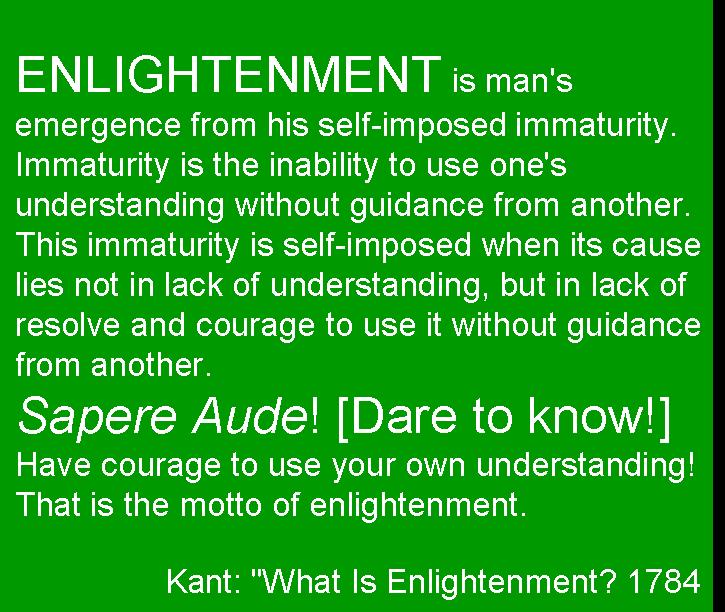
From religious fundamentalism to pseudoscience, it seems that forces are attacking the Enlightenment world view – characterised by rational, scientific thinking – from all sides. The debate seems black and white: you’re either with reason, or you’re against it. But is it so simple? In a series of special essays, New Scientist looks more carefully at some of the most provocative charges against reason. The results suggest that for all the Enlightenment has achieved, we still have a lot of work to do.
How to make reason more reasonable
The 21st-century passion for “Enlightenment values” owes a lot to the 18th century. Philosopher A. C. Grayling discusses where those values come from and what they mean today.
1: Reason stands against values and morals
Shaping a moral and humane world requires more than reason, says Archbishop Rowan Williams.
2: No one actually uses reason
If we had to think logically about everything we did, we’d never do anything at all, says neuroscientist Chris Frith. Watch a related video
3: I hear “reason”, I see lies
Science is routinely co-opted by governments and corporations to subvert people’s ability to make their own decisions, say sociologist David Miller and linguist Noam Chomsky.
Watch a related video.4: Reason excludes creativity and intuition
Reason is lost without art, says Turner prizewinner Keith Tyson. Watch a related video.
Real people don’t live their lives according to cold rationality, says bioethicist Tom Shakespeare. Watch a related video.
Even in formal mathematics, reason breaks its own rules, says mathematician Roger Penrose. Watch a related video.
7: Reason is just another faith
Unconditional reliance on a single authority is never sensible, says philosopher Mary Midgley.
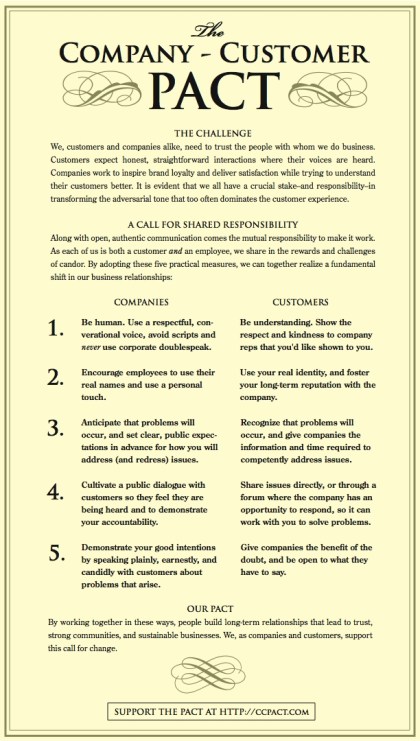
And for Julian, here is the link to The Blog Council and their best practices tool kit.
Filed under: Digital Strategy
Your dossier is made up of all the digital tracks you leave behind – from your photos on Flickr, to the Facebook messages you send, to all the data your credit card company collects about your transactions. On a daily basis, digital natives are consistently leaving information about themselves in secure or non-secure databases.
In this video, created by Kanupriya Tewari, the Berkman Centre for Internet and Society’s Digital Natives Project explores this issue from the perspective of a child born today – Andy – and the timeline of all the digital files he accumulates in a life span.
– The Digital Natives website and Wiki
– Born Digital
Filed under: Digital Strategy
In an effort to help inspire a new generation of inventors, the Ad Council partnered with the United States Patent and Trademark Office and The National Inventors Hall of Fame Foundation to launch this national Inspiring Invention PSA campaign.
Research conducted for the campaign found that today’s children, although naturally curious and inventive, do not realize the impact of their creativity.
Link found on a new source of goodness the Year of Creativity 2008:
Designed to stimulate something we all have in common:creativity.
It is a starting point from which to explore the amazing potential of small changes and the infinite opportunities they offer.
YOC is an invitation to be more curious and more imaginative.
It is a catalyst that promotes real and virtual opportunities for us all to discuss and compare our own creativity.
It is a space in which the endless personalities inside us can express themselves, as only those who are inwardly creative can also be creative with the world at large.
The first initiative in the YOC project is “Be the Change”, an entertaining and ironic way of expressing our multiple identities through a set of highly original, personalized business cards.
Here’s my first one:


Interview with Sophie Peer , Amnesty International, about human rights in China, with a special focus on the Great Firewall of China. By Stilgherrian.
Other great tips from him:
- Empirical Analysis of Internet Filtering in China | Harvard Law School: An analysis of China’s Great Firewall which concludes that the blocking systems are becoming more refined even as they are likely more labor- and technology-intensive to maintain than cruder predecessors.
- Handbook for bloggers and cyber-dissidents | Reporters sans frontières: Tips and technical advice on how to to remain anonymous and to get round censorship, by choosing the most suitable method for each situation.
- The Great Firewall of China: how it works, how to bypass it
Filed under: Zeitgeist

How internet famous are you? Type in your name and find out.
Go here then scroll down.
Woot! I’m a 57.
Via: The American Copywriter Boys (and Pablo)

Filed under: Digital Strategy
Presented at the Library of Congress, June 23rd 2008. 40 minutes of video for the 55 minute presentation. More info at http://mediatedcultures.net
0:00 Introduction, YouTube’s Big Numbers
2:00 Numa Numa and the Celebration of Webcams
5:53 The Machine is Us/ing Us and the New Mediascape
12:16 Introducing our Research Team
12:56 Who is on YouTube?
13:25 What’s on Youtube? Charlie Bit My Finger, Soulja Boy, etc.
17:04 5% of vids are personal vlogs addressed to the YouTube community, Why?
17:30 YouTube in context. The loss of community and “networked individualism” (Wellman)
18:41 Cultural Inversion: individualism and community
19:15 Understanding new forms of community through Participant Observation
21:18 YouTube as a medium for community
23:00 Our first vlogs
25:00 The webcam: Everybody is watching where nobody is (“context collapse”)
26:05 Re-cognition and new forms of self-awareness (McLuhan)
27:58 The Anonymity of Watching YouTube: Haters and Lovers
29:53 Aesthetic Arrest
30:25 Connection without Constraint
32:35 Free Hugs: A hero for our mediated culture
34:02 YouTube Drama: Striving for popularity
34:55 An early star: emokid21ohio
36:55 YouTube’s Anthenticity Crisis: the story of LonelyGirl15
39:50 Reflections on Authenticity
41:54 Gaming the system / Exposing the System
43:37 Seriously Playful Participatory Media Culture
47:32 Networked Production: The Collab. MadV’s “The Message” and the message of YouTube
49:29 Poem: The Little Glass Dot, The Eyes of the World
51:15 Conclusion by bnessel1973
52:50 Dedication and Credits (Our Numa Numa dance)
Thanks Gav.
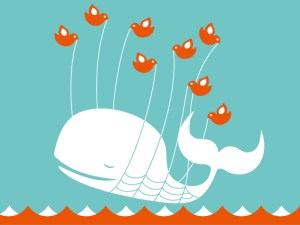
This stock licenced image ( a $5-10 fee) , an illustration by Yiying Lu, is the image you see when Twitter is down. It is called the “Fail Whale” and has moved as a meme into early adopter culture in a big way:
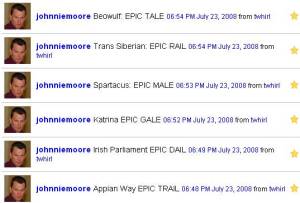
Wikipeda currently redirects searches to find information to the Fail Whale to the Twitter entry. Sensitive!
Using Compete.com, Garry Jenkin looked at Twitter’s analytics and saw that in April users had increased 42% and over 1,000% for the year. That’s some big time uptake.
BuzzFeed has a mass of links to follow including these:
- Fail Whale, the Fan Club– failwhale.com
- Fail Whale, the Gear– zazzle.com
- Fail Whale on Wikipedia
- What Twitter Users Are Saying -summize.com
Is the whale an endangered species? The Guardian‘s article last week”Twitter searches for the next step” mentions that “now might be a good time to grab one, before the fail whale swims out of sight for good.”
And really does it matter? Does it matter that a new technology is fragile and falls over through massive uptake? You can only be let down by something that you have already given your expectations to…
It reminds me of a great quote from the late great Randy Pausch:
When you see yourself doing something badly and nobody’s bothering to tell you anymore, that’s a very bad place to be. Your critics are your ones telling you they still love you and care.
Filed under: Great Stuff

“The truth is that wherever you go, people want ideas, want language, want discussion, want space to share and to talk. The Web is great but there is nothing better than people in a room together. I used to be a bit dubious about all these literary festivals happening all the time, but this last visit to Sydney has convinced me of how important, and necessary they are. There is a collective hunger for real things – a kind of self-administered antidote to consumerism and spin. Yes, people spend money, buy books, but it is not about redundant marketing or pointless shopping; it is about really choosing instead of being fed the lie of choice.” Jeanette Winterson
Thank you Mrs Tulip

