


Filed under: Great Stuff

The flow chart via Experience Curve.
Filed under: Digital Strategy

Mark Neely moderated a panel at AIMIA‘s conference on The Business of Digital Content. The panel itself explored the alternative branded content model that is starting to emerge in response to the fragmentation of traditional media channels.
He’s put together a mindmap of the key issues involved in the digital content industry, there’s also a PDF version – email Mark if you’d like a copy.
Filed under: Zeitgeist

Coke Zero has launched in Brazil an extreme guerrilla marketing campaign using people’s tongues. Trendhunter reports that several shops in Sao Paulo, Rio de Janeiro, Porto Alegre and Salvador give free piercings with the brand logo, with the only condition of taking pictures to publish on the website which redirects to a Google Picasa Album set. It would seem that the promise is that the brand can do your talking for you while you can’t.
Filed under: Get Activist
We believe
it’s possible to create
a new synergy between the non profit world and a spontaneous
and radical creativity.
This year the scope of the competition has widened to include more charities (Unicef and WWF joined Amnesty, Amref, Emergency, Greenpeace and Lila) providing briefs and a bigger jury of leading designers. However Good 50×70’s focus remains the creative competition based on briefs provided by charities on seven issues which affect thousands of people around the world.
Entrants are asked to design posters (on as many briefs as they wish) and the posters selected by the jury of graphic design luminaries as the best will be given to the charities to use for potential campaigns and exhibited around the world.
Last year Good 50×70 surpassed all expectations for its debut edition and received 1659 entries from all over the globe. Exhibitions of the best posters were held at the prestigious Triennale Gallery in Milan and Istanbul Design Week before touring Italy.
Workshops at design schools and colleges were run alongside the competition to promote the value of social communication to the young creatives who will be responsible for the next generation of communication.
This shows Good 50×70’s commitment to its cause –it’s not simply a competition, it aims to produce work that really makes a difference.
The communications industry is the best in the world at grabbing people’s attention and getting them to act on what it says.
It’s time to use these skills for more pressing issues than beer and trainers.
Good 50×70 is open for entries from February the 18th, 2008. The entries close on midnight April the 20th, 2008. Click here to download the complete Call for Entries, Conditions and Rules (PDF).
Filed under: Great Stuff
I was at The Studio last night watching SOMA puppets Cabaret Decadence and thinking how many delightful memories I have of the inspired silliness of The Muppets, and what an unknown loss Gen Y have from its lack as their Sunday evening family program was The Simpson’s.
And then I found this gem, and realised that puppets will have their way…
Filed under: Digital Strategy
.
Click through for origional Movement Map: 1hr in Front of the TV, originally uploaded by the_bumblebee.
Shows the movement of a family in the living room for an hour – in front of the TV.
Filed under: Digital Strategy
With input from people around the world an international group of leading technological thinkers were asked to identify the Grand Challenges for Engineering in the 21st Century. Now their conclusions are revealed on this Web site.
I particularly love the list of remarkable technology challenges for the 21st century, imagined to be presented to the National Academy of Engineering in 2101, by the first person (a Purdue graduate, of course) to step onto the surface of Mars.
Ages ago I was having an enjoyable shouting match with Rob Campbell in part about the nature of innovation- but mostly about how to inspire young people.
What I’ve learned from the recent groups we’ve done with University students is that they are (in the main) exited about the dramatically changing world they live in- they talk about technology as a connecting and equalising force, that social entrepreneurship will save the world where governments can’t and that they are confident that they have the skills to navigate a world that doesn’t exist now but that they will create. They’re not waiting for anyone to facilitate their future.
Rob has just told me he was involved in the creation with the Engineering site- nice one Cobber!
And I’ve been working on a project, to create a compelling challenge to match energy and enthusiasm with experience and opportunity, a challenge for economic activists. Pre-launch info here: http://www.figureditoutyet.com.au/
Filed under: Great Stuff

There is wisdom everywhere (thanks for the reminder Simon):
The strong person is not the one who can wrestle someone else down. The strong person is the one who can control himself when his is angry.
Filed under: Get Activist

Kids with Cameras is a non-profit organization that teaches the art of photography to marginalized children in communities around the world. All of which was a direct result of the amazing documentary Born into Brothels.
I’m humbled by the photographs produced by children who know a life far worse than most.
Found on the design:related a community site and inspiration tool that brings together creative people from different disciplines (and parts) of the design world. Design:related serves to motivate designers to share ideas, inspire, and be inspired- there are some lovely portfolios, go check ’em out.
Filed under: Get Friendly

Advice to sink in slowly is a series of posters designed by recent and established graduates of University College Falmouth for the purpose of passing on advice and inspiration to first year students. A poster is given as a welcoming gift to every first year student when they enrol.
Student Advice Posters Gallery can be found here.
Filed under: Get Activist

“Today we honour the Indigenous peoples of this land, the oldest continuing cultures in human history.
We reflect on their past mistreatment.
We reflect in particular on the mistreatment of those who were Stolen Generations – this blemished chapter in our nation’s history.
The time has now come for the nation to turn a new page in Australia’s history by righting the wrongs of the past and so moving forward with confidence to the future.
We apologise for the laws and policies of successive Parliaments and governments that have inflicted profound grief, suffering and loss on these our fellow Australians.
We apologise especially for the removal of Aboriginal and Torres Strait Islander children from their families, their communities and their country.
For the pain, suffering and hurt of these Stolen Generations, their descendants and for their families left behind, we say sorry.
To the mothers and the fathers, the brothers and the sisters, for the breaking up of families and communities, we say sorry.
And for the indignity and degradation thus inflicted on a proud people and a proud culture, we say sorry.
We the Parliament of Australia respectfully request that this apology be received in the spirit in which it is offered as part of the healing of the nation.
For the future we take heart; resolving that this new page in the history of our great continent can now be written.
We today take this first step by acknowledging the past and laying claim to a future that embraces all Australians.
A future where this Parliament resolves that the injustices of the past must never, never happen again.
A future where we harness the determination of all Australians, Indigenous and non-Indigenous, to close the gap that lies between us in life expectancy, educational achievement and economic opportunity.
A future where we embrace the possibility of new solutions to enduring problems where old approaches have failed.
A future based on mutual respect, mutual resolve and mutual responsibility.
A future where all Australians, whatever their origins, are truly equal partners, with equal opportunities and with an equal stake in shaping the next chapter in the history of this great country, Australia.”
I support this statment and point to my sentiments from Australia Day last year:
I’m sorry for what we have done. I celebrate who we are.
Filed under: Digital Strategy
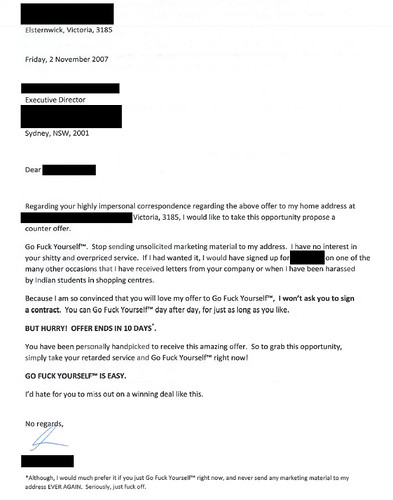
Here’s an angry customer’s letter complaining about being spammed in his home mailbox.
All brand managers take note are your customers thinking this but can’t be arsed to write a funny, snarky letter to your boss?
Click here to see bigger version. Thanks BannerBlog
Filed under: Zeitgeist

“The children now love luxury; they have bad manners,
contempt for authority; they show disrespect for elders and love
chatter in place of exercise. Children are now tyrants, not the
servants of their households. They no longer rise when elders enter
the room. They contradict their parents, chatter before company,
gobble up dainties at the table, cross their legs, and tyrannize their
teachers.”
Sound familiar? It’s a paraphrase of a quote about two and a half thousand years old. Socrates knew that the more thing change……
- Think not those faithful who praise all thy words and actions; but those who kindly reprove thy faults
- True wisdom comes to each of us when we realize how little we understand about life, ourselves, and the world around us.
- We are what we repeatedly do. Excellence, then, is a habit.
- Philosophy begins in wonder.
These are all robust building blocks to create a sustainable CRM strategy, which can be seen as your philosophy for generating great relationships:
-
Value criticism
-
Know that you can’t learn without questioning
-
Excellence is not set and forget
-
Genuinely want to know the people that you communicate with, genuinely believe that your relationship can be better the more you learn
Filed under: Digital Strategy

This morning I read the excellent post Measuring Audience 2.0. I was in the room at the time a lead media agency’s global digital thinker said: “I don’t know a lot about digital. But what I do know, is you can’t measure it”. At the time I Gavin had to hold me back, this being neither the time nor the place for shoutyness. And I rather liked my job at the time.
Now I think I have a better insight as to what that statement referred. Not that you can’t measure digital, just that marketers and media buyers can’t understand what those measurements mean. They speak a different language. When the Lingua Franca of effectiveness is TV, digital is speaking Esparanto. No one is a native speaker. It’s totally artificial. Yes, it’s academically constructed to be efficient. But no marketer uses it in day to day communication.
Here’s a cheat sheet to TV Audience Measurement terms and definitions.
While TV measurement provides “opportunities to see” to a demographic segment, and it’s effectiveness is measured out in the coffee spoons of program popularity and audience share, it does not take into account wastage.
1. Regular simultaneous media consumption for online, newspapers, magazines, radio, TV and direct mail is up from 1% to 35%, depending on the medium.
2. Channel surfing remains the number one regular activity engaged in during TV commercials with 41.2% doing so followed by:
* 33.5% talk with others in the room or by phone
* 30.2% mentally tune out
* 5.5% regularly fully attend to commercials
The amount of opportunities to see, or exposures builds into Effective Frequency. This is calculated to be the number of exposures (1+, 2+, 3+ etc) considered necessary for an advertising message to produce an effect (i.e. for the target market to take the desired action, or for the advertisement to elicit the desired response).
Frequency does not equal attention.
The deliverables of online effectiveness CAN speak that same language as marketers. Online CAN deliver on an Effective Frequency of 1. It’s as simple as that. And you you can prove it. And TV can’t. But it doesn’t mean we can’t be friends.
For me, the Trojan Horse for digital is cross-media planning. That’s taking just one of those exposures into the online environment. Only once you know who has actually responded to your message can you talk effectiveness. Then you can really start devising a customised plan to map audience engagement.
Filed under: Digital Strategy
Delicious!
Kit Kat (Nestle’) France & JWT have come up with an exquisite 3D-effect digital marketing campaign that is tied in to their ‘Ultimate Break/Win a Trip in Space’ campaign.
Createlf has a mobile insight:
The campaign call-to-action is for consumers to access the promotional website or to SMS a code via their mobile handset. What is a little surprising for such a brilliant campaign is that no mobile application (be it a game or other gimmick) or mobile site was built to go with it. This shows that despite the inroads mobile advertising is making in general, big brands are still reticent to capitalise reaching out to consumers through this channel -in my opinion, a missed opportunity.
Oh, and just in case you were wondering, the ‘trip in space’ prize offered is genuine and is apparently worth a cool €147,000…not a bad return on a few crispy chocolate sticks…
Filed under: Get Activist

1943 Guide to Hiring Women:The following is an excerpt from the July 1943 issue of Transportation Magazine. This was written for male supervisors of women in the work force during World War II.
It’s caused quite a bit of chat in the office:
Eleven Tips on Getting More Efficiency Out of Women Employees
There’s no longer any question whether transit companies should hire women for jobs formerly held by men. The draft and manpower shortage has settled that point. The important things now are to select the most efficient women available and how to use them to the best advantage. Here are eleven helpful tips on the subject from western properties:
1. If you can get them, pick young married women. They have these advantages, according to the reports of western companies: they usually have more of a sense of responsibility than do their unmarried sisters; they’re less likely to be flirtatious; as a rule, they need the work or they wouldn’t be doing it — maybe a sick husband or one who’s in the army; they still have the pep and interest to work hard and to deal with the public efficiently.
2. When you have to use older women, try to get ones who have worked outside the home at some time in their lives. Most transportation companies have found that older women who have never contacted the public, have a hard time adapting themselves, are inclined to be cantankerous and fussy. It’s always well to impress upon older women the importance of friendliness and courtesy.
3. While there are exceptions, of course, to this rule, general experience indicates that “husky” girls — those who are just a little on the heavy side — are likely to be more even-tempered and efficient than their underweight sisters.
4. Retain a physician to give each woman you hire a special physical examination — one covering female conditions. This step not only protects the property against the possibilities of lawsuit but also reveals whether the employee-to-be has any female weaknesses which would make her mentally or physically unfit for the job. Transit companies that follow this practice report a surprising number of women turned down for nervous disorders.
5. In breaking in women who haven’t previously done outside work, stress at the outset the importance of time — the fact that a minute or two lost here and there makes serious inroads on schedules. Until this point is gotten across, service is likely to be slowed up.
6. Give the female employe in garage or office a definite day-long schedule of duties so that she’ll keep busy without bothering the management for instructions every few minutes. Numerous properties say that women make excellent workers when they have their jobs cut out for them but that they lack initiative in finding work themselves.
7. Whenever possible, let the inside employe change from one job to another at some time during the day. Women are inclined to be nervous and they’re happier with change.
8. Give every girl an adequate number of rest periods during the day. Companies that are already using large numbers of women stress the fact that you have to make some allowances for feminine psychology. A girl has more confidence and consequently is more efficient if she can keep her hair tidied, apply fresh lipstick and wash her hands several times a day.
9. Be tactful in issuing instructions or in making criticisms. Women are often sensitive; they can’t shrug off harsh words the way that men do. Never ridicule a woman — it breaks her spirit and cuts her efficiency.
10. Be reasonably considerate about using strong language around women. Even though a girl’s husband or father may swear vociferously, she’ll grow to dislike a place of business where she hears too much of this.
11. Get enough size variety in operator uniforms that each girl can have a proper fit. This point can’t be stressed too strongly as a means of keeping women happy, according to western properties.
Filed under: Digital Strategy
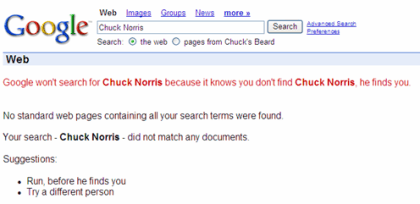
Go to Google
Type in “find Chuck Norris”
Press “I’m feeling lucky”
Very silly.
Filed under: Great Stuff

A five page downloadable ‘wish I could distribute them widely’ utterly underforced design feedback kit.
Gold bits:
-
Good idea wasted by poor execution
-
This is irrelevant
-
Microsoft Word is not a design tool
-
THIS DOES NOT COMMUNICATE
Thanks to Lauren for the find.

Filed under: Digital Strategy

In Australia, we know. We know we’re going to run out of fresh US TV content as a result of the writer’s strike. We have between 3 and six month grace. And then all those expensive spots simply dry up. Disappear.
So what advice are you giving brands as a result? What alternatives are you giving client for when people really can’t find anything interesting/new to watch on the box? When the TV spend doesn’t have a stranglehold on the budget?
People, of course, still want to be entertained. And brands have an amazing opportunity to show they understand people. Brilliant. Opportunity.
My ‘why not?’ recommendations right now:
-
Create family moments for family meals: provide gift with purchase value adds such as DVD’s and board games. Let your packaging point to online to sign up for the latest content offer news.
-
Storytelling and narratives can be interactive and engaging- and non linear and prompt discussion. Check out the recent work for Lost http://www.flyoceanicair.com for the precursor and then go to http://www.find815.com. Think about where soap operas came from in the first place.
-
Use the time to listen. Use this time to learn. Who knows….perhaps once the audience turns away it might just not come back.

