

Recently Wired had Clay Shirky and Daniel Pink sit down for a conversation about motivation and media, social networking, sitcoms, and why the hell people spend their free time editing Wikipedia.
I’m a huge Shirky fan, but of particular interest to me was the Wired contributing editor and the author of Drive: The Surprising Truth About What Motivates Us. I love Pink’s thinking about the power of the three drives that can be utilised in the workplace : Autonomy, Mastery and Purpose, and I’m also pretty sweet on the RSA Animate series that has brought it to life in the presentation above
Here’s a bit of the interview transcript:
Pink: We have a biological drive. We eat when we’re hungry, drink when we’re thirsty, have sex to satisfy our carnal urges. We also have a second drive—we respond to rewards and punishments in our environment. But what we’ve forgotten—and what the science shows—is that we also have a third drive. We do things because they’re interesting, because they’re engaging, because they’re the right things to do, because they contribute to the world. The problem is that, especially in our organizations, we stop at that second drive. We think the only reason people do productive things is to snag a carrot or avoid a stick. But that’s just not true. Our third drive—our intrinsic motivation—can be even more powerful.
Pink: Both of us cite research from University of Rochester psychologist Edward Deci showing that if you give people a contingent reward—as in “if you do this, then you’ll get that”—for something they find interesting, they can become less interested in the task. When Deci took people who enjoyed solving complicated puzzles for fun and began paying them if they did the puzzles, they no longer wanted to play with those puzzles during their free time. And the science is overwhelming that for creative, conceptual tasks, those if-then rewards rarely work and often do harm.
Shirky: You talk about the laws of behavioral physics working differently in practice from what we believe in theory.
Pink: Yes, often these outside motivators can give us less of what we want and more of what we don’t want. Think about that study of Israeli day care centers, which we both write about. When day care centers fined parents for being late to pick up their kids, the result was that more parents ended up coming late. People no longer felt a social obligation to behave well.
I think that the fundamental premise that organisations that link purpose and profit motives are more innovative and have greater long-term financial sustainability is a powerful one. Everybody needs to win when we’re designing what business goals looks like. Customers, employees and shareholders. And not a token ribbon for participation either. Everyone needs to feel like a winner, feel like they’ve backed one and are part of a winning team.
Time for some Seth Godin and his Simple five step plan for just about everyone and everything:
1. Go, make something happen.
2. Do work you’re proud of.
3. Treat people with respect.
4. Make big promises and keep them.
5. Ship it out the door.
When in doubt, see #1
Filed under: Get Friendly

Forgot to say: this should be sung to the tune of Mull of Kintyre, late at night, with the addition of toxic amounts of caffeine, sugar, trans fats and too little sleep. Loudly. Or it becomes the tune in your head for days. Or both.
Red Mullet with Thyme
A dish that I’m thinking
Might kill the desire
For chips and hard drinking
Red Mullet with Thyme
Crap have I munched on and bottles I’ve drunk
Late night fast food don’t feed brains that have shrunk
Pitching’s plate’s full of nutritional crime
As I dream of green beans with Red Mullet with Thyme
Filed under: Experience
Presented at the Retail Financial Lending Summit 14th May 2010
If everyone from supermarkets and search engines to phone companies and airlines offer banking services where does this leave banks?
- And what happens when we use less cash, if by 2018 less than half of all transactions will be paid that way?
- And this virtual currency thing- how does that change what a bank is- and what people might want from a bank?
- Australia’s big banks are failing to make the grade according to consumer ratings released by Mozo.com.au
- Yet innovation is coming from direct banks and credit unions.
- And players who have good retail understanding are encroaching on traditional territory.
Might focusing on your brand experience and your customers change the game?
- Zappos is powered by service
- The power of Repeat Customers & Word of Mouth
- Explicit core values that get translated into brand behaviors
- Recruitment is indoctrination into company culture- everyone gets a $2000 offer to leave. 1% take it.
- It sold for $1 billion
Why can’t complex organizations provide great brand experiences?
- Mike’s Hard Lemonade-Barry Schwartz call to defeat process over practical wisdom
- Best Buy’s Geek Squad turns the ordinary business of technology troubleshooting into a customer adventure
- Zip Car innovating the experience of car rental
What’s going on in the branch?
- That customers want to be served face-to-face. If banks are to move beyond acquisition – to retention and to wallet penetration – then they must reinvent the branch from a glorified transaction centre to a product sales and advisory service center.
- Up to 90% of customer relationships are formed – and lost – in branches.
- Banks will not succeed at maintaining and growing customer relationships unless they provide customers with quality sales and service in branches.
- The conundrum of customer centricity, however, is that most customers don’t see banks as providers of advice-based services. This is not surprising given the extent to which branches have been deskilled over the last decade. The perception map shows that banks deliver only on broad knowledge and bright smiles—not what is needed to deepen client relationships.
The reinvented bank
- There has been a lot of excitement recently around the “Gap-ification” of branches—making them look more like retail stores than like stodgy old branches. But a mere face-lift is not enough.
- The Umpqua Bank retail design strategy translated the culture of a small community bank into an integrated brand experience and helped Umpqua grow from $120M to $8B.
- “It’s all contrary to what you might find in a bank,” says Lani Hayward, executive vice-president for creative strategies at Umpqua. But deposits at the branches Umpqua has converted are up an average of 30% since the changeovers, and the average number of products sold to each household is double that at the traditional branches”
- ING Direct is an online bank, but management realized the bank needed some physical presence to reassure the public the bank was more than a billboard. So execs devised the ING café, which look like Starbucks; people can go have coffee, smoothies, use a free-wireless connection, and learn about ING if they choose. But the eight “branches” have no transactional ability whatsoever; people still must sign up and do transactions online. For example, the ING café in Chicago had “Bike to Work Week Specials” in mid-June. “Every bicyclist that rides to the ING DIRECT Café during Bike to Work Week will be treated to a free bike valet, beverage and tune up. While you’re there, ask a Café Associate about other simple ways to save your money.”
- WaMu rolled out its retail branch design with great fanfare in 2000, and used the new model as they moved into new markets such as Las Vegas and Atlanta. Later they remodeled existing branches to incorporate the new retail features. Before WaMu collapsed last September, they had spent roughly $1 billion on a branch-building binge.
- Some bankers are thinking along these lines, and they repeat a similar mantra: innovative branch design and technology must encourage engagement with employees, not to discourage human interaction. Executives at Barclays, Umpqua, Key Bank and TD Bank, to name a few, view the branch as the channel of choice to build customer relationships. “The biggest thing in banking is the relationship, and you can’t do that online,” says Lani Hayward, evp of creative strategies at Umpqua Bank. “You can make mistake after mistake after mistake, and the customer will stay with you if they believe you’ll take care of them.”
Aligning brand promises into brand behavior
- You can understand where you’re NOT delivering
- In order to work out where you can make improvements
- But you need to inspire your team’s BEHAVIOUR
- And understand that your team is made of different types of people
- Who have different engagement needs
- Warmth and Wisdom
- There are no miracles
Research compiled for this presentation can be found here: http://delicious.com/katiechatfield/banking
Filed under: Experience

It’s Autumn and the golden light seems to have tinted everyone and everything. I still seem to be navel gazing around nostalgia – perhaps the weather is my excuse.
I’m intrigued by a string of sepia-toned, passage of time-y, wasn’t it better and isn’t life fleeting confections being used to hock pretty much any product or service you care to think about. I’m sure you can pull a few to mind but have a look at John Lewis’ Never Knowingly Undersold and Sunbeam.
The Sunbeam TVC had this comment on Youtube:
SugarBeeDee Not another freaking whimsical, faux happy moment ad!
The summery pastely hipster thing has been whored to death and rather than make me feel all shinyfuckinghappy, I want to bash my head on a wall or kick the TV.
The song is so tacky too.
Argh, take it off and make something that doesn’t rot out teeth from our skulls, please!
If you do a shallow dive into the meaning of nostalgia you get this:
The term nostalgia describes a yearning for the past, often in idealized form.
Idealization is dangerous it seems powerful but really what it delivers is propoganda. You can’t own it. You can’t prove it and you can’t deliver it.
I can’t help but think that a lot of this ‘past that never happened’ stuff seems to create an emotional connection, with Mumbrella and others calling the John Lewis ad The Most Powerful of the Year. I wonder how useful this construct is in creating an imperative to take action. Is the argument of this notion not more than : We’ve been there in the past? Is there a strong enough ladder to the plea: You should be with us in the future?
Pretty bland stuff.
In “The Wheel” the writers of Mad Men use that emotional ladder to create a need for a new product and tie it to a universal human need :
Don Draper: Nostalgia – it’s delicate, but potent. Teddy told me that in Greek, “nostalgia” literally means “the pain from an old wound.” It’s a twinge in your heart far more powerful than memory alone. This device isn’t a spaceship, it’s a time machine. It goes backwards, and forwards… it takes us to a place where we ache to go again. It’s not called the wheel, it’s called the carousel. It let’s us travel the way a child travels – around and around, and back home again, to a place where we know are loved.
Bud Caddell’s presentation There’s More Time Than The Present examins how we experience ‘time’ to help craft more effective opportunities for calls to action. I’m liking the tension in between nostalgia and ‘time machine’. And what I’m thinking about is don’t forget to find that pain. It’s where the moment of truth lies. These moments are ‘around and around’, in the past and the future and they bind us together. So instead of using a mirror to reflect something that never happened it might be more useful to become that centre of gravity- a carousel that will give you an experience, show you the future and the past and deliver you home.
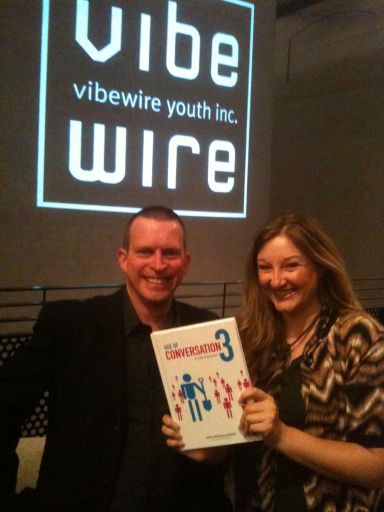
The proofs of the new Age of Conversation 3 have arrived in Australia with Gavin bringing one hot of the presses. He was kind enough share the hardcover version at Fastbreak on Friday.
Jye spoke about Innovation: Changing People’s Stories. He made me cry. It was awesome. (He also took the photo above.)
Just waiting on an announcement of when we all can order…should be soon.
And I believe that there were whispers of a launch party in Sydney….will let you know
I’ll be sharing company in the book with a bunch of smart thinkerers:

