


Filed under: Experience
What could you do with:
- Several cardboard boxes
- Beach balls
- An old bucket
- A 1950s-era Dansette record player that can play vinyl discs at both 78 and 33 rpm?
If you’re Robin Hemmings and Oliver Millingham you use them to bring to life the ”46 or 47” real and imaginary people, in the play One Small Step, who were involved in the space race between the Soviet Union and the United States.
Last year was the 40th anniversary of the moon landing – a defining moment in human history: something which would have engrossed the greatest scientific minds of the past 2500 years, from Aristotle to Copernicus, Galileo to Newton. Yet, just four decades on, the world was more interested in the antics of Paris Hilton and the death of Michael Jackson than recalling that thrilling vision
Steve Meachem, in his review “How to get to the moon – with just a little excess baggage”
Nevertheless, audiences have been moved by One Small Step, which relives the era when rival empires set themselves a seemingly impossible challenge, then raced to meet it via names like Sputnik, Gemini and Apollo.
”The whole show is like one big dare,” Hulse says. ”If it was just about technology it wouldn’t make good theatre. But it isn’t. It’s about human endeavour.”
I saw the show and I loved it. I was lucky enough (or rather I know @IanLyons …) to be able to take the creative team I work with to the show and this was their response:
How frickin‘ awesome are cardboard boxes…
What really came across was ingenuity- the passion and the playfulness of the storytelling. Cardboard boxes became rockets and jet packs and all kinds of gadgetry. Small children clapped and big kids cheered and everyone got swept away with the energy and the notions behind the adventure of having a really big vision and committing to a huge challenge.
The teams that participated in the space race didn’t have anything thing they needed on the shelf to get there. And yet NASA sent astronauts to the Moon using less computing power than you will find in a modern family car – we’re not even talking top of the range models here.
I can’t help but think that with advertising creative we can forget the vast color, depth and variety of the human imagination- and how much more fun (and effective) it can be to inspire an experience in someone’s head rather than giving it to them on a plate.
Maker-uppering works best when the storyteller and the storytell-ee are feeding off each other. When you play together. When its participatory.
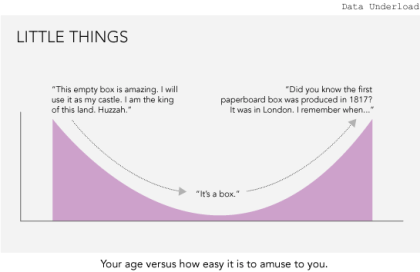
In realising our messaging to the n-th degree we can paint all the details and don’t allow our audiences imaginations to become involved. I can’t help but think that we might pre-digest our creative a little too much to allow a role for our audiences. We all know that kids can like the box better than the present: a toy is what it is while a box can be anything you want it to be. I wonder if instead of briefing “out of the box thinking” we might have more fun and invite more participation with “what could we do with this box” thought starters.
UPDATE: must share this Calvin and Hobbes’s transmogrifier from Simon
.
How to get to the moon – with just a little excess baggage
I am having a look at motion right now.
How people move, in relation to all other things.
In a lot of martial arts there is a notion called “ukemi”
A common take is that ukemi, (which Aikido calls “the art of falling”), is thought of as the passive, difficult, or the less desirable aspect of practice. The “fun” part is throwing people. The boring part is getting thrown.
The action of uke is called “taking ukemi (受け身).” Literally translated as “receiving body”, it is the art of knowing how to respond correctly to an attack and often incorporates skills to allow one to do so safely. These skills can include moves similar to tumbling and are often used as a valid exercise in itself. In aikido and judo training for instance, many classes begin with ukemi training as conditioning.
But there is a different way to approach ukemi that is not only more interesting, but much more effective. It means shifting your mindset from passive to active around the practice:
(At its simplest) Instead of being pulled around and thrown to the ground, you realize a tremendous advantage if you actively following an aggressor’s (nage) lead, moving under your own power and direction. At some point, nage may do something to take your balance beyond recovery. Once you notice that your balance is going, you actively disengage your interaction with nage and lower yourself to the ground! Notice who’s doing what in this description. Uke should always feel in control, even when being thrown.
The meaning I learned describes a practice that brings awareness and facilitates control in relationship to physical things in your environment. Most people who know me would say that my relationship with stairs would belie any knowledge of ukemi- but that’s where the practice bit comes in- you need to be mindful in order to get the benefits.
I’m thinking a way to describe it is perhaps ‘the art of response’. One of key benefits is that it prevents fear in the moment- most people are terrified of being hurt in a physical confrontation and that overwhelms them. Quite a bit of the practice for a female is evasion- not only how to get out of a physical situation but how to get some degree of control over it: how to manage it, to prevent it happening or defuse escalation. It’s an invisible art.
I like the tension between visible art (flashy, shouty, look at me stuff that happens in the moment)- and invisible art (tone, consistency, awareness/thoughtfulness that happens over time). I like that the everyday practice of ukemi changes experience and enjoyment of a moment- it also should positively impact the moment of all those around the practitioner.
I think we all focus quite a bit on form and attack- on the aggressive ‘nage’ expressions of advertising. And of course we need to have these skills, but when we combine these with the invisible arts of ‘uke’ we can create something a bit different. What can be achieved when these two skills are applied in concert is a duet where people can feel the harmony and wander off thinking that they are singing their own tune.
Filed under: Experience
I’m a huge believer that people can process information more quickly and more deeply when it is presented as a visual narrative. 80% of the brain is dedicated to visual processing….
One of the best examples of this is Gapminder -a data visualization tool used to highlight statistics about our world to promote the UN Millenium Development goals.
Contextualizing abstract data in this manner allows for an increased understanding of the World, possibly leading to insights and more informed decisions.
If you can get people to play with the information and see the impact, you can unlock even greater understanding:
Designers Jochen Winker and Stefan Kuzaj work with the visualization of data, and have been developing innovative models for absorbing complex information. Their latest work (you can see above) features methods for making information interactive, requiring users to engage with devices in order to fully unlock the value of the information at hand.
Some great examples:
- If there’s anything good that has come out of the financial crisis it’s the slew of high-quality graphics to help us understand what’s going on. Some visualizations attempt to explain it all while others focus on affected business. Others concentrate on how we have been affected. Some show those who are responsible. After you examine these 27 visualizations and infographics, no doubt you’ll have a pretty good idea about what’s going on.
- GOOD recently asked its readers to create an infographic that shows both the devastation of the recent Haiti earthquake along with aid efforts thus far
- the entire collection of GOOD’s infographics can be found here
- 7 Visualization Groups On Flickr
- Infographics & Data Visualisation (slideshare presentation)
- Jeffrey Veen – Designing our way through data
- We hear all about a rich web of data, but what can we learn from these trends to actually apply to our designs?
Love it live
- Experiential – from Live to LOUD
- Social media is having an explosive effect on experiential campaigns, creating the potential to multiply thousands of brand interactions into millions.
- Japanese landscape design studio EARTHSCAPE, have created a giant travelling human-shaped herb garden. Called Medical Herbman Café Project (MHCP), the garden arrives in shipping containers which convert into a shop and cafe at each location. Proceeds from the shop and cafe are used to build playgrounds in developing countries.
- For Sony Ericsson’s Hopper Invasion campaign a grid of inflatable ‘hoppers’ were constructed that were each connected to air pump devices. Fans of the event were encouraged to use the hashtag #prompt while tweeting what creative things they would like to do if they had hundreds of hoppers; these tweets triggered the inflation of the hopper grid, resulting in a real-space visualization of online activity associated with the event.
The business of show business
- Julia’s Bicycle :an online tool to measure a venue or event’s greenhouse gas emissions
- Check out the reviews of some European expos: PLASA for lighting & visuals, audio and motion control; ABBT for theatre tech; ProLight+ Sound
- The staging at the Brit Awards was mind blowing.
- See the versatility of the staging: Dizzee Rascal & Florence + The Machine and Jay Z & Alicia Keys
- Have a read of the how the 2009 Awards were put together
- See the versatility of the staging: Dizzee Rascal & Florence + The Machine and Jay Z & Alicia Keys
Innovation
- Sportpong is an interactive physical computer game where the field is projected on the ground and two (or more players) compete in teams. With a ‘paddle’ you hit the ball and try to strike a goal or defend your goal.
- Elie Zananiri’s Big Screams project featured an interactive screen displaying cartoon-like characters, each generated by, and linked to participants, who called into a specific number through their mobile. Each character battled the other participants in a game won by whoever screamed the loudest into their phone, the resulting audio pushing other characters off the screen.
- It may become possible to transform a variety of surfaces into a touch sensitive screen. Displax has created an incredibly thin, interactive film that can be applied onto surfaces both curved and flat.
- faderTouch 3.0, is a portable rear projection touchscreen interface. The display can be viewed from front and rear. Audio visual instruments are programmed in Processing triggering sounds in Ableton Live via MIDI.
- Augmented reality (AR)
- A short film about the social and architectural consequences of new media and augmented reality.
- A t-shirt houses an AR game of Paper, Scissors, Stone.
- 35 great examples of where Augmented Reality and their applications to the commercial and art world.
Show Business
· Check out the reviews of some European expos: PLASA for lighting & visuals, audio and motion control; ABBT for theatre tech; ProLight+ Sound
· The staging at the Brit Awards was mind blowing.
o See the versatility of the staging: Dizzee Rascal & Florence + The Machine and Jay Z & Alicia Keys
§ Have a read of the how the 2009 Awards were put together
· Julia’s Bicycle :an online tool to measure a venue or event’s greenhouse gas emissions
· Love the rambunctious jazz cabaret, twisted circus and burlesque performers that create the mayhem at Redbennies in South Yarra
Innovation
· Sportpong is an interactive physical computer game where the field is projected on the ground and two (or more players) compete in teams. With a ‘paddle’ you hit the ball and try to strike a goal or defend your goal.
· Elie Zananiri’s Big Screams project featured an interactive screen displaying cartoon-like characters, each generated by, and linked to participants, who called into a specific number through their mobile. Each character battled the other participants in a game won by whoever screamed the loudest into their phone, the resulting audio pushing other characters off the screen.
· It may become possible to transform a variety of surfaces into a touch sensitive screen. Displax has created an incredibly thin, interactive film that can be applied onto surfaces both curved and flat.
· faderTouch 3.0, is a portable rear projection touchscreen interface. The display can be viewed from front and rear. Audio visual instruments are programmed in Processing triggering sounds in Ableton Live via MIDI.
· Augmented reality (AR)
o A short film about the social and architectural consequences of new media and augmented reality.
o A t-shirt houses an AR game of Paper, Scissors, Stone.
o 35 great examples of where Augmented Reality and their applications to the commercial and art world.
Filed under: Get Activist
The ad is written by Richard Curtis and stars Bill Nighy.
A British coalition of charities and unions has launched a campaign The Robin Hood tax for a tax on speculative banking transactions.
The ‘Robin Hood Tax’ targets financial institutions who were bailed out using public money during the global financial crisis.
The idea is to direct the money to public services, poverty relief and addressing climate change.
For an Australian perspective you can listen to ABC’s Life Matters program which interviewed Max Lawson, Senior Policy Advisor, Oxfam U.K and Professor Neil Warren from the Australian School of Taxation, University of New South Wales. They have a chat about it here.
I’d have to agree: Not complicated. Just brilliant.
Filed under: Experience

Social Media
- Facebook Groups Vs Pages: The Definitive Guide
- Over the past couple years the Facebook Pages and Groups products have moved closer together, forcing marketers to ask themselves: which one should they use? A be useful to highlight the core differences between Facebook Pages and Facebook Groups. If you had any lingering questions, this guide should completely clear things up for you
Online Measurement
- YouTube – Measuring Social Media
- Just the 1st three minutes of this one
- A presentation on the tools of social media monitoring
- A word to the wise- monitoring leads to measurement in social media
- You need to design what you’ll monitor when you design your experience in social media
- This means things like hash tags and naming protocols
- … cues that you can point your monitoring tools to find and report on
- This means things like hash tags and naming protocols
- The Missing Google Analytics Manual |
- There’s a whole bunch of ‘how-to’s’ and ‘what-does-it-means’ here
- And for the really keen
- The Science of Social Media Marketing by Dan Zarella– a fairly analytical approach to socila media and makes sense of something that is often hyped. 55 minutes
Case Studies
- A new take on viral video from Addidas
- Genius 101 website architecture and the outlines of the roles responsible for each section internetonlinewebsite.com/
- Google Wave in Action: Real-World Use Case Studies – Google Wave – Lifehacker
Creative and Strategic thought starters
- idea = p(k+i) where p is the person, k is knowledge, and i refers to new information. “The ability to combine knowledge and information in a new way is important. Just because you have knowledge and information does not mean you are a creative person. But it is also impossible to be a creative person without knowledge and information.” More here: http://knowledge.smu.edu.sg/article.cfm?articleid=1267
- The Future of Planning
- Where will planning go next? Will different agency planners — creative, media, digital, strategy — form a collaboration of like minds, or will planning reside at the client? An Admap roundtable of six planning sages recently gathered to debate their future
The New Economics of Business (Or, the Case For Going Great-to-Good)
Filed under: Zeitgeist

This weekend was a very strange one in Sydney.
It rained. Sheets and sheets. For days.
But that was just the bed that was made for strange. This weekend, it seems, is when Chatroulette (very VERY NSFW) shacked up in the spare rooms of our imaginations.
The New York Times states: “created just three months ago by a 17-year-old Russian named Andrey Ternovskiy, (Chatroulette) drops you into an unnerving world where you are connected through webcams to a random, fathomless succession of strangers from across the globe.”
17! Check out Fast Company’s coverage of the bidding war between the U.S. and Russia over where the company will end up. Some estimates put the site’s worth somewhere between €10 million and €30 million.
The site activates your webcam automatically; when you click “start” you’re suddenly staring at another human on your screen and they’re staring back at you, at which point you can either choose to chat (via text or voice) or just click “next,” instantly calling up someone else. The result is surreal on many levels.
Huh ?
The ever awesome Annik puts it this way:
If you haven’t checked out ChatRoulette, I highly recommend it. This kept me and my housemate entertained for no less than 2 hours during last Saturday’s never-ending downpour and at first I was embarrassed to be talking to complete strangers in my pajamas, but by the end I needed to be prized away from the computer. (and I do heartily suggest you visit her site for some seriously good funny)
During my session, the average “chat” lasted about 5 seconds and I observed several people drinking malt liquor, two girls making out, many many guys who disconnected as soon as they saw I wasn’t female, several girls who disconnected after seeing my face (but not before I caught the looks of disgust on theirs), 3 couples having sex, and 11 erect penises. In a Malkovichian moment, I was even connected to myself once…and then the other me quickly disconnected. In short, Chatroulette is pretty much the best site going on the internet right now.
What the?
New York Magazine’s Sam Anderson braved the fray in his piece The Human Shuffle Is ChatRoulette the Future of the Internet or Its Distant Past?
Although ChatRoulette feels radically new, it’s built entirely out of recycled parts—it’s just a potent combination of programs we’ve all been familiar with for years. Web chat has been around since the beginning of the Internet. Skype made the Star Trek–like experience of instant synchronized video communication an everyday reality back in 2003. But these experiences were almost always curated: The point was to chat and Skype with co-workers and friends, or at least with strangers who shared your interests
I really like this kernel
The internet has always been defined by (and drawn much of its energy from) the tension between chaos and control—and over the last ten years, web culture has skewed heavily toward control. Our most popular new online tools—Google, Facebook, Tumblr, Twitter, Digg—were designed to help us tame the web’s wildness, to tag its outer limits and set up user-friendly taxonomies. ChatRoulette is, in this sense, a blast from the Internet past. It’s the anti-Facebook, pure social-media shuffle.
Once you dive in, there’s no way to manage the experience—to filter users, search for friends, or backtrack and reconnect with someone you chatted with an hour ago. There’s only the perpetual forward motion of “next.” It’s the Wild West: a stupid, profound, thrilling, disgusting, totally lawless boom.
Dip your toe in and catch up on the latest random adventures here: The Best of Chatroulette
UPDATE: and it had to happen…the first pitchslapping I’ve seen:
If you rise above the sea of failing men and charm a woman on Chaatroulette, we’ll give you a token for real life date-winning outfit: A French Connection voucher for 250 pounds
from Manifesto Feb 26 2010
This weekend was a very strange one in Sydney.
It rained. Sheets and sheets. For days.
But that was just the bed that was made for strange. This weekend, it seems, is when Chatroulette (very VERY NSFW) shacked up in the spare rooms of our imaginations.
The site activates your webcam automatically; when you click “start” you’re suddenly staring at another human on your screen and they’re staring back at you, at which point you can either choose to chat (via text or voice) or just click “next,” instantly calling up someone else. The result is surreal on many levels.
Huh ?
The ever awesome Annik puts it this way: http://annikskelton.com/2010/02/08/2612/
If you haven’t checked out ChatRoulette, I highly recommend it. This kept me and my housemate entertained for no less than 2 hours during last Saturday’s never-ending downpour and at first I was embarrassed to be talking to complete strangers in my pajamas, but by the end I needed to be prized away from the computer. (and I do heartily suggest you visit her site for some seriously good funny)
Jason Kottke has this to say http://kottke.org/10/02/chatroulette
During my session, the average “chat” lasted about 5 seconds and I observed several people drinking malt liquor, two girls making out, many many guys who disconnected as soon as they saw I wasn’t female, several girls who disconnected after seeing my face (but not before I caught the looks of disgust on theirs), 3 couples having sex, and 11 erect penises. In a Malkovichian moment, I was even connected to myself once…and then the other me quickly disconnected. In short, Chatroulette is pretty much the best site going on the internet right now.
What the?
New York Magazine’s Sam Anderson braved the fray in his piece The Human Shuffle Is ChatRoulette the Future of the Internet or Its Distant Past? — New York Magazine http://nymag.com/news/media/63663/#ixzz0f12UXjCE
Although ChatRoulette feels radically new, it’s built entirely out of recycled parts—it’s just a potent combination of programs we’ve all been familiar with for years. Web chat has been around since the beginning of the Internet. Skype made the Star Trek–like experience of instant synchronized video communication an everyday reality back in 2003. But these experiences were almost always curated: The point was to chat and Skype with co-workers and friends, or at least with strangers who shared your interests
I really like this kernel
The internet has always been defined by (and drawn much of its energy from) the tension between chaos and control—and over the last ten years, web culture has skewed heavily toward control. Our most popular new online tools—Google, Facebook, Tumblr, Twitter, Digg—were designed to help us tame the web’s wildness, to tag its outer limits and set up user-friendly taxonomies. ChatRoulette is, in this sense, a blast from the Internet past. It’s the anti-Facebook, pure social-media shuffle.
Once you dive in, there’s no way to manage the experience—to filter users, search for friends, or backtrack and reconnect with someone you chatted with an hour ago. There’s only the perpetual forward motion of “next.” It’s the Wild West: a stupid, profound, thrilling, disgusting, totally lawless boom.
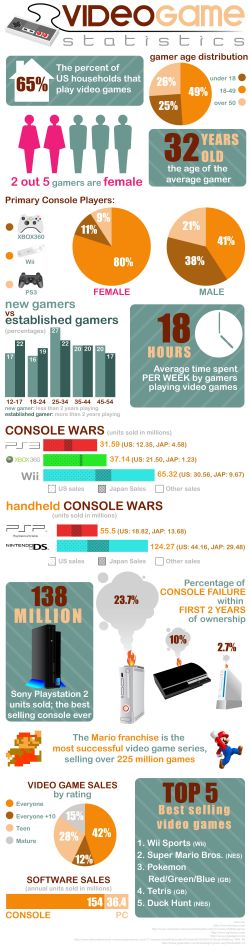
Got to love visualisation.
Also check out the video game time line here.
You can search the timeline by person, technology, business, console, accessory, game or cultural.
The timeline starts at Charles Babbage in 1792 with some key turning points games development, like the establishment of Milton Bradley in the 1860’s and the launch of Nintendo in 1889.
1947 is believed to be the first year when a game was designed for playing on a Cathode Ray Tube (CRT). This very simple game was designed by Thomas T. Goldsmith Jr. and Estle Ray Mann. A patent application was filed on January 25th, 1947 and U.S. Patent #2 455 992 issued on Dec 14th, 1948.
Spacewar! is one of the earliest known digital computer games. Steve “Slug” Russell, Martin “Shag” Graetz and Wayne Witaenem of the fictitious “Hingham Institute” conceived of the game in 1961. It took approximately 200 hours of work to create the initial version.
Anyways- there’s loads of history geekiness – and some really useful launch dates and synopsis of most of the major games up to 2010.
Filed under: Great Stuff

Some bits and pieces for inspiration and information- from the sublime to the ridiculous
- Google Search Stories:
- These super short videos show how people are using search technology to achieve their goals
- Your investment: maybe a couple of minutes
- 1500 examples of social media marketing from various corporations – a wiki of social media marketing examples.
- It’s searchable by company, type of social media, industry and country
- Your investment: maybe a couple of minutes today- useful forever
- How IBM Uses Social Media to Spur Employee Innovation
- How do you pull off “authentic” while maintaining the company brand message?
- Your investment: maybe a couple of minutes
And for the super keen
- Deloitte’s Centre for the Edge: Measuring the force of long term change- the 2009 Shift index
-
- For those who haven’t seen the Shift Happens video:
- What’s going on with the media- what’s going to happen with technology
- Your investment: this is a 142 page dense read…but I really love the concepts of Foundation Flow and Impact.
-
- 2010 Trust Barometer
- Neilsen: The Global Online Media Landscape
- April 2009 – 20 pages
And for the silly
- Everything you ever needed to know about social media: simply explore this site for everything you ever needed to know about the client agency realtionship.
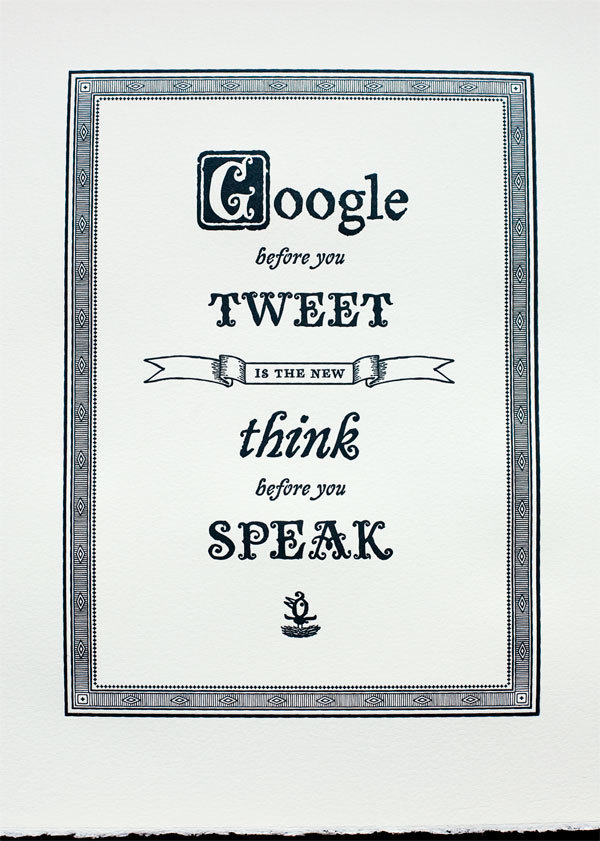
I’ve seen this all over the place- and I do love to track down the artist:
Letterpress print designed by Joe Newton.
Typeface: Olduvai by Randy Jones.
Paper: Somerset Velvet 300 gsm, soft white.
Size: 8.5″ x 11″ (approx A4).
Printer: Woodside Press, Brooklyn, NY.Signed and numbered limited edition of 100.
You can buy it for $15 at I Love Typography here.
We just forget how much we mean to people.
We forget how vulnerable and precious we are.
And yet I love how much this notion moves us and how powerfully we can express this without a word.
Take care out there everyone.
Filed under: Experience

Innovation is undoubtedly the ‘secret sauce’ of business success. The good news is, the ability to innovate is a learnable skill — at least according to three researchers from INSEAD, Brigham Young and Harvard in their new study conducted over a six-year period.
‘Our research showed that at most companies, top executives do not feel personally responsible for coming up with strategic innovations,’ said Hal Gregersen of INSEAD. ‘True innovators rely on their courage to innovate and a willingness to take risks.’
Most innovative leaders possess five key “discovery skills” that distinguish them from their less creative colleagues:
- Associating – The ability to successfully connect seemingly unrelated questions, problems, or ideas from different fields, is central to the innovator’s DNA. The world’s most innovative companies prosper by capitalising on the divergent associations of their founders, executives, and employees.
- Questioning – Innovators constantly ask honest questions that challenge common wisdom or ‘question the unquestionable.’ While most managers focus on how to make existing processes – the status quo – work better, innovative entrepreneurs are more likely to challenge assumptions.
- Observing – Discovery-driven executives produce uncommon business ideas by scrutinizing common phenomena, especially the behaviour of potential customers.
- Experimenting – Using the world as their laboratory, innovative entrepreneurs actively try out new ideas by creating prototypes and launching pilots. Most engage in some form of active experimentation, whether it is intellectual exploitation, physical tinkering, or engagement in new surroundings.
- Networking – Innovative entrepreneurs devote time and energy to finding and testing ideas through a network of diverse individuals in order to develop radically different perspectives. Unlike most executives who network to access resources, innovators go out of their way to meet people with different kinds of ideas and perspectives to extend their own knowledge domains.
The five skills, Gregersen says, are ‘a habit, a practice, a way of life’ for innovators.
Although Gregersen and his co-authors use the DNA metaphor, innovative entrepreneurs are actually made or developed, rather than born. “We each have unique, fixed physical DNA,” says Gregersen, “but in terms of creativity, we each have a unique set of learnable skills that we rely on in order to get to the ideas that will give us some insight.” Research involving identical twins suggests that only about 20-25 per cent of our creativity ability is geneticically driven. “This means the other 75-80 per cent comes from the world we live in,”
Quotes and data compiled from here, here and here. The study appears in the December 2009 issue of Harvard Business Review and can be accessed online at http://www.hbr.org.
Filed under: Great Stuff
Red Riding Hood Remix is a primer for breaking out of a default story and finding ‘tools for telling taller tales.’
Jason Theodor explores the creative methods for innovating a ‘story’ (or project) by approaching it in different ways and from different perspectives using his Creative Method and Systems in the presentation below:
Filed under: Experience

New York photographer Spencer Tunick is looking for thousands of Australians to disrobe in the name of art on the steps of the Sydney Opera House.
The photographer, who has produced almost 100 installations around the world, wants to create an installation involving nude volunteers on the steps of the Sydney Opera House on Monday, March 1.
Tunick is hoping at least 2,000 people will get involved in the photograph to be called The Base.
“In a way, I’m making a base for the structure, a base for the architecture – and by combining straight and gay and lesbian people I’m weaving the different sexes and society together to form this wonderful fabric that holds up this gorgeous building,” he said.
Stolen from TIGS tumblr
I just fell in love with this video…and then I dug a little further.
It’s a call to action to apply for the Rethink Scholarship here :
The Communication and Ideation Design (CID) program is a modern educational approach to the Graphic Design, Art Direction, Advertising and creative industries. It provides a design education where each class builds upon the previous one to expand the creative process. Particular attention focusses on ideation, which is the process of initiating, developing, and refining ideas. Ideation is an integral part of the design process.
Classes are structured around a wider approach for today’s modern designer. The curriculum incorporates communication for design and human interaction, with regards to digital (web pages) and physical realms (graphic and information design print, publication, wayfinding, exhibition and experiential design).
Noice. Wayfinding. Someone’s thinking about the future of our industry then….
I’m a bit fond of the entry mechanism:
We’ll be judging the winner based on one thing: a sketchbook.
Remember not to worry about filling out the whole book, because a few brilliant ideas are always better than a huge pile of mediocre work.
Your job is to put your most interesting ideas into that sketchbook to demonstrate what you can do. Your book should also tell us something about who you are.
Love this insight on how they’ll pick the winner:
Plain and simple, we want a book that amazes us. Here’s a few criteria we’ll be judging the books on:
– Clarity. Both in your idea(s) and your execution.
– Relevance. Keep in mind the program you’re applying to.
– How fresh the thinking is.
– Quality not quantity. Don’t show us every idea you’ve ever had please.
– The craft and execution of your work.
Can’t help but think that’s how work ‘wins’ in my world too.
Check out the site: http://www.rethinkscholarship.com. The video showcase of last year’s entries are worth a look.
Filed under: Great Stuff
One of the best things about having little people about is quite surprising.
It’s not what you get to pass on.
It’s what you get to learn.


