


Filed under: Digital Strategy

One of the fundamentals of connections planning is that all audiences are not the same. For maximum effectiveness messages and experiences should be tailored to cater to the needs and expectations of different types of people.
The Roundtable
I’ve been asked to contribute to a Marketing Magazine roundtable discussion. The question is: “Should there be one standard measure for online audiences?”
But if all audiences are unique and granular can any interaction measurement be standardised? And would this build any actionable business intelligence for a brand?
The Knights
I have my own roundtable: Facebook, Twitter and this blog. And in the spirit of ‘it’s not what you know it’s who you know to ask’ I sent out an invitation to participate and a few of my favourite knights got back to me straight away:
Mike (via Facebook): Do you mean quantitative or qualitative? Surely you can’t have a standard with out knowing who you are measuring first? Also, not all traffic is created equal…..
http://publishing2.com/2007/01/25/not-all-traffic-is-created-equal/Todd: Sure. There should also be a Unified Theory of Everything but they haven’t cracked it yet either. Web is complex, can’t over simplify it.
katiechatfield @Todd: better questions might be :What is important to measure? What does success look like? What’s your answer then?
Todd: Depends what the problem is. Do you ask a doctor to give you a single answer re your wellbeing? Success can mean many things depending on your market position
servantofchaos @katiechatfield you may want to achieve different things with different niches
Sara The Bargain Queen (via Facebook) :Absolutely not! 100,000 one-time readers is worth far less than 10,000 devoted regulars…
Ian (via Facebook): Online tends to mean interactive so it’s magnitudes more difficult to measure than views/impressions/clicks. We’d have to create a set of engagement metrics – perhaps weighted to the context of the interaction & value of the individual participatingbh_Todd It’s in the interests of media / content owners to do so, but it might not mean too much for marketers.
The Holy Grail
And that’s the sticking point of the question really- what is the value offering of online publishers? As Doug Anderson from Neilsen so neatly puts it:
In order for the marketplace between advertisers and sellers of media to function, both sides must agree on the key metrics that are used to measure and value audiences
So my answer is that we don’t need one standard measure, we need a matrix of measures that maps needs, goals and audiences to outcomes.
Filed under: Digital Strategy

What does digital strategy offer?
- an opportunity to understand the people who buy and might like to buy your product better
- a business process that will increase the effectiveness of your marketing spend
- a architectural plan of the places and experiences required to unpack the offer of a brand and connect it to people that increases value
Why do you need it?
- because you need to know the right questions to get the right answers
- because simply knowing the highest traffic-ed sites of your target audience might not solve any of the brand’s business problems
- because designing response and prompting interaction is more than media placement pointing to destination websites.
My unfavorite ‘briefs’
- What can I get for $50K? Quickly.
- What sites match our magazine strategy?
- Increase site visitation 650% and triple our subscribers. Tell us how much money we can make from serving ads to our database afterwards.
Great digital experiences that build brands and grow audiences are all about connections planning
- What are we trying to achieve?
- What’s the core idea that makes the brand and people lean into each other?
- How can we create romance, a series of interactions, to achieve the first two ideas?
This is not technology dependant: it’s idea dependant, it’s insight dependant.
It’s just good business.
Filed under: Digital Strategy

I’m writing my piece for Interesting South which examines a bit of personal insight around the barriers to really becoming fluent in a language.
Common barriers to fluency are:
– self-consciousness
– anxiety and self-censorship
– fear of making a mistake rather than getting the message across
I can’t help but thinking that these are also barriers for brands in the digital environment- that there isn’t fluency in this ‘new’ language and so people just aren’t speaking it.
The only real way to address this lack of fluency, to speak that language of your target people, is to have the discipline to give their language a go and the fortitude and resilience required to make mistakes.
You might feel exposed at first, but it’s the only way you will be able to join in the conversation later.
Filed under: Digital Strategy
Vodpod videos no longer available.
Tired of losing your audience due to toilet breaks? The I Need To Go Campaign poses this question for ING- you can pick up this widget. The promise:
Paste this code into a blog post, your readers will be delighted at this convenience. Works on most blogs as well as MySpace and Facebook!
Okaaaay.
The announcement and resulting activity (which I’ve been following here) of Google’s Open Social platform last week (and the ‘don’t track me’ movement) has got me thinking about online privacy. About how much you want people to know about your life, how much you want to know about friends and colleagues lives. Do I really want to know when anyone goes to the bathroom? Do I really want anyone else to know when I do?
What happens when we can aggregate and understand behaviour (as well as serve information) through an App?
As my friend Tim would say: What would happen to social networking if you could write a widget that would tell you how often your girlfriend visited any of her ex’s profiles?
Differentiating layers of intimacy describes degrees of trust and discretion around information. The closer you are the more access you have. Permission to access also gives permission to know and also conveys the ability to share.
As we take down the walled gardens we’re going to need some privacy screens!
UPDATE: Nice piece of work from Colin
Paul McEnany, Gavin Heaton and Sean Howard are back with another episode. This time they invited me to talk about the Mountain Dew brand campaign in New Zealand.
Here are the highlights from Gavin:
- Sean leads us out and straight into trouble — man-style trouble. Well, you will see what I mean. (0:00)
- The Grim Reaper’s ugly assistant drops by (2:55) to introduce our special guest star, Katie Chatfield (3:45), talking about some of the great recent work for Mountain Dew
- the Mountain Dew Ambassador Programme and Sponsorships are developed and managed by Brand Spanking
- the brilliant web work done by Marker Studio
- the behind the scenes interview shown and TVC shot by Three Drunk Monkeys
- the MDTV episodes can be seen here
- Paul unpacks his thinking around extreme sports, brand association and niche marketing without swearing once. True (7:02)! But then, he was the one who brought up paedophiles in the first place.
- Sean gets the chance to imagine himself in Captain Kirk’s tight fitting velour sweater and showcase the great William Shattner’s efforts at hawking Commodore 64s way back when home computers were a revolution (8:43).
Filed under: Digital Strategy

Social networking is not a platform, it’s not a destination, it’s a behaviour.
As people explore the benefits of increased connectivity, opportunities to enhance their social lives and find new interests the platform that they choose to do this on becomes more and more irrelevant.
The question is not- how do I put my brand on MySpace? or How do I put my brand on Facebook?
The question is, as Bruce Mau might say, how do I “create utility and delight in interesting sustainable ways”.
Filed under: Digital Strategy

I was lucky enough to spend some time last week in New Zealand with a client team that included the very bright sparks from Marker Studio, Tim Laing and Jon Beattie.
Jon and I think very much alike about blogs as witnessed conversations. He was telling me a story about a financial services client that was really having trouble with the notion of employing blogs to tell the stories that would inspire uptake of a new product, which would also provide feedback about people’s perceptions of the product: the FAQ’s, the resists, the barriers to understanding and so on…
The client’s policy on the written word currently requires that everything that is to be published gets sign off, not merely from the Marketing Director, but from the Trustees!
If you look at a blog like a witnessed conversation you can start to readdress this kind of thinking. For example, you wouldn’t involve the Trustees in every conversation that was happening in the call centre. When you empower someone in your retail environment (or call centre) to tell the story of the brand and describe the product you are taking more of a risk than in the ‘think and release’ environment of a blog. In fact, a brand has a great deal more control of the conversations that take place on a blog, as the author should be the recognised expert in bringing the product to life.
I’m a huge fan that company blogs are not only an opportunity to talk and learn from the brand’s audience. I think that by creating a narrative structure around the day to day best practices of a brand, written by the leading expert, that they are also a great platform for knowledge management for employees to witness and contribute.

In the spirit of Faris, I’ve almost entirely nicked this post.
Waaaaay back in July I shared my infatuation with the lovely Lynette. She’s been sharing her Interesting Snippets via Flickr for a year or so now – they are basically ready made slides to steal looking at the impact of digital. If that wasn’t enough crush points she has possibly the coolest job in the business – Director of Futures for Google UK.
At the time I mentioned that she was compiling the first year into a book via Lulu, and it’s available now.
Proceeds are being donated to the Battery Hen Welfare Trust.
Filed under: Digital Strategy
Michael Wesch and the KSU digital ethnography crew also posted this video on the same day as “A Vision of Students Today.”
According to the Information R/evolution post description: This video explores the changes in the way we find, store, create, critique, and share information. It was created as a conversation starter, and works especially well when brainstorming with people about the near future and the skills needed in order to harness, evaluate, and create information effectively.
As for a summery of the ‘Students Today’ post: 200 Students made 367 edits to the document, and surveyed themselves, to bring you the following message:
-
My average class size is 115. 18% of my teachers know my name. I complete 49% of the readings assigned to me.
-
I buy hundred dollar textbooks that I never open.
-
I will read 8 books this year, 2300 web pages, and 1281 facebook profiles. I will write 42 pages for class this semester, and over 500 pages of email
-
I get 7 hours of sleep each night, 1 ½ hours watching TV each night, 3 ½ hours a day online, I listen to music 2.5 hours a day, I spend 2 hours on my cellphone, 3 hours in class, 2 hours eating. I work 3 hours every day, 3 hours studying. That’s a total of 26.5 hours.
-
I’m a multitasker. I have to be.
-
I will be over $20,000 in debt after graduation. I’m one of the lucky ones.
-
Over 1 billion people make less than one dollar a day. This laptop costs more than some people in the world make in a year.
-
When I graduate I will probably have a job that doesn’t exist today.
Filed under: Digital Strategy

Why the focus on trash mags and reality TV? What’s the payoff?
Gossip is the twenty first forum for telling stories. Celebrities become protagonist archetypes that navigate modern morality tales.
Gossip unpacks understanding of people and their motivations.
Celebrity and reality drama gossip allows a neutral platform to display these understandings- each member of a gossip group can increase social currency and achieve social consensus ‘safely’ through the discussion of people they’ve never met.
Filed under: Digital Strategy

Harold Sogard, Vice President of Goodby Silverstein and Partners presenting “Traditional and Digital- Unbundled” at the iMedia conference. His focus is not how they took a ‘nice piece of Australian business’ (his words), but how the company best known for amazing TV and print work turned around perceptions and won serious kudos and recognition as a digitally lead agency in just over a year.
How did they make so dramatic a change? Well watch here.
As a summary:
- “No digital?- Go away”
- In 2005 18% of work was digital compared to 83% traditional
- By May of 2007 it was 50/50
- the focus on digital increases the agency’s ‘hit rate’
- in 2005 the success rate for pitches was 37% and 51% in 2006
- in 2007 55% of their work is digital and they have won $2 billion dollars of new business as a result of the changes made
- well worth a 55 minute investment!
Filed under: Digital Strategy

On October 4, 2007 we are combining action with words …you can join by writing a single blog post with the title “Free Burma”. (For those who have not seen the coverage, take a look at the latest update from Amnesty International.)
Filed under: Digital Strategy
I love a conspiracy theory. And Mark Twain.
A lie can travel half way around the world while the truth is putting on its shoes
Don’t get me started on Atlas tags + Microsoft.
All generalizations are false, including this one.
When a web developer in my home town said he would call his baby Spider Pig if 100,000 people joined his Facebook page, and he gets over 120,000 and no journalist checked the story- do we really need to be worried about the millions of pieces of data that we generate with our digital footprints?
It’s no wonder that truth is stranger than fiction. Fiction has to make sense.
As Arthur Wesley might say: “publish and be damned”.
All right, then, I’ll go to hell.
Let us make a special effort to stop communicating with each other, so we can have some conversation.
Filed under: Digital Strategy

With the election coming up there are a number of campaigns running to agitate some agenda setting on tackling climate change. And there are a number of advertisers me-too astroturfing.
The independent Climate Institute launched a $2.5 million campaign, tackling climate change through the eyes of an intuitive nine-year old. It will be the biggest advertising campaign ever by an Australian climate or environment non-government organisation.
By comparison Pilot Pens have launched a new range of pens made from recycled materials. Rock on. They’ve launched a campaign called Make a Scene. On the front page of Yahoo7. Cheap (not) :
Putting our money where our mouth is
For every 100* people who register their email address below, Pilot will purchase a Carbon Credit to offset 1 tonne of carbon emissions**. So tell your work colleagues and friends about Begreen and encourage them to join us in making a positive scene for our planet.* Limited to first 5,000 email addresses received.
** The carbon credits will be purchased from an organisation registered under the NSW Greenhouse Gas Abatement Scheme
2.5 seconds of research shows that the cost of a tonne of carbon emissions is currently trading at $6. So Pilot are willing to invest $300 in the environment to get a database of 5,000 email addresses. Wow. Applaud the sentiment but donating 6c for an email address doesn’t seem to me to be a message worth waving a flag about…
Perhaps if the pens were used to write up a storm….or if Pilot linked through or supported the initiatives already on the table, or just wasn’t so naff with their over claim I wouldn’t think they deserved a raspberry.
Does anyone have examples of brands really getting it right in this space?
Filed under: Digital Strategy
Don’t you love it when your beta testers take your brand outside of it’s safe and self referential environment and show your stuff to the world?
Thanks to Sean and Gavin for spreading the word about the new bellamyhayden blog.
The rationale behind a blog for the agency was inspired by Peter Williams, who heads up Deloitte and is one of Australia’s thought leaders in online, mobile and emerging technology. I saw him speak last year and apart from being a shining light and beacon for intelligent enthusiasm, calculated risk taking and just going berserk at your job he gave me a fabulous outtake (and I paraphrase)
- the more IP you have outside of your firewall the stronger your brand will become
He spoke again today at the iMedia conference and basically set the room on fire- it was as if he was a Pied Piper for innovation and if he had said ‘follow me’ one hundred people would have quit their job on the spot. Anyways….
I work in an industry where most people play their cards very close to their chest- and not only between agencies, it’s quite common internally in agencies too.
When I started working at bh I noticed that the team here write brilliant, interesting strategy for their clients on a daily basis and as the digital director I might have been the only person to see the entire range of work across the agency.
This strategy takes the form of stories and is translated into charts that bring to life insight in a compelling and visual way.
I wanted the team to recognise that what they do is unique- and the design of our website is to recognize and celebrate what we do, and allow us to share our work and our thoughts about our work with each other.
The design rationale behind the site is ‘digital footprints’:
- allow users (the team and our clients) to follow some of our thought pathways (either in a blog post or a case study)
- and see some of the journeys that we have taken in order to get to that pathway (our deli.cio.us or our pageflakes reference section).
So, fundamentally it’s about Knowledge Management- sharing the success and thoughts of the team. This is my brief to them:
I’m sure that once a month (at least) you will
- have created a chart that you’re proud of and want to share with the team
- have found a piece of research that you have an opinion on that is relevant to all of us
- have had a client success that you’d love to share
- remember that a post can be as simple as saving a chart as a .jpeg and posting it to the blog with a title and perhaps a bit of a voice over.
It will be a challenge to get the team’s uptake but I’m sure they are all more than up for it and I look forward to the conversations that they’ll inspire.
Filed under: Digital Strategy
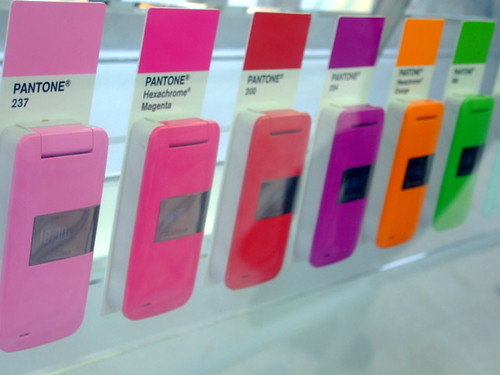
I’ve been recently asked by a client if mobile will ever be considered a serious channel by marketers…
Right this minute the mobile phone is bigger in its reach than the car, TV or internet.
Already in China, Japan and South Korea the majority of internet access is via mobile phone. In total over 750 million people access internet content via a mobile phone today
The Communities Dominate Brands post Putting 2.7 billion into context puts forward some great stats: There are 800 million cars, 850 million personal computers, 1.3 B fixed landline phones, 1.4 billion credit cards, 1.5 billion TV sets and at the beginning of 2007, 2.7 billion mobile phones. That’s three times as many mobile phones as automobiles or personal computers. About twice as many mobile phone owners as those of fixed landline phones or credit cards. And almost twice as many mobile phones are in use as TV sets.
Australians love their mobile phones and there are more than 16.5 million mobile services in use in Australia, according to the Australian Communications Authority (ACA). We spend, on average, an hour on the mobile phone every day and 35 minutes of that is spent texting
It is inevitable that the mobile phone will become an important part of the communication mix. While the Australian telco’s walled gardens and premium content focus have restricted advertising innovation, the times are changing.
It’s important to keep reminding marketers that they are in the message delivery business. The ability for marketers to deliver timely and targeted messages to specific audiences is one reason that media planners still knock on the telco’s doors. This, in addition to the mobile phone’s ability to provide a procrastination destination and information a service for the 3.5 million people browsing the mobile internet in this country, means that there is a large and growing opportunity for brands to connect with their consumers by using this channel.
Filed under: Digital Strategy

I know I’m biased but I’ve already been able to steal borrow a lot of people’s homework today. Find out what you might be able to pass off as your own reference here. I liked these:
- Matt Dickman’s interview with Scott Beck the Marketing Director for Harley-Davidson Motorcycles- great to show some clients that not only can their brand use the web for emotional engagement, but widgets can engage people other than ‘the chess club’
- Tell Ten Friend’s An Entry Level Guide to Video Blogging
- And this lovely piece on serious games
Hurray for the gift economy that is the Age of Conversation.
Filed under: Digital Strategy

I was at the Effectiveness Awards last week with the brilliant Todd. I think it was the second time he got up on stage one of the agency types who were sitting next to me said, ‘who did the TVC on that account?’
-No one.
– ” “
Chatting about it afterwards, Todd said: “30 seconds doesn’t give you a lot of room for seduction” and it’s been making me think ever since, and not just ’cause he really knows what he’s talking about. Todd is also behind one of Australia’s best known TVC campaigns. The ad plays only on one day of the year. Once. It’s over 3 minutes long. And its remembered by 51% of the target group. This is despite it only reaching 33% of them. So there’s a bit of other stuff going on then…..maybe…
How much of our thinking is proscribed by the ad units of channels- not just TV but all channels? We can buy Reach and Frequency and we can build Context and Creativity, but how effective can we really be if all ad messages are interruptions?
During the geek love in between Faris and Iain the guys wrap their heads around that ‘5 years into the future’ thought, with a great ‘what if’ (which I’m completely paraphrasing):
– What if all consumers only ever subjected themselves to content entirely of their own choosing?
I’m not all that sure that this reality is five years away.
It is possible to create advertising that people look for, that they look forward to, that they talk about, and helps them to buy stuff…. and you don’t have have to rent space on somebody else’s platform to achieve it.
What if…..instead of buying engagement vehicles to deliver an audience to your brand message…you threw away convention and created your some of your own engagement instead.
Keep in your mind that advertiser don’t integrate messages- consumers do.
I’m a huge fan of musical structure as an analogy to allow understanding of layered brand communication. I get told again and again that consumers cannot understand more than one message at a time.
Think of musical round– a simple one like “Row, row, row your boat”. It has four parts. Each voice starts at a different time. 5 year old children can manage it.
So why have a brand song with only one note?
Why not allow you consumers to build their own tune and join in with you as they uncover your song in what ever way works best for them.
Filed under: Digital Strategy

Felix Jung has used Flickr’s API search functionality to add dimensions the lyrics of Dan Frick’s lovely song “Astronaut” The content will never be the same-every time you watch it as each time the Flash file is loaded, new images are randomly pulled from Flickr use keywords in the song as trigger points.
Ultimately, I think that’s the way this project should be: new and surprising with each refresh. I like that it changes with each interaction; I like that it changes over time. In many ways, it’s also what I like about people: there is a lot of repetition, and there’s a whole lot of variation.
I watched it a couple of times- it’s intriguing how you try to create narratives to sequences of images even when you know that they’re random. The effect can be humorous but mostly it’s an unvarnished gentle celebration of the gift economy of Flickr and the beautiful work of both Felix and Dan.
Ahhh Virgin Mobile….what might have been eh?
More about the project here. Thanks to Lovely Laura and Infosthetics for the find.
Filed under: Digital Strategy
Charles over at Punk Planning had some interesting observations on some of the statements I made in the post Compelling Challenges.
I was talking about an audience of super smart kids undergoing tertiary education, and their finely honed ‘bullshit detectors’ and he asked how that insight was constructed:
scepticism and perspicacity are different. What made me curious was that subjectivity makes it hard for us as adults to accept that we may not have detected bullshit. So how would we secure that information from kids?
In my experience ‘kids’ don’t have the same subjectivity barriers when they formulate responses as ‘adults’ might. They’re not overly worried about being objective when asked for their opinion, they celebrate their bias, they believe that you’re asking for ‘their opinion’ not ‘the right answer’.
I’m loving the space between scepticism and perspicacity (and I had to look it up). I’ve been really challenged by the question: what exactly is it that activates BS spidey senses?
Going through my notes to find the source of the tingle , coming up time and time again is a notion of intent. It seems that when there is no value foundation for a brand statement, no proof of claim and no experience other than an organisation simply making money, any brand notion other than ‘buy me’ is seen as BS.
There is a series of fantastic posts about brand values over at Charles’ place:
All too frequently many ‘wannabe’ brands share only one common tangible value and that is shareholder return, or chasing money in plain language if you wish. There’s nothing wrong with making money and indeed wealth creation has many positive effects, but if that’s the raison d’etre for an organisation, it practically sweats from the pores of their executives and makes a squelching sound from the carpets of the boardrooms as we make our way about the C-Suite.
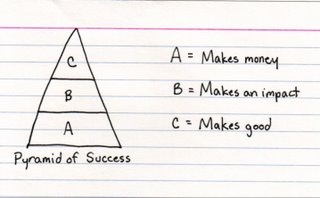
I think what we’re both talking about is the pointy end of Jessica Hagy’s Pyramid of Success: you can make money and you can make an impact, but if you really want differentiation, cut through and brand value then, as a brand, it might be a great idea to start defining what you stand for and set about creating some good too.

