



All information on Blogger Social ‘08, including registration is available here.And if you wan to know who is coming along … the list includes: Susan Bird Tim Brunelle Katie Chatfield Terry Dagrosa Matt Dickman Luc Debaisieux Gianandrea Facchini Mark Goren Gavin Heaton Sean Howard CK Valeria Maltoni Drew McLellan Doug Meacham Marilyn Pratt Steve Roesler Greg Verdino CB Whittemore Steve Woodruff Paul McEnany Ann Handley David Reich Tangerine Toad Kristin Gorski Mack Collier David Armano Ryan Barrett Lori Magno Tim McHale Gene DeWitt Mario Vellandi Arun Rajagopal Darryl Ohrt Joseph Jaffe Rohit Bhargava Anna Farmery Marianne Richmond Thomas Clifford Lewis Green Geoff Livingston Kris Hoet Connie Reece CeCe Lee Jonathan Trenn Toby Bloomberg Seni Thomas
Senno Ekto Gamat
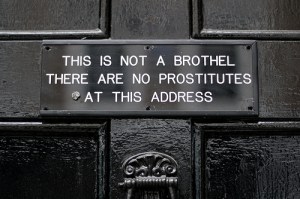

To paraphrase: “this space is not for sale”
While researching for this post I found that this experience, this revulsion at shilling, is more common than I thought and equally as distressing:
Tom Coates over at plasticbag.org was compelled to share this image and story as a result of experiences when:
press people consider me an outlet to push their marketing messages. It upsets me that people in the world can look at me and only see ways that they can scavenge some limited advantage through which to push their agendas. They see my personal expression, my unadulterated opinion and they think they can use it as a host for their parasitic bullshit.
I couldn’t agree more with these heartfelt manifestos.
My experiences with kind of behavior have left behind a slightly different flavour. I’m not a died in the wool opponent to people making money out of their content and am a staunch believer in the capitalist imperative…
But it needs to be the decision of the content creator:
never NEVER without my permission
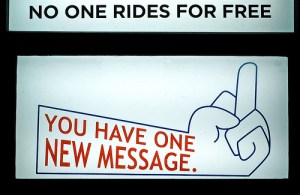
we kill bad ideas with new business models
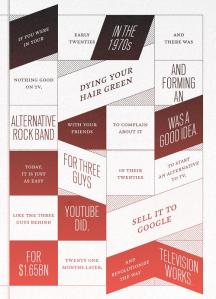
Over six weeks writers including Booker-shortlisted Mohsin Hamid, popular teen fiction author Kevin Brooks, prize-winning Naomi Alderman and bestselling thriller author Nicci French will be pushing the envelope and creating tales that take full advantage of the immediacy, connectivity and interactivity that is now possible. We Tell Stories begins with Charles Cumming’s Google Maps adventure. ‘He was the wrong man, in the wrong place, at the wrong time’. Now you can follow his adventures across the nation and across the world, step by step.
But somewhere on the internet is a seventh story, a mysterious tale involving a vaguely familiar girl called Alice. Readers who follow this story will discover clues that will shape Alice’s journey and help her on her way. These clues will appear online and in the real world and will drive readers to the other six stories where they will have the chance to win prizes, including The Penguin Complete Classics Library.
The gaming community has been awaiting the first project from SixtoStart and the next digital publishing initiative from Penguin whose last project, the wikinovel (http://amillionpenguins.com) generated 85,000 unique visitors in five weeks, arriving at a rate of 10 per second at one point.
We Think and We Share
April 11, 2008, 9:30 pm
Filed under: Digital Strategy
Filed under: Digital Strategy
New York must be a small town- I keep running into Mike Arauz, which reminded me that I needed to share this piece promoting a new book by Charles Leadbeater, ‘We Think’ which says it explores the potential of the latest developments of the internet.
For me one of the most interesting questions posed is: How do we earn a living when everyone is freely sharing their ideas? In the was you were what you owned. Now you are what you share.
One of my favourite quotes about our current gift economy is: ‘the more information your organization has outside of it’s firewall the stronger you become”
Information is particularly suited to gift economics, as information can be copied and transmitted at practically no cost. It can be treated as a nonrival good: when you share information, you do not deprive yourself of the information (although you may deprive yourself of certain revenues that could be gained in the market economy from the intellectual property rights).
Traditional scientific research is an information gift economy. Scientists produce research papers and give them away through journals and conferences. Other scientists freely refer to such papers. The more citations a scientist has, the more prestige and respect he or she has, which can attract funding and positions. All scientists therefore benefit from the increased pool of knowledge.
Gift cultures are adaptations not to scarcity but to abundance. In gift cultures, social status is determined not by what you control but by what you give away.
You see when everyone is giving away their ideas- how can your client tell tell when your idea is a good one? What can communicate that you might have the right idea, the right approach- that’s where authority and reputation comes in. It proves that you have been able to have ideas worth sharing and prompted valuable conversations. So it’s economically worthwhile to build this reputation.
The ideas you share can only be a contemporary reflection (often campaigns are planned more than six months in advance)- and so relatively useless in the rapidly changing environment in which we are trying to create brand experiences. And I’d like to think that the experiences that we make for brands, because they are designed to differentiate, are not replicable by anyone else anyway after the fact.
Our ideas will earn us a living when they are consultative, forward facing, built on strategic insights and anthropological rigour. We need to share our ideas so that the work we do can stand out from the crowd and so we can create fascinating and delightful experiences in the future.
expanding horizons
March 25, 2008, 3:04 am
Filed under: Digital Strategy
Filed under: Digital Strategy

Madison Avenue Journal has invited me to Ad:Tech San Francisco April 15th to 17th, 2008- and I’m looking forward to getting pretty inspired as the theme of the conference is : “brand strategy and the expanding world of digital marketing”
Jonah Bloom over at Ad Age invited the the Power 150 bloggers to ponder:
“I see a lot of chatter on the Power 150 about different digital technologies, websites and web applications, but which single technology, site or application do you think is most deserving of marketers’ attention in 2008 and why?”
and published the results in the article Crystal Ball 2.0. The responses are a trend map of the latest and greatest bits and pieces of technology.
And here is where I’ll stick my neck out: great digital marketing is not about a single piece of technology. It will never be delivered by one site. It cannot be experienced through one application:
I’d have to say that both great band strategy and brilliant digital marketing are fed by insight and the online landscape is providing amazing opportunities to listen and learn and grow stronger relationships as a result.
Content Map
March 7, 2008, 5:50 am
Filed under: Digital Strategy
Filed under: Digital Strategy

Mark Neely moderated a panel at AIMIA‘s conference on The Business of Digital Content. The panel itself explored the alternative branded content model that is starting to emerge in response to the fragmentation of traditional media channels.
He’s put together a mindmap of the key issues involved in the digital content industry, there’s also a PDF version – email Mark if you’d like a copy.
Movement Map: 1hr in Front of the TV
February 21, 2008, 12:07 am
Filed under: Digital Strategy
Filed under: Digital Strategy
.
Click through for origional Movement Map: 1hr in Front of the TV, originally uploaded by the_bumblebee.
Shows the movement of a family in the living room for an hour – in front of the TV.
Challenges for the 21st Century
February 19, 2008, 11:44 pm
Filed under: Digital Strategy
Filed under: Digital Strategy
With input from people around the world an international group of leading technological thinkers were asked to identify the Grand Challenges for Engineering in the 21st Century. Now their conclusions are revealed on this Web site.
I particularly love the list of remarkable technology challenges for the 21st century, imagined to be presented to the National Academy of Engineering in 2101, by the first person (a Purdue graduate, of course) to step onto the surface of Mars.
Ages ago I was having an enjoyable shouting match with Rob Campbell in part about the nature of innovation- but mostly about how to inspire young people.
What I’ve learned from the recent groups we’ve done with University students is that they are (in the main) exited about the dramatically changing world they live in- they talk about technology as a connecting and equalising force, that social entrepreneurship will save the world where governments can’t and that they are confident that they have the skills to navigate a world that doesn’t exist now but that they will create. They’re not waiting for anyone to facilitate their future.
Rob has just told me he was involved in the creation with the Engineering site- nice one Cobber!
And I’ve been working on a project, to create a compelling challenge to match energy and enthusiasm with experience and opportunity, a challenge for economic activists. Pre-launch info here: http://www.figureditoutyet.com.au/
First: do no harm
February 12, 2008, 11:25 pm
Filed under: Digital Strategy
Filed under: Digital Strategy
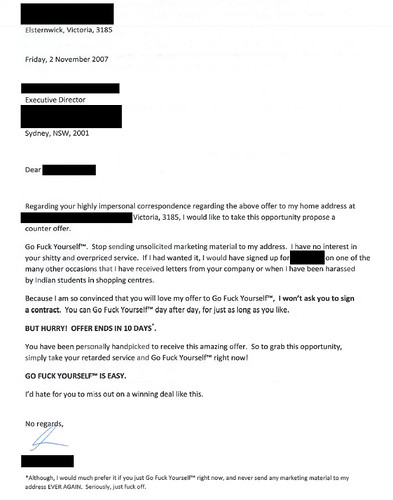
Here’s an angry customer’s letter complaining about being spammed in his home mailbox.
All brand managers take note are your customers thinking this but can’t be arsed to write a funny, snarky letter to your boss?
Click here to see bigger version. Thanks BannerBlog
Learning the Lingua Franca
February 5, 2008, 3:13 am
Filed under: Digital Strategy
Filed under: Digital Strategy

This morning I read the excellent post Measuring Audience 2.0. I was in the room at the time a lead media agency’s global digital thinker said: “I don’t know a lot about digital. But what I do know, is you can’t measure it”. At the time I Gavin had to hold me back, this being neither the time nor the place for shoutyness. And I rather liked my job at the time.
Now I think I have a better insight as to what that statement referred. Not that you can’t measure digital, just that marketers and media buyers can’t understand what those measurements mean. They speak a different language. When the Lingua Franca of effectiveness is TV, digital is speaking Esparanto. No one is a native speaker. It’s totally artificial. Yes, it’s academically constructed to be efficient. But no marketer uses it in day to day communication.
Here’s a cheat sheet to TV Audience Measurement terms and definitions.
While TV measurement provides “opportunities to see” to a demographic segment, and it’s effectiveness is measured out in the coffee spoons of program popularity and audience share, it does not take into account wastage.
1. Regular simultaneous media consumption for online, newspapers, magazines, radio, TV and direct mail is up from 1% to 35%, depending on the medium.
2. Channel surfing remains the number one regular activity engaged in during TV commercials with 41.2% doing so followed by:
* 33.5% talk with others in the room or by phone
* 30.2% mentally tune out
* 5.5% regularly fully attend to commercials
The amount of opportunities to see, or exposures builds into Effective Frequency. This is calculated to be the number of exposures (1+, 2+, 3+ etc) considered necessary for an advertising message to produce an effect (i.e. for the target market to take the desired action, or for the advertisement to elicit the desired response).
Frequency does not equal attention.
The deliverables of online effectiveness CAN speak that same language as marketers. Online CAN deliver on an Effective Frequency of 1. It’s as simple as that. And you you can prove it. And TV can’t. But it doesn’t mean we can’t be friends.
For me, the Trojan Horse for digital is cross-media planning. That’s taking just one of those exposures into the online environment. Only once you know who has actually responded to your message can you talk effectiveness. Then you can really start devising a customised plan to map audience engagement.
Ultimate Break
January 31, 2008, 11:30 pm
Filed under: Digital Strategy
Filed under: Digital Strategy
Delicious!
Kit Kat (Nestle’) France & JWT have come up with an exquisite 3D-effect digital marketing campaign that is tied in to their ‘Ultimate Break/Win a Trip in Space’ campaign.
Createlf has a mobile insight:
The campaign call-to-action is for consumers to access the promotional website or to SMS a code via their mobile handset. What is a little surprising for such a brilliant campaign is that no mobile application (be it a game or other gimmick) or mobile site was built to go with it. This shows that despite the inroads mobile advertising is making in general, big brands are still reticent to capitalise reaching out to consumers through this channel -in my opinion, a missed opportunity.
Oh, and just in case you were wondering, the ‘trip in space’ prize offered is genuine and is apparently worth a cool €147,000…not a bad return on a few crispy chocolate sticks…
you don’t find him, he finds you
January 30, 2008, 2:41 am
Filed under: Digital Strategy
Filed under: Digital Strategy
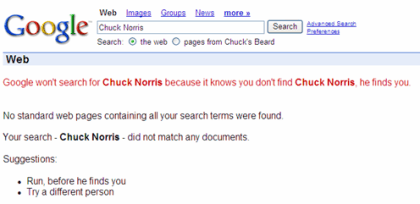
Go to Google
Type in “find Chuck Norris”
Press “I’m feeling lucky”
Very silly.
I loves it.
So whatta ya going to do?
January 21, 2008, 9:21 am
Filed under: Digital Strategy
Filed under: Digital Strategy

In Australia, we know. We know we’re going to run out of fresh US TV content as a result of the writer’s strike. We have between 3 and six month grace. And then all those expensive spots simply dry up. Disappear.
So what advice are you giving brands as a result? What alternatives are you giving client for when people really can’t find anything interesting/new to watch on the box? When the TV spend doesn’t have a stranglehold on the budget?
People, of course, still want to be entertained. And brands have an amazing opportunity to show they understand people. Brilliant. Opportunity.
My ‘why not?’ recommendations right now:
-
Create family moments for family meals: provide gift with purchase value adds such as DVD’s and board games. Let your packaging point to online to sign up for the latest content offer news.
-
Storytelling and narratives can be interactive and engaging- and non linear and prompt discussion. Check out the recent work for Lost http://www.flyoceanicair.com for the precursor and then go to http://www.find815.com. Think about where soap operas came from in the first place.
-
Use the time to listen. Use this time to learn. Who knows….perhaps once the audience turns away it might just not come back.
Taking Conversation to the Next Level
Not quite a year ago, Drew and Gavin asked a question — would you like to write a business book? And over 100 people responded from all over the world … contributing 400 words each to the book Age of Conversation.
This dream team have decided to go ahead and do it again in 2008. That’s right, they’re looking for contributors to another collaborative publishing project.
The rules and approach for all authors will be the same:
-
You will sign over all rights to your chapter
-
You understand that all proceeds of the book will be donated to Variety, the Children’s Charity
-
You will promote the book, throughout the process, on your blog if you have one
-
You’ll embrace the cooperative, collaborative spirit that defined Age of Conversation
-
You’ll honor deadlines so Drew does not have to be a nag
-
You’ll honor word counts so Gavin doesn’t have to be a nag
This year the topic of the book is being turned over over to us. The short-list:
- Marketing Manifesto
- Why Don’t People Get It?
- My Marketing Tragedy (and what I learned)
And now we want you to vote for the topic that interests you most. Please go HERE to cast your vote (you have until the end of January to vote).
Please note: you can vote regardless of whether you want to contribute or not.
And if you are keen to CONTRIBUTE, email Drew and let him know.
the present future of social networking
January 14, 2008, 9:17 am
Filed under: Digital Strategy
Filed under: Digital Strategy

I’ve recently come into a great new term: ‘the present future’. What I think it means is that our world is changing so rapidly that you really can only plan for the next 10 minutes. What you can conjure up is only informed by what you can see right now and that it’s very likely subject to change, possibly next week. But hey- it’s traditional at this time of year to look forward.
Social Networking was certainly the J curve to beat in Australia for digital uptake. I really don’t think that the behaviour going to change, though I believe that participants will have growing needs as the ecosystem expands. I’m feeling alliterative as I look into my crystal ball for 2008, so this is the future for it that I’m seeing right now:
-
Filtering
-
We’re all suffering from information overload, even in our personal digital spaces. Too many Facebook friends. Too many emails in too many accounts. Too much content from people that we never wanted to know quite that well preventing us from getting updates from the people that we started social networking to keep in contact with.
-
2008 will be the year the we set up filters so that not every one can see after-hours photos or information about career successes. We will choose who can see what aspects of our lives. We will value our own individual micro-networks over the exposure of a totally open platform.
-
-
Fetching and Feeding
- Remember when you couldn’t send an SMS between carriers- that you had to be on the same network? Seems mad now, eh?
-
Isn’t it amazing how quiet the whole Open Social thing has become? One of it’s greatest promises was for you to be able to be social networking platform agnostic…..unless you were on Facebook of course…
-
2008 will be the year when you’ll be able to fetch and feed any information about your mates from anywhere, and to any device.
-
Facilitation
-
No I really don’t want to be bitten, I don’t want to bid for you in an auction and I can’t be arsed finding out my “whatever” name.
-
2008 will find applications that provide a whole lot more utility than merely prompting interaction, particularly as brand find out that they can provide real value in facilitating great experiences for people who use social networking.
-
Facilitation could mean providing real world events and opportunities for people to meet like minds, or fetching me content that it is known that I like (provided by my filter), or group feeding me and my friends information on a subject that we want to grow our knowledge about….
-
However you look at it, for Social Networks it will be two thousand and great.
(I promise I won’t do that again!)
Blogger Social ’08 (register by 02.15.08 or miss out!)
What is it? Blogger social is like no other marketing event because it’s not about marketing and it’s not about blogging—it’s about the marketers behind the blogs.
Mark Goren put together this video compilation answering that very question.
Neither conference nor summit, it’s one weekend, held once a year, where the online marketing community descends upon a designated city for a weekend full of events designed to allow everyone to get to know one another better—and designed to give everyone free time to design their own meetups, too!
What blogging luminaries will be in New York for the Blogger Social? View the cool map that shows you that this truly is going to be a global affair. (Thanks Matt Dickman!)
You’ve got until February 15 to register. Do it here. Do it now. Can’t wait, guys…

Value and tulip bulbs
December 11, 2007, 6:17 am
Filed under: Digital Strategy
Filed under: Digital Strategy

In the book Extraordinary Popular Delusions and the Madness of Crowds, Charles Mackay wrote about tulip mania. The term originally came from the period in the history of the Netherlands during which demand for tulip bulbs reached such a peak that enormous prices were charged for a single bulb. It took place in the first part of the 17th century, especially in 1636–37.
In 1623, a single bulb of a famous tulip variety could cost as much as a thousand Dutch florins (the average yearly income at the time was 150 florins).
By 1635, a sale of 40 bulbs for 100,000 florins was recorded. By way of comparison, a ton of butter cost around 100 florins and “eight fat swine” 240 florins.
In February 1637 tulip traders could no longer get inflated prices for their bulbs, and they began to sell. The bubble burst.
I’m sure that you’ve seen or heard of (or even experienced) many economic manias like this- llamas, emu eggs and about a hundred thousand websites.
So much a part of educating clients is helping them navigate an essentially manic environment: ‘build me and internet’, ‘get me a Facebook’, Second Life the creation of Linden Labs…or Lewis PR?
We can get terribly focused on the bulb- on the device that will deliver the results that we are after. As strategic guardians of brands we need to remember the heart of what it is that we are trying to deliver- to plant a seed so that a flower will grow.
stories and experiences
December 10, 2007, 6:59 am
Filed under: Digital Strategy
Filed under: Digital Strategy

This is my current best explanation for what I do without using the words ‘advertising’ or ‘consumer’:
Identify stories and experiences that will help connect brands with the people that will increase the brand’s value.
I first used ‘create’ to describe the stories and experiences, but in our content creation environment it is much more accurate and flexible to describe how those stories and experiences can be identified without necessarily being proscriptive about who actually makes them. This also means that you’re not limited by what you can produce, and can actively seek what fits the brand messaging best.
I’m also enjoying exploring the increased territory of ‘the people that will increase the brand’s value’. So often there are messages that need to be created for internal and external stakeholders that might not necessarily be people who buy your product at a cash register.

