


Filed under: Great Stuff
I hope you’re sharing something lovely with people you care about today.
Filed under: Great Stuff
Tim Minchin’s stunning performance of his beat poem ‘Storm’ Eloquently and wittily honouring reason, science and life appreciation and debunking homeopathy, psychics, alternative medicine, religion etc.
Love Tim Minchin. Love.
Filed under: Great Stuff
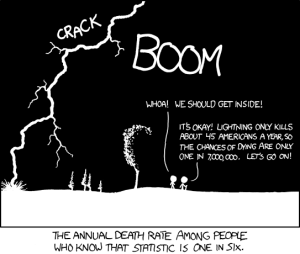
Sometimes questions are better than facts:
“The most important maxim for data analysis to heed, and one which many statisticians seem to have shunned, is this: Far better an approximate answer to the right question, which is often vague, than an exact answer to the wrong question, which can always be made precise”
Tukey
Filed under: Great Stuff
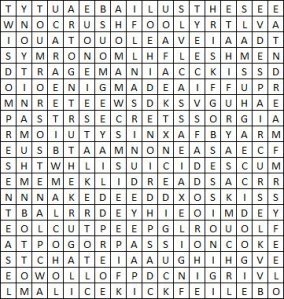
So apparently, our psychological state allows us to see only what we want/need/feel to see at a particular time.
I’ve checked this out...
On Friday I saw: naked, lust, crush,
Today I see : secrets, malice, rage, deed
What do you see?
Click the image to watch The Unseen Sea by Simon Christen– it’s intensely beautiful.

This collection of time lapses taken around the San Francisco Bay Area was roughly shot over the period of one year. It got me thinking about ebb and flow. About our own unseen seas. (thanks Stig)
I’m fascinated by people choosing to live their lives with passion, truth and rigour. Setting sail on uncharted waters but with an internal lodestone and a clear eye on the imagined destination. Charting by the stars. People who take the time to know themselves and have the courage to be themselves.
Mark shared a link to this wonderful story of the journey that TK recently went through to reduce the gap between his desired and current realities the process of making a principled and conscious life decision:

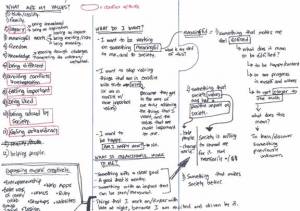
If you squint at the picture, you’ll see the rough process that he followed:
- Starting by answering “What are my values?”
- Based on my values, then “What do I want my life to be about?”
- Thinking hard about what the first two columns meant and elaborating on the things that had the likelihood of being buzz-wordy, undefined, or just plain untrue.
- You can’t see this part in the picture, but I then thought through where I am now in my life and reconciled the differences between what I want and where I am today.
- Finally, I formulated a plan that would allow me to make the changes I need to make to my life to get to what I want in and out of my life.

Happy sailing my friend.
Was reading William Gibson Talks Zero History, Paranoia and the Awesome Power of Twitter over at Wired and loved this…
Gibson: Well, I discovered Twitter while I was writing the novel, and I immediately saw its odd potential for being a tiny, private darknet that no one else can access. I’m always interested in the spooky repurposing of everyday things. After a few days on Twitter, what was most evident to me is that, if you set it up right, it’s probably the most powerful novelty aggregator that has ever existed. Magazines have always been novelty aggregators, and people who work for them find and assemble new and interesting stuff, and people like me buy them. Or used to buy them, when magazines were the most efficient way to find novel things.
But now with Twitter, after following people who have proven themselves to be extremely adroit and active novelty aggregators, I get more random novelty every day that I can actually use. A lot of it just slides by, but a lot of it is stuff that I used to have to go through considerable trouble to find. And a lot of it is so beyond the stuff I used to be able to find, which is good.
Jonah Lehrer reports why thinking too much causes us to focus on variables that don’t matter:
When it comes to judging jam [the focus of the studies], we are all natural experts. We can automatically pick out the products that provide us with the most pleasure.
When researchers added extra analysis to the study, asking participants to explain the why of their jam preference and justify their decisions, the “extra analysis seriously warped their jam judgment:”
“[T]hinking too much” about strawberry jam causes us to focus on all sorts of variables that don’t actually matter. Instead of just listening to our instinctive preferences, we start searching for reasons to prefer one jam over another.
And it’s not just jam:The new science of morality
[The researchers] have since demonstrated that the same effect can interfere with our choice of posters, jelly beans, cars, IKEA couches and apartments. We assume that more rational analysis leads to better choices but, in many instances, that assumption is exactly backwards.
The larger moral:
[O]ur metaphors for reasoning are all wrong. We like to believe that the gift of human reason lets us think like scientists, so that our conscious thoughts lead us closer to the truth. But here’s the paradox: all that reasoning and confabulation can often lead us astray, so that we end up knowing less about what jams/cars/jelly beans we actually prefer. So here’s my new metaphor for human reason: our rational faculty isn’t a scientist — it’s a talk radio host.
As Howard Moskowitz, expert researcher on Prego spaghetti sauce and other foodstuffs once declared, “The mind knows not what the tongue wants.”
I’m liking the space in between novelty aggregator and “extra analysis seriously warped their jam judgment”. We don’t know why we like what we do, or even what we’ll like but tasty new stuff is what we’re after….
Filed under: Great Stuff

Dan Cobley is a Marketing Director at Google, who found his first love in physics. He recently spoke at TED about how some of the key principles of physics also offer insights and lessons to the less scientific discipline of marketing:
- Newton’s Law states that force = mass x acceleration. In layman’s terms, a large item requires a larger force in order to change direction. Similarly, in the realm of brands, it’s generally safe to say that the larger a brand, the more difficult it is to reposition it. This is why a company like Arthur Andersen needed to spin off Accenture, or why L’Oreal might need both L’Oreal and Lancome, or why Coca-Cola may need Nestea and Gold Peak. A larger company may need smaller brands within its portfolio in order to allow them to act ’smaller’ – even if they’re owned by a corporate behemoth.
- Heisenberg’s uncertainty principle says that it’s impossible, by definition, to measure exactly the state (i.e., the position and the momentum) of a particle because the act of measuring it changes it. In the marketing realm, the same can be said of consumers – the act of observing them changes their behavior. Anyone that has been involved with marketing research – and the ubiquitous focus group – will recognize that there is oftentimes a wide gap between stated intent and actual behavior. For example, participants in an ethnography or focus group may overstate their healthy dining choices. Yet the continually high sales of fast-food restaurants proves this is not always the case.
- The scientific method states that you cannot prove a hypothesis through observation; you can only disprove it. You may be able to gather more data that will strengthen your hypothesis, but you cannot unequivocally prove it. However, it can only take one observation to disprove a theory. The parallel to marketing is that one incident – like an oil spill, a recall, or public relations snafu – can undermine your brand indefinitely, even after years or decades of investment in building and maintaining that brand image. The lesson? Avoid these ‘accidents’ and take actions that are true to the image you’ve fostered.
- The second law of thermodynamics states that entropy – a measure of disorder of a system – will always increase. The same is true of marketing. In the not-s0-distant past, one message controlled by one marketing manager could define a brand. Today, the increasingly fragmented media landscape – and particularly digital media – has facilitated a brand becoming dispersed, and sometimes even chaotic. Consumers can actually take a stake in your brand message, make it their own and change or build upon it (sometimes for better – others, for worse). This distribution of energy from a single source to many ultimately democratizes your brand, putting it closer to consumers. The lesson? Your brand cannot be controlled – it can be built, shared and supported – but it cannot be fully controlled if you want to involve consumers in the exchange, and become part of their culture.
Looking outside of one’s own discipline can provide fresh perspective to a challenge, or inspiration for a more creative approach and solution. The combination of physics and marketing certainly sounds more relevant than we’d initially think.
TED Blog: “What physics taught me about marketing: Dan Cobley on TED.com”
Filed under: Great Stuff
For Paul Rand’s posthumous induction into The One Club Hall of Fame, Imaginary Forces created this short film, combining original animation with a videotaped interview of Rand himself, that encapsulated his unique and timeless contribution to the design community.
(via swissmiss)
I also enjoy following Angry Paul Rand on twitter
That scary, panicked feeling when you start a project and just have a blank page? That’s graphic design Viagra
Spec work is like going to a strip club; you get all excited, but it almost never pays off in the end.
You are a designer. If a client just wants someone who can push a mouse around, they can get a fucking cat.
Filed under: Great Stuff
thanks Charles
Journalist and designer, David McCandless (who also blogs about infographics), and infamous graphic designer of our times, Neville Brody bash out a debate on over design vs information design.
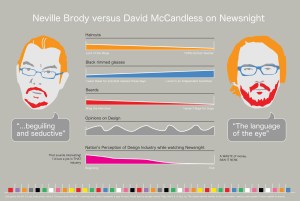
…well worth the time.
Filed under: Great Stuff
The Creative Beast has a downloadable PDF workbook. Get one, print it, and draw all over. Enjoy! http://betsystreeter.blogspot.com/p/us8.html
Filed under: Great Stuff
Whether it’s a baby’s heartbeat or subway traffic in Singapore, all complex activity results in data. How can you give humanity to data? By visualizing it through coders and designers — the pioneers of a new art form can do it.
Ogilvy’s Create or Else presents the code artists http://motiontheory.com
Some of the things I love, love, love about what I get to do for a day job are the opportunities to examine workplace cultures and develop ways to influence them to exhibit resilient positive outcomes.
It’s not a simple process, it’s not even complicated. It’s complex and sometimes chaotic. Mostly though where I start is Disorder.
I recently got asked by my friend Matt Granfield to comment on what he put forward as an hypocritical action from a holding company about the contradictory behavior and promises of two of their brands, and did I see anything wrong with that.
I thought it was an interesting notion that we might hold advertising to greater standards of morals and ethics than we hold ourselves. I thought that it might be valid to ask if that was right.
In I tweet therefore I am, Peggy Orenstein shares her experiences:
Each Twitter post seemed a tacit referendum on who I am, or at least who I believe myself to be. The grocery-store episode telegraphed that I was tuned in to the Seinfeldian absurdities of life; my concern about women’s victimization, however sincere, signaled that I also have a soul. Together they suggest someone who is at once cynical and compassionate, petty yet deep. Which, in the end, I’d say, is pretty accurate.
Anyways….Won’t steal his thunder (it will be published in Marketing Mag)- but ultimately my call is that brands reflect the culture of their target audiences. They don’t create culture.
Because they can’t. Changing culture is extremely difficult, time-consuming and you need to have a very strong vision and a mandate to do it.
It’s only because I’ve worked across a number of these projects that I’ve had access to a whole bunch of new tools and new thinking about how groups people behave and had the experience to understand how long it takes and how agile, responsive, brave and patient you need to be to shift the course of thousands of people.
One of the things I see as the person responsible for planning and creative strategy at an agency is that this role is becoming more and more responsible for the workplace culture.
How that outcome is described is usually around building a culture of inspiration, innovation and collaboration.
I’ve shared some of the experiences and experiments I’ve had in Do you do your best work at your desk
I can see a link between designing these experiences and how Dave describes organising a children’s party:
I’m chewing on this cynefin framework and how I can use it to frame briefs….more later. Geoff Brown has put together a fab post Great use of YouTube by Dave Snowden:
Why do we still see policies in workplaces like, “You Tube banned on Government Servers to stop staff wasting time!”, when staff could be learning stuff as rich as these videos from Dave Snowden? Dave is the Founder & Chief Scientific Officer at Cognitive Edge. His blog is very heavy, often amusing and well worth following.
Dave is working with an Australian video producer to help communicate his models and frameworks with the world. The videos bring a subtle and effective use of visuals and graphics to illuminate the key points that Dave is making. Dave’s confidence and sense of humor shines through as well.
I have embedded a series of videos from Dave (and others) to help you understand the world of complexity. Another place to visit is Dave’s series of posts on the Origins of Cynefin.
Filed under: Great Stuff

“Playing” by Frank Chimero (thanks Austin)
It reads:
I think a large part of the obligation of art is to
not express how things are, but instead express how
things feelThe beauty of play is that it is completely submersive
You can’t play and do something else at the same time
It monopolises your attention in a very good way
(and that sounds beautiful, as distracted and segmented
as I am)With play, you focus on nonsense to see the potential
of what is around you. And doesn’t being completely
Submersed in the infinite potential of every single
Little bit sound like a beautiful way to live.
Filed under: Great Stuff
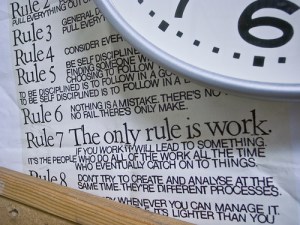
In the print lab at City College, litherland spied, half hidden under a clock, a copy of Corita Kent’s “Artful Rules for Work and Life,” developed for the Art Department of Immaculate Heart College, where she taught for over twenty years.
Her “rules” are worth quoting in full.
Rule 1 Find a place you trust and then try trusting it for a while.
Rule 2 General duties of a student: Pull everything out of your teacher. Pull everything out of your fellow students.
Rule 3 General duties of a teacher: Pull everything out of your students.
Rule 4 Consider everything an experiment.
Rule 5 Be self-disciplined. This means finding someone wise or smart and choosing to follow them. To be disciplined is to follow in a good way. To be self-disciplined is to follow in a better way.
Rule 6 Nothing is a mistake. There’s no win and no fail. There’s only make.
Rule 7 The only rule is work. If you work it will lead to something. It’s the people who do all of the work all the time who eventually catch on to things.
Rule 8 Don’t try to create and analyse at the same time. They’re different processes.
Rule 9 Be happy whenever you can manage it. Enjoy yourself. It’s lighter than you think.
Rule 10 “We’re breaking all of the rules. Even our own rules. And how do we do that? By leaving plenty of room for x quantities.” —John Cage.
Helpful Hints: Always be around. Come or go to everything. Always go to classes. Read anything you can get your hands on. Look at movies carefully. Often save everything — it might come in handy later.
Filed under: Great Stuff
The Third & The Seventh from Alex Roman on Vimeo. Fullscreen it, please. For HD version, go vimeo here
Sunday afternoon was close to perfection. A thunderstorm storm rolling in over the city on the back of a sunny morning. On the couch surrounded by newspapers and my note-book. Bach. And a beautiful documentary in the background Learning from the Light: The vision of I.M. Pei.
Dipping in and out of it I was inspired by the interplay of culture, nature and light in his discipline supported by the unpacking of the design principles involved in the construction of Fatehpur Sikri in India, the Alhambra palace and the Great Mosque of Cordoba, both in Spain. The notion that really stayed with me was the importance of understanding how light changes what might seem to be a flat structure, how shadows create geometry across the day and how infinitely changeable the perception of a building can be. How temporal it is to the people who use it. This understanding provides tension to the idea of the ‘timeless art of the architect’.
To stop me writing about light dancing around architecture Alex Roman’s video above better explores this idea. And is completely awesome. So beautiful. (thanks Ben)
Please watch it. And check out the galleries below.
“Nature cannot be made by a human being.” The definition of nature has been a truth since the ancient Greek philosophy… Satoshi Okada
“To create architecture is to put in order. Put what in order? Function and objects.” Le Corbusier
“In the old buildings, the columns were an expression of light. Light, no light, light, no light, light, you see… …the
same realization that you are realizing light.” Louis Isadore Kahn
“Less is more” Ludwig Mies van der Rohe
Mel Exon shared this fab presentation over at BBH LAbs
“… my presentation focused primarily on what brands and their agencies are learning about integration, interaction and new partnerships in the hypersocial environment we find ourselves in. I also attempted to explain why brands may be reticent about taking a step further into building deep, immersive, narrative worlds. Along the way, telling the story of a (failed) BBH Labs joint venture and what we took from it… and finally, ending with a proposal.
That proposal was simply this: that producers should look beyond viewing brands as “promoters” (cf the current raft of Toy Story 3 and The A-Team tie-ups) and consider them as partners instead. Develop stories together that add value to the overarching narrative (think Jeep for Lost Experience) AND stay open-minded to the idea of engaging audiences through collective creativity.

‘I have a set of silverware made by an eighteenth century silverworker called Hester Bateman, one of the very few women working in flatware at that time. When I eat with her spoons, I feel the work and the satisfaction that went into making them – the handle and bowl are in equal balance – and I feel a part of time as it really is – not chopped into little bits, but continuous. She made this beautiful thing, it’s still here, and I am here too, writing my books, eating my soup, two women making things across time. I feel connection, respect, delight. And it is just a spoon…’
Have been thinking about the experience of making things, the lovely thought above and the notion of working in bronze:
“it becomes permanent….you can take a thought that has occurred to the artist
and it’s still there a thousand years later
you just have to make sure that it’s a good thought”
I wonder how it might affect the things we make, or cause to have made, if we held the responsibility of causing delight for a thousand years front and centre?
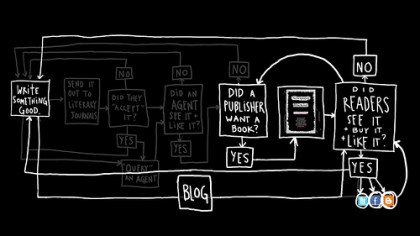
Austin Kleon’s TEDxPennQuarter talk is centered around a flowchart that compares his own publishing journey with what he was taught in college was the traditional route of becoming a published author. Looking at the chart, it strikes you that no matter what route you take, everything always comes back to the simplest beginning:
Write something good.
I’m the hugest fan…as he says: Keep making things.

