


Filed under: Experience
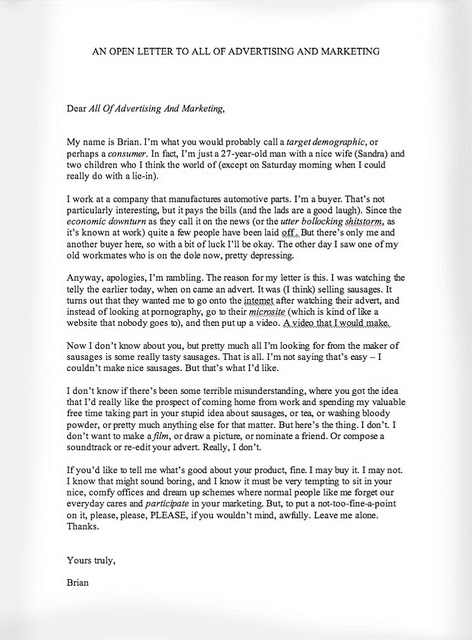
(via Kirsty)
Can’t say anything cleverer than this today….
Read it. Remember it.
Filed under: Great Stuff
Whether it’s a baby’s heartbeat or subway traffic in Singapore, all complex activity results in data. How can you give humanity to data? By visualizing it through coders and designers — the pioneers of a new art form can do it.
Ogilvy’s Create or Else presents the code artists http://motiontheory.com
Some of the things I love, love, love about what I get to do for a day job are the opportunities to examine workplace cultures and develop ways to influence them to exhibit resilient positive outcomes.
It’s not a simple process, it’s not even complicated. It’s complex and sometimes chaotic. Mostly though where I start is Disorder.
I recently got asked by my friend Matt Granfield to comment on what he put forward as an hypocritical action from a holding company about the contradictory behavior and promises of two of their brands, and did I see anything wrong with that.
I thought it was an interesting notion that we might hold advertising to greater standards of morals and ethics than we hold ourselves. I thought that it might be valid to ask if that was right.
In I tweet therefore I am, Peggy Orenstein shares her experiences:
Each Twitter post seemed a tacit referendum on who I am, or at least who I believe myself to be. The grocery-store episode telegraphed that I was tuned in to the Seinfeldian absurdities of life; my concern about women’s victimization, however sincere, signaled that I also have a soul. Together they suggest someone who is at once cynical and compassionate, petty yet deep. Which, in the end, I’d say, is pretty accurate.
Anyways….Won’t steal his thunder (it will be published in Marketing Mag)- but ultimately my call is that brands reflect the culture of their target audiences. They don’t create culture.
Because they can’t. Changing culture is extremely difficult, time-consuming and you need to have a very strong vision and a mandate to do it.
It’s only because I’ve worked across a number of these projects that I’ve had access to a whole bunch of new tools and new thinking about how groups people behave and had the experience to understand how long it takes and how agile, responsive, brave and patient you need to be to shift the course of thousands of people.
One of the things I see as the person responsible for planning and creative strategy at an agency is that this role is becoming more and more responsible for the workplace culture.
How that outcome is described is usually around building a culture of inspiration, innovation and collaboration.
I’ve shared some of the experiences and experiments I’ve had in Do you do your best work at your desk
I can see a link between designing these experiences and how Dave describes organising a children’s party:
I’m chewing on this cynefin framework and how I can use it to frame briefs….more later. Geoff Brown has put together a fab post Great use of YouTube by Dave Snowden:
Why do we still see policies in workplaces like, “You Tube banned on Government Servers to stop staff wasting time!”, when staff could be learning stuff as rich as these videos from Dave Snowden? Dave is the Founder & Chief Scientific Officer at Cognitive Edge. His blog is very heavy, often amusing and well worth following.
Dave is working with an Australian video producer to help communicate his models and frameworks with the world. The videos bring a subtle and effective use of visuals and graphics to illuminate the key points that Dave is making. Dave’s confidence and sense of humor shines through as well.
I have embedded a series of videos from Dave (and others) to help you understand the world of complexity. Another place to visit is Dave’s series of posts on the Origins of Cynefin.
Filed under: Great Stuff

“Playing” by Frank Chimero (thanks Austin)
It reads:
I think a large part of the obligation of art is to
not express how things are, but instead express how
things feelThe beauty of play is that it is completely submersive
You can’t play and do something else at the same time
It monopolises your attention in a very good way
(and that sounds beautiful, as distracted and segmented
as I am)With play, you focus on nonsense to see the potential
of what is around you. And doesn’t being completely
Submersed in the infinite potential of every single
Little bit sound like a beautiful way to live.
Filed under: Great Stuff
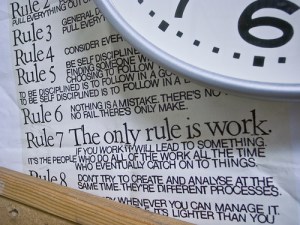
In the print lab at City College, litherland spied, half hidden under a clock, a copy of Corita Kent’s “Artful Rules for Work and Life,” developed for the Art Department of Immaculate Heart College, where she taught for over twenty years.
Her “rules” are worth quoting in full.
Rule 1 Find a place you trust and then try trusting it for a while.
Rule 2 General duties of a student: Pull everything out of your teacher. Pull everything out of your fellow students.
Rule 3 General duties of a teacher: Pull everything out of your students.
Rule 4 Consider everything an experiment.
Rule 5 Be self-disciplined. This means finding someone wise or smart and choosing to follow them. To be disciplined is to follow in a good way. To be self-disciplined is to follow in a better way.
Rule 6 Nothing is a mistake. There’s no win and no fail. There’s only make.
Rule 7 The only rule is work. If you work it will lead to something. It’s the people who do all of the work all the time who eventually catch on to things.
Rule 8 Don’t try to create and analyse at the same time. They’re different processes.
Rule 9 Be happy whenever you can manage it. Enjoy yourself. It’s lighter than you think.
Rule 10 “We’re breaking all of the rules. Even our own rules. And how do we do that? By leaving plenty of room for x quantities.” —John Cage.
Helpful Hints: Always be around. Come or go to everything. Always go to classes. Read anything you can get your hands on. Look at movies carefully. Often save everything — it might come in handy later.
Filed under: Experience
A number of people have asked to see my one page brief.
Here it is:

To me the planner’s role in giving a creative brief to a team is to tell team a the story- set up the protagonist/ the consumer, outline their obstacle and the part you have for them- the hero.
Give your story a beginning a middle and end. Allow the team to collaborate with you as you tell the story.
Show the landscape that the story takes place in (and how your choice of landscape drives the narrative).
It might look like this at the end:
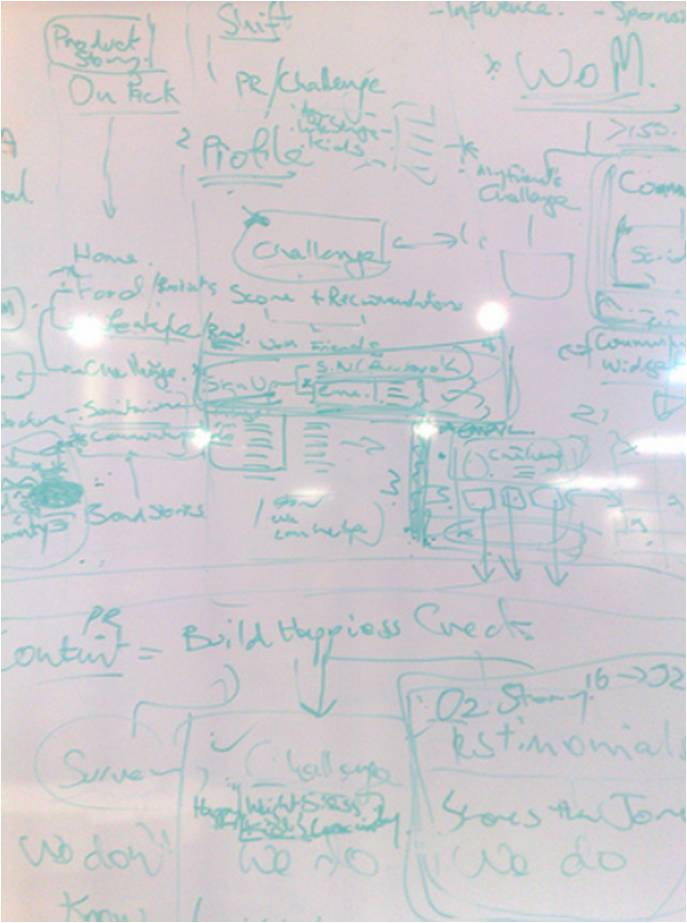
But it won’t look like this:
Filed under: Great Stuff
The Third & The Seventh from Alex Roman on Vimeo. Fullscreen it, please. For HD version, go vimeo here
Sunday afternoon was close to perfection. A thunderstorm storm rolling in over the city on the back of a sunny morning. On the couch surrounded by newspapers and my note-book. Bach. And a beautiful documentary in the background Learning from the Light: The vision of I.M. Pei.
Dipping in and out of it I was inspired by the interplay of culture, nature and light in his discipline supported by the unpacking of the design principles involved in the construction of Fatehpur Sikri in India, the Alhambra palace and the Great Mosque of Cordoba, both in Spain. The notion that really stayed with me was the importance of understanding how light changes what might seem to be a flat structure, how shadows create geometry across the day and how infinitely changeable the perception of a building can be. How temporal it is to the people who use it. This understanding provides tension to the idea of the ‘timeless art of the architect’.
To stop me writing about light dancing around architecture Alex Roman’s video above better explores this idea. And is completely awesome. So beautiful. (thanks Ben)
Please watch it. And check out the galleries below.
“Nature cannot be made by a human being.” The definition of nature has been a truth since the ancient Greek philosophy… Satoshi Okada
“To create architecture is to put in order. Put what in order? Function and objects.” Le Corbusier
“In the old buildings, the columns were an expression of light. Light, no light, light, no light, light, you see… …the
same realization that you are realizing light.” Louis Isadore Kahn
“Less is more” Ludwig Mies van der Rohe
Filed under: Experience
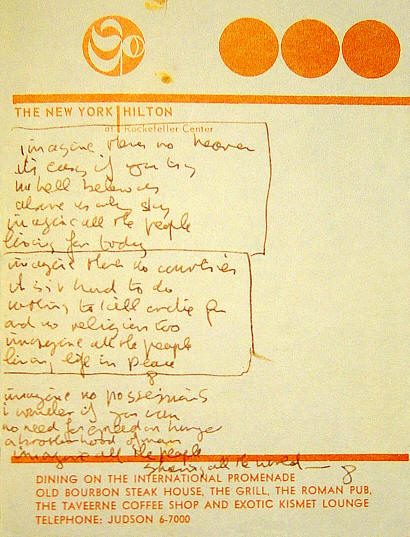
I’m thinking a thousand years again- work that might still resonate after that time, what do you need to do to make it, how is it different from the ephemeral stuff that we churn out every day…
The above image is John Lennon’s original handwritten lyrics to the 1971 song ‘Imagine’, written on a piece of The New York Hilton Hotel’s stationery paper. You can see that it’s just dashed out- and yet I can’t help think it might last forever.
I’m ruminating on this article and this notion:
What is art for? (from The Marine Corps’s Combat Art Program – NYTimes.com)
It’s the pact we make with the warrior: You will live forever and we will remember you…and to me the best way to do that is through art. We can’t give him his life, but we can give him that immortality.
I like the idea of your output being a pact that you make with your subject- that there’s a sence of gravity there. I’m intrigued by the notion of exchange (immortality for heroic sacrifice, like an ancient greek notion of Elysium) and the fact that the expression of the subject through art elevates/immortalises it.
And then when I take this comment into context:
“The thing I hate most about advertising is that it attracts all the young, bright, creative people, leaving us with only the slow and self-obsessed to become our artists. Modern art is a disaster area. Never in human history has so much been used by so many to say so little.”- Banksy
…..I wonder…I wonder if there is a piece of advertising that will last a thousand years.
Filed under: Digital Strategy
Love the Soap guys:
After the success of the 6 Principles of Digital Creative and our 2010 Predictions for Digital we now bring you 10 Facebook Myths Busted.
Paul? Julian? Heather? Jye? anything to add?
Mel Exon shared this fab presentation over at BBH LAbs
“… my presentation focused primarily on what brands and their agencies are learning about integration, interaction and new partnerships in the hypersocial environment we find ourselves in. I also attempted to explain why brands may be reticent about taking a step further into building deep, immersive, narrative worlds. Along the way, telling the story of a (failed) BBH Labs joint venture and what we took from it… and finally, ending with a proposal.
That proposal was simply this: that producers should look beyond viewing brands as “promoters” (cf the current raft of Toy Story 3 and The A-Team tie-ups) and consider them as partners instead. Develop stories together that add value to the overarching narrative (think Jeep for Lost Experience) AND stay open-minded to the idea of engaging audiences through collective creativity.

‘I have a set of silverware made by an eighteenth century silverworker called Hester Bateman, one of the very few women working in flatware at that time. When I eat with her spoons, I feel the work and the satisfaction that went into making them – the handle and bowl are in equal balance – and I feel a part of time as it really is – not chopped into little bits, but continuous. She made this beautiful thing, it’s still here, and I am here too, writing my books, eating my soup, two women making things across time. I feel connection, respect, delight. And it is just a spoon…’
Have been thinking about the experience of making things, the lovely thought above and the notion of working in bronze:
“it becomes permanent….you can take a thought that has occurred to the artist
and it’s still there a thousand years later
you just have to make sure that it’s a good thought”
I wonder how it might affect the things we make, or cause to have made, if we held the responsibility of causing delight for a thousand years front and centre?
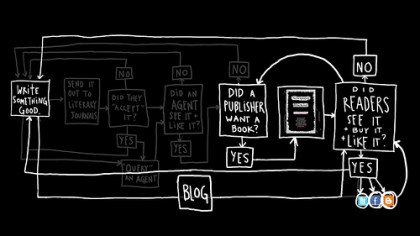
Austin Kleon’s TEDxPennQuarter talk is centered around a flowchart that compares his own publishing journey with what he was taught in college was the traditional route of becoming a published author. Looking at the chart, it strikes you that no matter what route you take, everything always comes back to the simplest beginning:
Write something good.
I’m the hugest fan…as he says: Keep making things.
Filed under: Experience
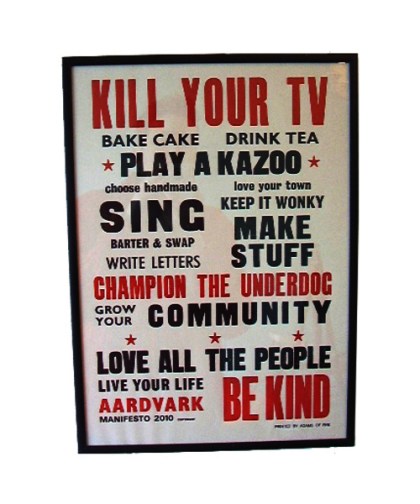
The satisfaction we get from buying vacations, bikes for exercise and other experiences starts high and keeps growing. The initial high we feel from acquiring a flashy car or megascreen TV, on the other hand, trails off rather quickly, reports a new Cornell study, “that shows experiences are better than possessions.”
I’m not really on board with having these two on opposite ends of a scale cause I think that I see people champion the handmade- a manifestation that comes as the result of experience.
Loving this piece by Mark Pollard on Why strategists should make stuff. The experience of making something, of creating something that didn’t exist except in your imagination is good for you and makes you a better person in all kinds of ways.
I’m in San Miguel de Allende in Mexico right now, so creating art is a big part of my day. I’m hanging out with my Dad (see him talking about his work here) and a whole bunch of artist types who have spent their life making stuff, and more than stuff, fine art: sculpture.
It brings to mind a bunch of fairly shouty conversations I’ve had with mates over recent creative award wins.*
The conversation started to turn a little with:
When will the industry realise we’re in the [at best] commercial art industry, not just art?!
I’m a big fan of creative, don’t get me wrong. But no-one gets to say ‘just art’ on my watch, or separate out the commercial drive of artists either.
Let’s get this straight: artists eat. Artists make money at what they do, because they make things that people want. I know the stories of Van Gogh and him not selling a painting and all, but widely known artists have patrons, take commissions, sell stuff and make a their living out of their work- or they’re just dabbling. Part of the process is learning how to ‘speak’ to people- how to create desire for the work, for the story.
Art is a commercial industry.
If the output of advertising delivers neither results nor inspiration- it’s not art. It’s wank.
* (and to be fair, the company I work for Jack Morton Worldwide won a Silver Lion in the Film Craft category at Cannes Lions. Very Proud. Click here to watch. Love this Fooseball one too ).
Filed under: Zeitgeist
Inspired by David’s Every now and Then post:
Every now and then I plug my blog into Wordle and see what it spits out. As a summation of what I’m thinking about at the time, it often reveals things to me long before I would have stumbled across the themes myself.
I’m pretty happy that ‘people’ is my overarching theme here. As David noticed you do learn a bunch from this exercise. I do like the patterns:
- in 2006 ‘people’, ‘life’ and ‘others’ were the main themes.
- By 2007 I kind of got distracted with tactics, ‘online’ and ‘digital’ being the top two.
- In 2008 ‘community’ and ‘life’ were slugging it out to ge my attention
- 2009 stories came to the fore (luckily I was looking for ‘great’ ones)
- and now it’s ‘people’ , ‘time’, ‘creative’, ‘strategy’ and ‘experience’
Love the Wordle. What not create your own? I’d love to see it.
The completely adorable Jasmin Cheng brings us this investigation on the effectiveness of the Creative Brief as a tool to generate brilliant advertising solutions.
She’s interviewed a whole bunch of really smart people and brought her conclusions to life with some of the most charming drawings I’ve seen in a while. One to watch….
Love the thinking here:
- Thinking about it, the one thing I feel like we’re tasked with daily is to ‘change behaviour’. To get people to ‘do something that they’re currently not doing’.
- Organisations spend a lot of energy trying to get people to spend their energy differently.
- Let’s look at consumer energy first
- Is it worth it? Is what they’re getting out of it worth the effort needed to participate?
- That’s what it all comes down to… Reward vs effort what are we giving what do they have them? To do to get it?
- Every day, billions of people do things whether you ask them to or not
- How do you take advantage of the waves of human energy already out there
- Eco-systems re-channeling existing energy
- “When millions of people are tapping away at computers every day: filling in forms, clicking links, forwarding emails, there is energy and effort that can easily be re-used if we’re smart about it.”
- Why fight against the current?
- You shouldn’t have to… Persuade people to do things they don’t want to do waste energy when you can borrow it invest in something temporary, when you can build things that run themselves
- Disrupt. Persuade. Help
- It’s getting easier… To help people do the things they already love to help people see the relevance and value of new ideas to match products and experiences to the people that want them
I’m thinking about agency agility and crack content creation teams that have a newsroom editorial structure and publishing discipline.
This work by Chet– it’s a couple of years old, but its’ still pretty clever clogs.
I can’t help but think that all those notions of finding the story, getting the angle, getting it out the door in a day in a way that’s going to build an audience and get people watching as it all unfolds is an intriguing model to bring to our agency skill set.
When you combine the ultra topical with easily findable you might be onto a good thing.
I’m liking the question ‘what’s newsworthy?‘ as a thought starter. It’s more than ‘what will generate Word of Mouth?’ ’cause it takes me to places where I think about: what can we report on? what will get us coverage? what’s the photo op? what wires will pick it up?
More later..
Jack Thompson- could your delivery or timing be any better?
the future I might aspire to- the past I remember with pleasure
life’s crowning glory is the here and now
I saw this powerful video at the FastBreak:are you alone ? session – it’s part of the Stories are Everything Project, which includes a mobile space to view and record real stories.
Developed by Sophie Weldon, the founder of Youth for UNHCR and one of two Special Youth Representatives for Australia. She’s also a resident at the Vibewire Enterprise Hub.
This e-mail is making the rounds. I’d reblog it from someone, but that would seem pointless. What I really like are the bits about the Flaming Lips and “saying yes”:
The thing is, I really like saying yes. I like new things, projects, plans, getting people together and doing something, trying something, even when it’s corny or stupid. I am not good at saying no. And I do not get along with people who say no. When you die, and it really could be this afternoon, under the same bus wheels I’ll stick my head if need be, you will not be happy about having said no. You will be kicking your ass about all the no’s you’ve said. No to that opportunity, or no to that trip to Nova Scotia or no to that night out, or no to that project or no to that person who wants to be naked with you but you worry about what your friends will say.
No is for wimps. No is for pussies. No is to live small and embittered, cherishing the opportunities you missed because they might have sent the wrong message.
…
What matters is that you do good work. What matters is that you produce things that are true and will stand. What matters is that the Flaming Lips’s new album is ravishing and I’ve listened to it a thousand times already, sometimes for days on end, and it enriches me and makes me want to save people. What matters is that it will stand forever, long after any narrow-hearted curmudgeons have forgotten their appearance on goddamn 90210. What matters is not the perception, nor the fashion, not who’s up and who’s down, but what someone has done and if they meant it. What matters is that you want to see and make and do, on as grand a scale as you want, regardless of what the tiny voices of tiny people say.
Do not be critics, you people, I beg you. I was a critic and I wish I could take it all back because it came from a smelly and ignorant place in me, and spoke with a voice that was all rage and envy. Do not dismiss a book until you have written one, and do not dismiss a movie until you have made one, and do not dismiss a person until you have met them. It is a fuckload of work to be open-minded and generous and understanding and forgiving and accepting, but Christ, that is what matters. What matters is saying yes.

